The Glenbuchat Image Library
No: 2598 Contributor: No Contributor Year: 2024
47 1825 Gaelic Dictionary


1825 Gaelic Dictionary
The Forbes Family of Newe were very keen on promoting the development of Scottish customs and culture following the proscription of Scottishness after Culloden.
Click to see the album of Treasures of Castle Newe
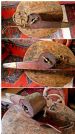
The above are pages from the first comprehensive Gaelic dictionary by Robert Armstrong published in 1825
In the pictures above you will see
The Spine of the book
The Page saying that it is owned by at that time Capt. Charles Forbes who was stationed with the 17th Lancers. He later inherited the baronetcy and became the 3rd Baronet
The Title page with Sir Charles Forbes name added probably when he became the baronet.
Introductory page in Gaelic.
Following two pages of the dictionary English to Gaelic and Gelic to Emglish
From Wikipaedia.
The first dictionary in the modern sense was published in 1780 by the Rev. William Shaw, the Galic and English Dictionary, which contained a large percentage of Irish terms.This was quickly followed by Robert MacFarlane's small-scale dictionary, Nuadh Fhoclair Gaidhlig agus Beurla ("New Gaelic and English dictionary") in 1795. Exactly 10 years later Peter MacFarlane, a translator of religious publications published the first bidirectional dictionary in 1815, the New English and Gaelic Vocabulary - Focalair Gaelig agus Beurla.
Although the Highland Society of Scotland had set up a committee in 1806 to produce a full-scale dictionary, but was beaten by Robert Armstrong who published his Gaelic Dictionary in 1825, followed three years later by the Highland Society's dictionary in 1828 entitled Dictionarium Scoto-Celticum - A Dictionary of the Gaelic Language
Robert Archibald Armstrong, LL.D. (bapt. 16 February 1788– 25 May 1867), was a Gaelic lexicographer. He was the eldest son of Robert Armstrong, of Kenmore, Perthshire, by his wife, Mary McKercher. He was born at Kenmore in 1788, and educated partly by his father, and afterwards at Edinburgh and at St. Andrews University, here he graduated. Coming to London from St. Andrews with high commendations for his Greek and Latin acquirements, he engaged in tuition, and kept several high-class schools in succession in different parts of the metropolis. He devoted his leisure to the cultivation of literature and science
But his great work was A Gaelic Dictionary, in two parts — I. Gaelic and English, II. English and Gaelic — in which the words, in their different acceptations, are illustrated by quotations from the best Gaelic writers, London, 1825. This was the first Gaelic dictionary published, as there previously existed only vocabularies of the language like those of William Shaw (An Analysis of the Galic Language 1778 and Galick and English Dictionary 1780) and others. This work, running to nearly 1100 pages, was the first Gaelic dictionary to attempt to provide etymological information. It also improved on previous works by incorporating a grammar of Gaelic and by indicating the word-class of entries
Picture added on 02 October 2024 at 22:15
This picture is in the following groups
castle
castle
Thank you for sharing these photographs of an early Gaelic dictionary which I had never seen before. It's of great interest to me.
Added by Graham Cooper on 29 October 2024
castle