The Glenbuchat Image Library
No: 2585 Contributor: No Contributor Year: 1767
39 Newe 1767 Blunderbuss


Newe 1767 Blunderbuss
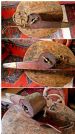
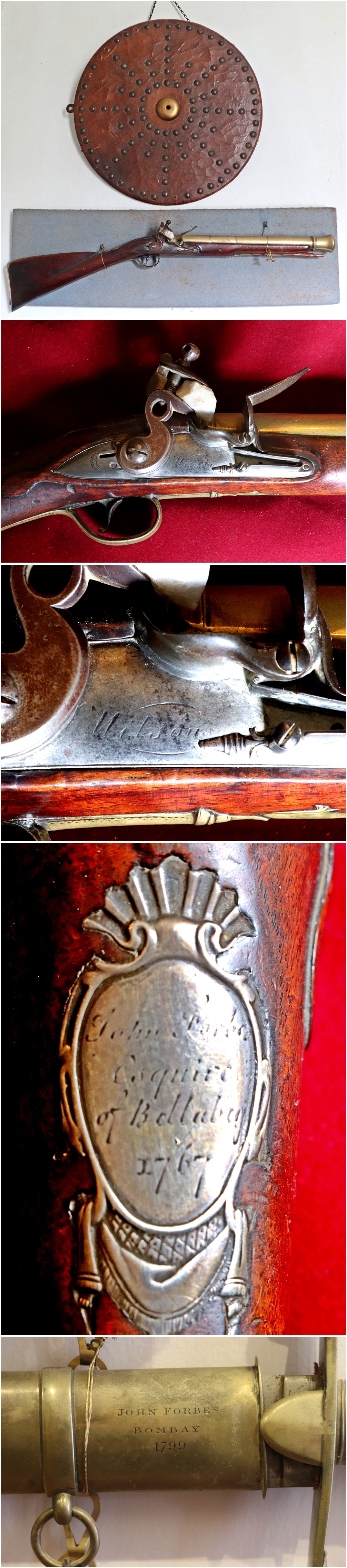
The pictures above show:
1 Displayed on the wall a leather shield with below it a flintlock blunderbuss
2 A close up of the Flint Lock mechanism with some flint in place
3 Close up of the makers name ‘Wilson’
4 Inscription on the gun ‘John Forbes Esquire of Bellabeg 1767’
5 Inscription of a sword belonging to John Forbes Bombay 1799
If a larger view required click on the ‘view large version’ link at the bottom of the page.
Click to see the album of Treasures of Castle Newe
John Forbes was the name of Bombay Jock and also of his father the Laird of Bellabeg
The blunderbuss could have belonged to either father or son. Two factors indicate that it probably belonged to John Forbes the son (Bombay Jock)
Firstly, as noted below, the title esquire had many applications but there is some suggestion that it was given to the sons of noblemen or gentry. Secondly the date. In 1767 Bombay Jock, who had already made a number of journeys to India, finally decided to set up business there. He may have acquired the gun to protect himself while in India. Finally, Wilson, the gunmaker was a supplier of armaments to the East India Company with whom John Forbes had been a purser.
In 1767 after three years as a purser on East India Ships, Forbes was authorized by the Court of East India Company to act as a “Free Mariner” and later was a part of the select category of “Free Merchants” in India. He created Forbes & Company, Ltd., in 1767 to conduct the business of trading Indian cotton
Wilson Blunderbuss
18th Century Brass Barrelled Blunderbuss
Wilson
Richard born 1703. Apprenticed to uncle, Thomas Green, 1718; free of Gunmakers Co., 1725. Proof piece and mark, 1730. Elected Assistant, 1734; Master, 1741. Gunmaker, at the Fowler, Minories, took over business of Agnes Green, 1730. Contractor to Ordnance, from 1746; East India Co., 1733-6; Hudson’s Bay Co., 1730-56; Royal African Co., 1739. With son, William, became Richard & William Wilson & Co., 1757-9; Richard Wilson & Co., 1759-66. Died 1766.
William Son of Richard born 1732. Apprenticed to father, 1747; free of Gunmakers Co., 1754. Proof pieces, 1756. Elected Assistant, 1756; Master, 1760, 1769, 1772, 1774. Took Livery, 1778. Became partner with father, 1756. After father’s death in 1766, used same mark, traded as William Wilson & Co., 154 Minories, 1767-93; then as William Wilson & Son, 1794 until his death in 1808. Contractor to Ordnance, East India Co., Hudson Bay Co. and America. Succeeded by William.
From Garth Vincent Antique Arms and Armour
Blunderbuss
From Wikipedia, the free encyclopaedia
The blunderbuss is a 17th- to mid-19th-century firearm with a short, large calibre barrel which is commonly flared at the muzzle, to help aid in the loading of shot and other projectiles of relevant quantity or calibre. The blunderbuss is commonly considered to be an early predecessor of the modern shotgun, with similar military usage. It was effective only at short range, lacking accuracy at long distances. A blunderbuss in handgun form was called a dragon, and it is from this that the term dragoon evolved.
The muzzle (and often the bore) was flared with the intent not only to increase the spread of the shot, but also to funnel powder and shot into the weapon, making it easier to reload on horseback or on a moving carriage.
Etymology
An English flintlock blunderbuss
The term "blunderbuss" is of Dutch origin, from the Dutch word donderbus, which is a combination of donder, meaning "thunder", and bus, meaning "container, tin" (Middle Dutch: busse, box, jar, from Latin buxus, box tree)
The transition from donder to blunder is thought by some to be deliberate; the term blunder was originally used in a transitive sense, synonymous with to confuse, and this is thought to describe the stunningly loud report of the large-bore, short-barreled blunderbuss. The term dragon is taken from the fact that early versions were decorated with a carving in the form of a mythic dragon's head around the muzzle; the muzzle blast would then give the impression of a fire-breathing dragon.
Use of the title Esquire.
In 1848, Burke published an article in The Patrician, that addresses the question “who is a gentleman, and who an esquire?”.
“The sons of all the peers and lords of parliament in the lives of – their fathers; the younger sons of peers after the death of their fathers; the eldest sons of the younger sons of peers, and their eldest sons in perpetual succession.
The eldest (and we think, if any, all the) sons of baronets, and the eldest sons of knights.”
 View Large Version
Picture added on 24 April 2024 at 22:43
This picture is in the following groups
castle
castle
castle