The Glenbuchat Image Library
No: 2591 Contributor: No Contributor Year: 2024
45 Indian Sewing Box with Initials CCB


Indian Sewing Box with Initials CCB
The initials refer to Caroline Coombes Battye
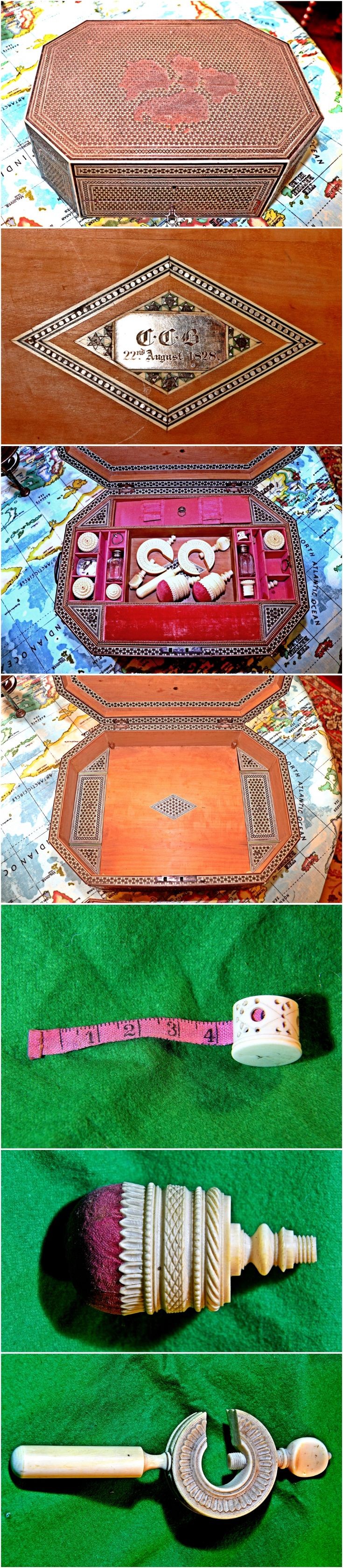
The Photos above show
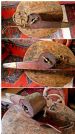
1 A box decorated with Sadeli mosaics (see below)
2 Inscription in the box lid. CCB 22nd August 1828
3 Upper layer inside the box with Sewing accessories
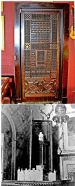
4 Lower part of the box with mosaic patterned hatches.
5 – 7 Sewing accessories.
Click to see more of Caroline Battye’s family history.
If a larger view required click on the ‘view large version’ link at the bottom of the page.
Click to see the album of Treasures of Castle Newe
Caroline Coombes Battye was born on 25 Mar 1809 at Kensington, Royal Borough of Kensington and Chelsea, she died on 6 Sep 1877 at Broomwood, Clapham Common, Surrey, England
Caroline Battye married Sir Charles Forbes the 3rd Baronet of Newe on 21st August 1830. She was born on 25th March 1809 and was therefore aged 19 when she received the sewing box in 1828. She married two years later.
She and her father had not been in India but her brothers had served in the Indian army and Sir Charles’ father had lived in India. The box therefore might have been an engagement present given by the Battye family to her or also it might have been presented by the Forbes family.
The box is an Indian Sewing box with a selection of sewing accessories in it.
Details from
www.carters.com.au/index.cfm/index/4338-anglo-indian-vizagapatam-and-sadeli-boxes-sewing-and-other-boxes
19th century Anglo-Indian Vizagapatam and Sadeli sewing and other boxes
These terms were used to describe furniture and objects made in India from the 18th century onwards by Indian cabinetmakers using local timbers and accessories, for the colonial British market and wealthy locals, that was a fusion of the styles and techniques of the two cultures. Teak, camphor wood, padouk, coromandel and ebony were common timbers, and the furniture was sometimes inlaid with ivory or bone, and usually extensively carved with Indian themes including elephants and intricate foliate designs. Similar furniture was made in other colonies such as Ceylon (Sri Lanka) and Kashmir.
Vizagapatam, now known as Visakhapatnam is an industrial city that stretches 3 km along the coast between Calcutta and Madras. In British colonial times the city was called Waltair, and part of the city is still known by its colonial British name.
In the mid-18th and 19th century the town became one of the centres in India for the manufacture of small wooden items, especially boxes, and furniture made of local hardwoods such as sandalwood, which has a strong fragrance and elaborately inlaid with ivory and other exotic materials including horn, ivory, porcupine quills and silver.
Another form of decoration used, was with Sadeli mosaics, an ancient craft that is said to have been introduced from Shiraz in Persia (now Iran) to India.
Ivory, silver, pewter, wood and horn were cut into faceted rods which were bound together to form geometric patterns. When the glue was set, the rods were sliced in transverse sections. This gave the maker a number of angled circular pieces in the original pattern. Several variations of patterns could be achieved by combining the materials in different ways. The ivory was sometimes dyed green to give an extra colour.
The technique, required a high degree of skill and patience, and as well, wasted a large amount of the precious materials.
Initially these items were mainly purchased by the Indian ruling classes and officials of the British East India Company, but when India came under British rule in the Victorian era, a wider market opened up.
The boxes were brought back or sent back to England usually by the people who had commissioned them. From the beginning of the nineteenth century, they were imported more commercially, although not in any significant numbers until the middle decades.
Export was facilitated by the location of Vizagapatam: it was an important trading port for South East Asia, and a stopping point for vessels en-route from Europe to Canton.
 View Large Version
Picture added on 02 May 2024 at 21:39
This picture is in the following groups
castle
castle
castle