The Glenbuchat Image Library
No: 2512 Contributor: Ken Cruickshank Year: 2023
143 Educational Reports for Glenbuchat


Click for History of education in Glenbuchat
Reports of Education in Glenbuchat
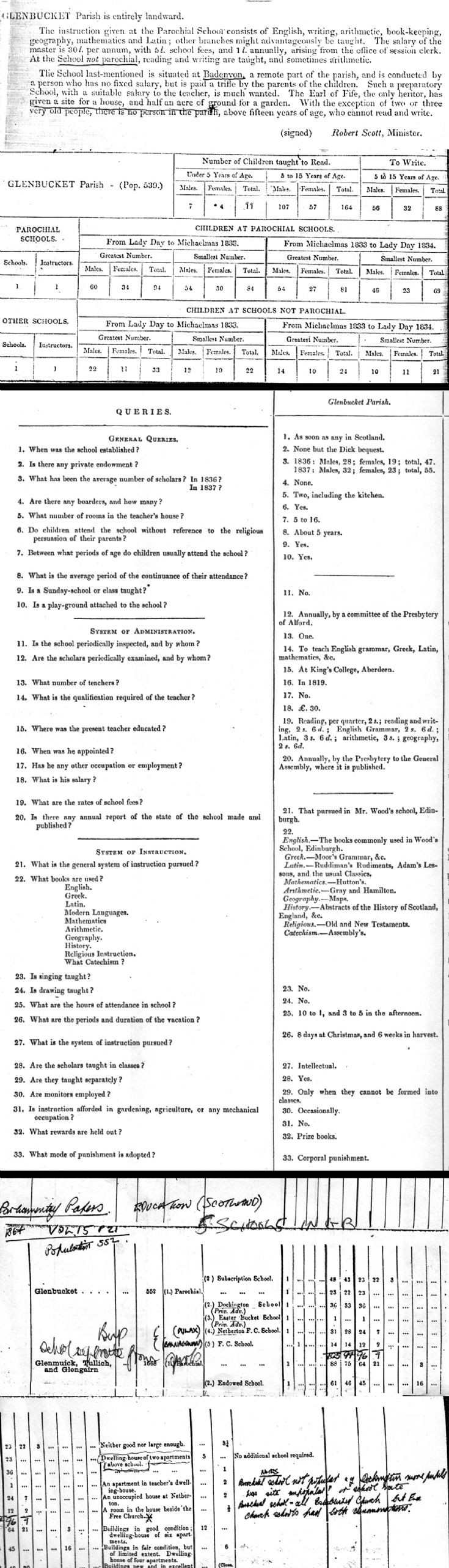
This page highlights copies of data from three reports which gives greater detail on the provision of education in Glenbuchat..
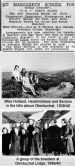
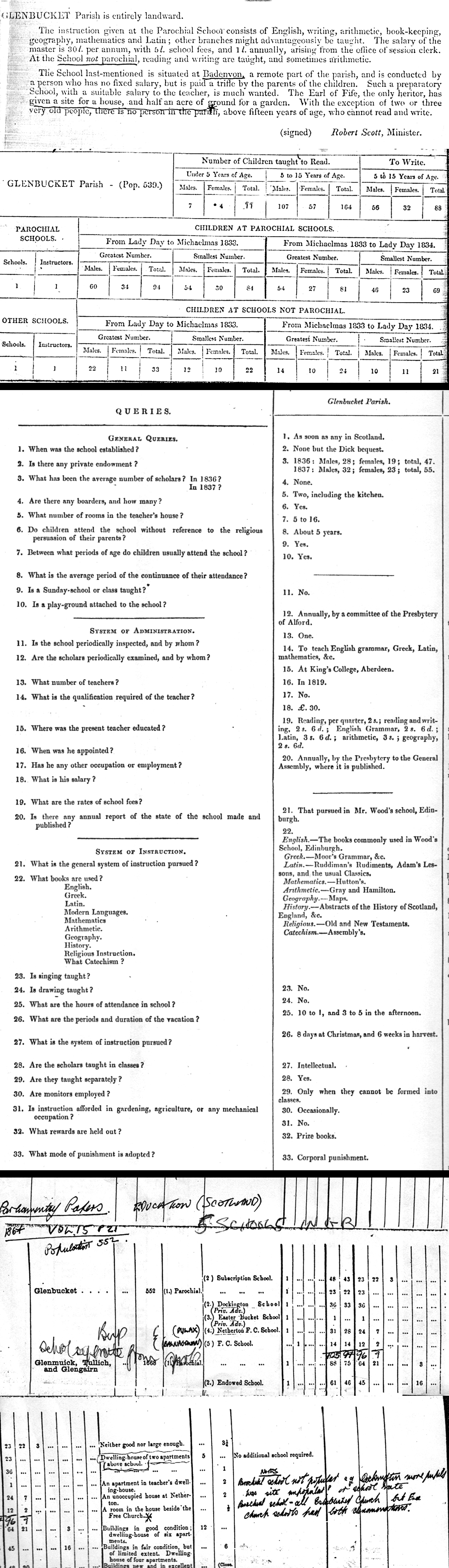
The Photo above shows:
1. A report of 1834 by the minister of Glenbuchat with figures to indicate the number of children at school.
2. A questionnaire and answers from a Parliamentary report published in 1841.
3. A report in 1867 which detailed figures of the education provision in the Glen.
Comment
Records of Education in Glenbuchat go back a long time:
In 1687 there is a record in the Exercise of the Presbytery of Alford that state of Glenbucket:
"That there is a school and some tolerable maintenance for a Schoolmaster."
Until the Education Act of 1872 schools in Glenbuchat had been the responsibility of the two church of Scotland factions, the Established Church and the Free Church. The Established Church had a school at the top of the Belnacraig hill and the Free Church had schools at Bowiebank Belnacraig for Girls and at Dulax. for Boys. Later a school was built at the Balloch at the top of the Glen to serve children at the top of Glenbuchat and Glen Nochty.
In 1868 the new Glenbuchat Parish School built (previously the pupils had been taught in the Schoolhouse).
1. 1834 Report
This report is prepared by the Rev Robert Scott the minister of Glenbucket. It was probably prepared for the 1834 Statistical account but has different wording.
Click for the 1834 Statistical Account
From the figures in the table the following are of note:
There were two schools in Glenbuchat at the time, the parochial School at Belnacraig and another at Badenyon, the western end of the Glen. It is unclear which building housed the school. It may have been held in the farm barn and the teacher had been engaged by the parents privately. This had been arranged as the parish school was 3-4 miles away. The report states that the Landowner, the Earl of Fife, was to be providing land and a building for the Badenyon School.
There were 127 children on the school roll, 94 at the parish school and 33 at the Badenyon School. The children did not however attend all the time and as noted in a subsequent report, only on average for 5 years education. The Rev Scott notes that apart from the very old and preschool children there was no one in the Glen who could not read or write.
2. 1841 Parliamentary Report
This report relates to the figures for 1837-8 and was prepared for a Parliamentary report into Scottish Education.
The information that is available is the form of a Questionnaire with answers provided by each parish. It seems to relate only to the Parish School. At that time there were a maximum of 55 pupils at the school. It also highlights the teacher’s education and pay and the subjects taught.
Parliamentary Report 1841 Relates to 1836 and 1837
QUERIES. '
GENERAL QUERIES
l. When was the school established? ‘
2. Is there any private endowment?
3. What has been the average number of scholars? In 1836? In 1837?
4. Are there any boarders, and how many?
5. What number of rooms in the teacher’s house?
6. Do children attend the school without reference to the religious persuasion of their parents?
7. Between what periods of age do children usually attend the school?
8. What is the average period of the continuance of their attendance?
9. In a Sunday-school or class taught? ‘
I0. Is a play-ground attached to the school?
System of Administration
l 1. Is the school periodically inspected, and by whom?
12. Are the scholars periodically examined, and by whom?
13. What number of teachers?
14. What is the qualification required of the teacher?
lb. Where was the present teacher educated?
16. When was he appointed?
I7. Has he any other occupation or employment?
16. What is hie salary?
19. What are the rates of school fees?
20. Is there any annual report of the state of the school made and published?
System of Instruction
21. What in the general system of instruction pursued?
22. What books are used?
English.
Greek.
Latin.
Modern Languages.
Mathematics
Arithmetic.
Geography.
History.
Religious Instruction.
‘What Catechism?
28. Is singing taught?
24. Is drawing taught?
25. What aria the hour! of attendance in school?
26. What are the periods and duration of the vacation?
27. What in the system of instruction pursued?
28. Are the scholars taught in classes?
29. Are they taught separately?
30. Are monitors employed?
31. Is instruction afforded in gardening, agriculture, or any mechanical occupation?
32. What rewards are held out?
33. What mode of punishment in adopted?
ANSWERS
Glenbucket Parish.
I. As soon as any in Scotland.
2. None but the Dick bequest.
3. 1836: Males, 23; females, 19; total, 47. 1837: Males, 32; females, 23; total, 55.
4. None.
5. Two, including the kitchen.
6. Yes.
7. 5 to I6.
8. About 5 years.
9. Yes.
10. Yes.
ll. No.
12. Annually, by a committee of the Presbytery of Alford.
13. One.
14. To teach English grammar, Greek, Latin, mathematics, etc.
15. At King’s: College, Aberdeen.
16. in I819.
17. No.
18. £ 30.
19. Reading, per quarter, 2s.; reading and writing, 2s. 6d.; English Grammar. 2s. 6d: Latin, 3s 6; arithmetic, 3s geography, 2s 6p.
20. Annually, by the Presbytery to the General Assembly, where it is published.
21. That pursued in Mr. Wood's school, Edinburgh.
22.
English. — The books commonly used in Wood’s School, Edinburgh.
Greek. — Moor’s Grammar, etc 8 - 0.
Latin. — Rudddiman's Rudiments, Adam's Lessons. and the usual Classics.
Mathematics. — Hutton's.
Arithmetic. —- Gray and Hamilton.
Geography. -— Maps.
History. — Abstracts of the History of Scotland, England, etc.
Religious. -- Old and New Testaments.
Catechism – Assembly’s
23. No.
24. No.
25. 10 to 1, and 3 to 5 in the afternoon.
26. 8 days at Christmas, and 6 weeks in harvest.
27. Intellectual.
28. Yes.
29. Only when they cannot be formed into classes.
30. Occasionally.
31. No.
32. Prize books.
33. Corporal punishment.
The questionnaire answers mention ‘Woods School’ in Edinburgh
Wood's School. Initially, in Drumeldrie and later in Newburn, (Fife across the Forth Estuary from Edinburgh) this school was another legacy of John Wood's. Founded on 7th July 1659 by John Wood of Orkie (a descendant of Admiral Sir Andrew Wood), two years before his death, the grammar school was to provide free education to a maximum of six boys with the surname Wood on either their father or mother's side.
3. 1864 report
The important change in this report is that the Free Church had been established in Glenbucket and it took on half the education of the parish children. The Schism in the church divided the Glen I two, even dividing families. Previously the three Schools in the Glen were known, the Church of Scotland Parish School at Belnacraig, and the Free Church Schools at Bowiebank (Named Balnagowan) (Girls) and Dulax/Netherton. (Boys)
Note also that the Bowiebank/balnagowan Free School was still in a room beside the Free Church as the Teachers House and School room up the hill at Craig Cottage was not built until 1865.
This report however indicates that there were five schools, with two unknown ones at Dockington and Easterbucket. These two were private schools.
Note the written comments.
“Parochial School not popular e.g., Dockington more popular.
Was school unpopular or school roll
Parochial School all Established Church – but Free
Church Schools had both denominations”
 View Large Version
Picture added on 29 January 2023 at 21:41
This picture is in the following groups
school
school
school