The Glenbuchat Image Library
No: 2305 Contributor: No Contributor Year: 2020
18 Schools in Glenbuchat esp the Balloch School


History of Glenbuchat Schools especially the Balloch School
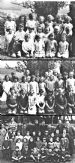
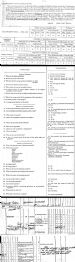
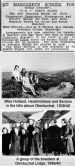
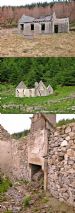
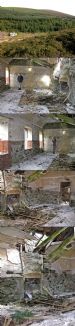
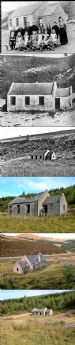
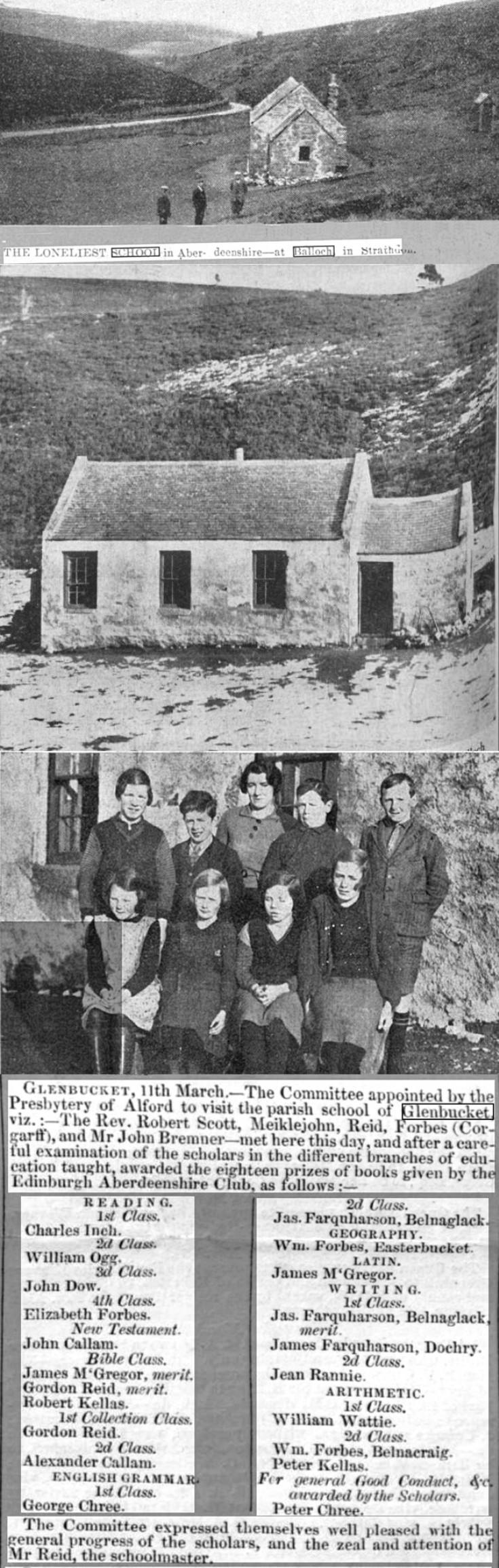
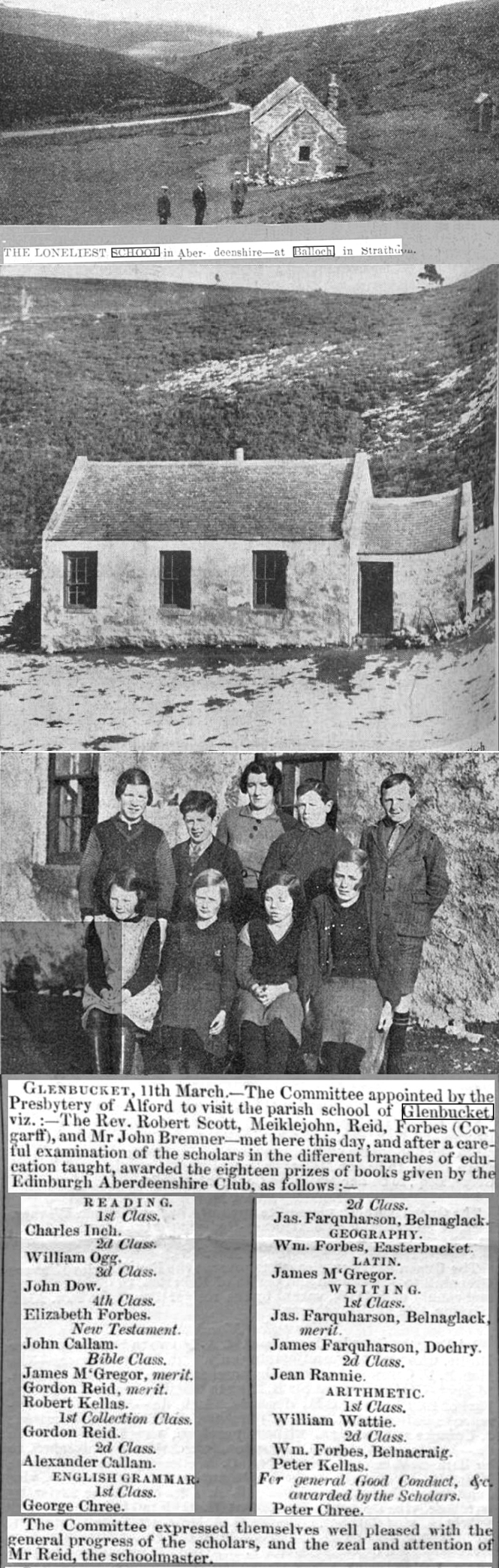
Pictures above show:
1-3. Balloch School 1934 with Mrs Thomson and pupils
4. Glenbuchat Balnacraig School Prizes 1845
The history of schools in Glenbuchat reflects the development of Scottish Education through the years. The history is highlighted by the passages below taken from various sources especially newspapers of the time
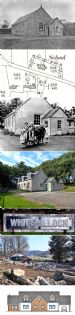
This page concentrates mainly on the Balloch School which lay at the junction between the two glens of Glenbucket and Glen Nochty.
Click for personal reminiscences of the Balloch School
Click for more details of one of the teachers at the Balloch.
Click to search for other references to the Balloch School
Prior to the Reformation country schools were few and far between and when they were present, they were supported by a combination of kirk funds, contributions from local heritors or burgh councils and parents that could pay.
In 1616 an act in Privy Council commanded every parish to establish a school "where convenient means may be had", and when the Parliament of Scotland ratified this with the Education Act of 1633, a tax on local landowners was introduced to provide the necessary endowment.
In the Scottish Highlands as well as problems of distance and physical isolation, most people spoke Gaelic which few teachers and ministers could understand. Here the Kirk's parish schools were supplemented by the Society in Scotland for Propagating Christian Knowledge, established in 1709. Their aim was to teach English language and end Roman Catholicism associated with rebellious Jacobitism.
The Disruption (Split in the Church of Scotland )of 1843 all undermined the tradition of parish schools.408 teachers in schools joined the breakaway Free Church of Scotland. By May 1847 it was claimed that 513 schoolmasters were being paid direct from a central education fund and over 44,000 children being taught in Free Church Schools. Attempts to supplement the parish system included Sunday Schools.
In 1872 Scotland moved to a system like that in England of state-sponsored largely free schools, run by local school boards. Overall administration was in the hands of the Scotch (later Scottish) Education Department in London. Education was now compulsory from five to thirteen and many new board schools were built.
In 1890 school fees were abolished, creating a state-funded national system of free basic education and common examinations
In Aberdeen Epitaphs and Inscriptions J A Henderson highlights the schooling in Glenbucket in the 1700’s
SCHOOLS AND TEACHERS.
On the occasion of a visit to the parish the Presbytery of the bounds 16th June, 1675, the minister was asked "If there was a Schoolmaster, which answered negative. Wherefor the heritors were seriouslie dealt with for the amendment of this defect." (New Spalding Club's "Exercise Alford," p. 243.) Practical steps were taken and brought to successful issue, as evidenced by the entry of 27th July, 1687 “That there is School and some tolerable maintenance for a Schoolmaster." (Ibid., p. 383.) A century ago, (1817) the parish school stood at Belnacraig, the teacher being Mr Raeburn. He also officiated as session clerk. Unfortunately, during his tenure of the combined offices, the school buildings were destroyed by fire, and a large proportion of the Kirk Session records were consumed. retired about 1826. A new schoolhouse was then erected on the present site, and Mr Forbes, a native of the parish, was elected schoolmaster.
As mentioned above Sabbath Schools (Sunday Schools) were also important for education in the glen and of course were run by both established and Free churches.
Sabbath Schools
Banffshire Journal and General Advertiser - Tuesday 18 February 1868
STRATHDON and Glenbucket. —The annual soirees of the Schools this district connected with the Free Church took place the evenings of the 10th and 11th current. On both occasions, the churches were quite filled, and the whole proceedings were of the most pleasant and interesting kind. All present partook of an excellent tea, and were afterwards supplied with service of fruit. Interesting and appropriate addresses were delivered by Rev. A. C. Fullarton, who presided, in his usual able and happy manner; Rev, Win. Aitken, U.P. Church, Tough; Rev. H. Nicoll, Auchindoir; Mr John Walker, and Mr Alex. Dunbar, Strathdon. In the course of the evening, a number of beautiful hymns were sung by the children, with fine effect. At the meeting in Glenbucket, tin excellent choir, conducted Mr Anderson, delighted the meeting with a number pieces sacred music, exquisitely rendered. Anything finer than the rendering of ‘Jerusalem, my happy home,’ and Sweet hour of prayer,’ it would not be easy to imagine. Anderson is present conducting large and prosperous classes in these parishes, and none who had the good fortune to present on this occasion, could doubt his eminent qualifications and great success as teacher of sacred music.
Thus, Glenbucket had a school at the top of the Belnacraig brae where the old School house still stands. It was burned down in about and rebuilt in 1868. As most schools were run by the Parish Church and when the church divided in the disruption of 1843 into the Established church of Scotland and the Free Church of Scotland so, the schools were divided also. The Established Church continued with the existing school at the top of Belnacraig Brae and the Free church built a house and School room in the lower part of Belnacraig at Bowiebank now Craig Cottage. And which was a girls School and used the house at Dulax further up the Glen for the boys. Thus, the Glen of less than 600 people ended up with two Churches and three schools. In addition, both churches had Sabbath Schools.
Aberdeen Press and Journal - Wednesday 02 April 1845
Presentation of Prizes at Belnacraig School
(See picture above)
The Committee appointed by the Presbytery of Alford to visit the parish school of Glenbucket, Viz the Rev. Robert Scott, Meiklejohn, Reid, Forbes (Corgarff), and Mr John Bremner - met here this day, and after a careful examination of the scholars in the different branches of education taught, awarded the eighteen prizes of books given by the Edinburgh Aberdeenshire Club, as follows:
READING.
1st Class. Charles Inch.
2d Class. William Ogg.
3rd Class, John Dow.
4th Class. Elizabeth Forbes.
New Testament. John Callam.
Bible Class. James McGregor, merit. Gordon Reid, merit.
Robert Kell as. 1st Collection Class. Gordon Reid. 2d Class. Alexander Callam
ENGLISH GRAMMAR,
1st Class. George Chree.
2d Class. Jas. Farquharson, Belnaglack.
GEOGRAPHY. Win. Forbes, Easterbucket
LATIN. James McGregor.
WRITING.
1st Class. Jas. Farquharson, Belnaglack, merit. James Farquharson, Dochrv.
2nd Class. Jean Rannie.
ARITHMETIC
1st Class. William Wattie.
2d Class .Wm. Forbes, Belnacraig. Peter Kellas.
For general Good Conduct, etc. awarded by the Scholars. Peter Chree.
The Committee expressed themselves well pleased with the general progress of the scholars, and the zeal and attention of Mr Reid, the schoolmaster.
A ‘Soiree’ was held to raise money for books for the Balloch School.
Banffshire Journal and General Advertiser - Tuesday 02 February 1869
GLENBUCKET SOIREE
A Soiree came off in the Parish School here, Friday evening, the 20th ult. We may mention that the building, which is very commodious one, was erected last year almost solely the expense of the Earl of Fife, the proprietor of the parish, and is situated the northern slope of the Strath watered the Bucket, and has a commanding view of the valley and Ben Newe in front.
The school is taught Mr Cameron, and in very efficient state. The soiree was got up for the purpose of raising some funds for procuring books for prises for the scholars, and have no doubt this has been realized. The house was densely filled eight o'clock, and we should say there were about present, there being many people from distance. The chair was occupied the Rev. Mr Bremner. the minister of the parish, and on the platform, we observed the Rev. Mr Watt, Strathdon, Milne. Towie; Christie. Kildrummy; McHardy. Corgarff; Mr Cameron, teacher.
Amongst others in the meeting observed Messrs Sutherland. teacher, Balloch School; Grant, assistant teacher. Strathdon Parish School; Dr Robb. Towie; Miss Robb, teacher, Towie female School; J. L. Douglass, Esq. J.P., Buchaam; Mrs Smith, Mains opened the meeting by few suitable remarks on the benefit of such re-unions all classes for objects connected with the education of the rising generation. Thereafter, A. F. Chree. with very efficient choir, sang My happy home, which was greatly applauded. The Misses Chree gave ‘I’m our young to marry yet.’ which was really well sung; the girls, daughters of A. F. Chree. leader of the choir, are only from five to seven years of age apparently. Next followed song by the choir. ‘The hunter’s pride,’ which was exceedingly well rendered in all the parts.
The Rev. Milne then gave a most admirable address on the various relaxations and amusements suitable for both body and mind of the various classes of society. The subject was replete with much interesting matter connected with our every-day duties.
The choir then gave a song, entitled. ‘Trancodillo. we are not so sure of the merits of the song, but the harmonies throughout the air were admirably executed, and were heartily Mr Chree gave “My Nannie’s awa” which was very well sung
The Rev. Mr Christie then gave few very interesting remarks on the early history of the parish of Glenbucket, similar to what appeared in the Journal some two or three months ago. The Fairies’ Song was then given the choir with capital harmonics blending exceedingly well. The Misses Chree then gave’ Johnny comes marching home’, which they did very well. The choir then gave ‘Jock Hazledean.’ This was scarcely well sung the others, some of the parts slightly out of time, but towards the last verse or two it went very well. We should mention that some of the principal voices the choir were unavoidably absent.
The Rev. McHardy. Corgarff. gave a few remarks on ‘Happiness and Success in Life, and the means to use to attain the same.’ Mr. John Reid. Kirkton. gave (solo) ‘Where there’s a will there’s a way’ a very humorous piece. and very well sung, receiving a hearty encore. The choir then gave ‘The Boatman’s Song.’ exceedingly well sung. Mr Chree, with real characteristic humour, gave ‘Gudewife. gae flit the cow’. Mr Brodie, gave a recitation. ‘Charles Stuart’. The choir then gave ‘The Farmer’s Song.’ The whole of the parts were well blended. We should think it about the best song of the night
The Rev. Mr Watt then gave an address on Schools, Schoolmasters, and Education, pointing out the duties of the parents, as well as the teacher. The address contained many valuable hints to youth generally. Master J. Begg Blackhillock. here gave a very good recitation from the ‘Sayings of Poor Richard’, which was very correctly delivered, and well received. The choir gave ‘The Hunt,’ very well sung. James Shearer, jun. Heughhead, Strathdon, added much to the enjoyments of the proceedings by several airs played on the flute, and which received hearty applause.
Rev. Mr Christie paid high compliment to the choir for their efficiency, and proposed a vote thanks to Mr. Chree and the Choir, which was heartily given. After the usual vote of thanks to the Chairman. Etc., Mr Cameron thanked the audience for the way which they bad turned out to farther the object for which the meeting was organized. The meeting (which, notwithstanding the great crush, was most orderly throughout) quietly dispersed, all apparently highly pleased.
An article of March 1868 outlines four new schools in Strathdon and the donors who supported them. They included Knocklea at Inverernan, Towie, Belnacraig and The Balloch
Strathdon new schools in district. Banffshire Journal 24 March 1868
STRATHDON New Schools.
Although our district lies far among the Northern Grampians, the cause of education is not neglected. Glenbucket and Strathdon, during the last year or two. some four new schools have been erected, independent of the parish schools both parishes. Wednesday last, one of these new schools, that of Knocklea, Inverernan, was examined a Committee the presbytery Alford, consisting of the Rev. Messrs Watt, Milne, Towie; Bremner Glenbucket, and McHardy of Corgarff. We understand the school was found to in excellent order, and upwards of 50 scholars attending, the situation which is considerable distance from the parish school. last year, the Rev. Watt (who pays more than ordinary attention the education of the young in his parish) brought the matter before General Forbes C.B. of Inverernan who most generously agreed to build excellent school and schoolhouse solely his own expense, the farmers in the district driving the materials. The heritors, whose properties are benefited by this school, also agreed give liberal salary for the teacher. This is not the only instance of the interest the heritors and other gentlemen have in the cause of education in the district. We noticed lately in the Journal a soiree in connection with the new school lately erected in the Pass between Strathdon and Glenbucket. This school was built the liberality parties connected with these parishes. The principal subscribers were the Karl and Countess of Fife, W. B. Harvey, Esq, M P, (of Langley Park, Buckinghamshire, and presently lessee of the (Glenbucket shootings),; Sir Charles Forbes, Bart, of Newe, £l5; W. Spence, Esq of. Edinburgh (son a former minister of (Glenbucket), £10; 11. N. Forbes. Esq. of Auchernach and Dunnottar, £5; General Forbes, C.B. of Inverernan, £5; General Sir Charles Stewart, C.B a native Noughtyside, Mrs John Forbes. £5; Miss Forbes, London, £5 Etc. The Society for Propagating Christian Knowledge has guaranteed the teacher a permanent salary not less than £20
The Balloch School
The Balloch is the name given to the pass between Glenbucket and Glen Nochty. This was to enable children from the more sparsely populated ends of both Glens to access education. However, it was probably not a great choice as it was quite desolate and isolated and easily affected by bad weather. Despite having only one room at its peak it had a school roll of 58 Children. Children did not attend all the time as many were held at home to help with farming etc.
The soiree mentioned above was reported I February 1868
Banffshire Journal and General Advertiser - Tuesday 25 February 1868
Glen-Noughty.
A soiree, in connection with the new school the Balloch, was held 13th inst. at Auchernach, in a large granary, kindly granted for the purpose by the tenant of the home farm, Mr Rogie. This school was built last year in the Balloch Pass, through which a commutation road connects Strathdon and Glenbucket. The locality is wild and romantic, but still the position in which the building was placed was the only one make it accessible to the upper end of Glenbucket and Noughtyside, a part of the parish of Strathdon.
The meeting was very numerous one. The Rev. Mr Watt, who occupied the chair, said the object of the meeting was raise funds for procuring prize-books for the Glen-Noughty school, and hoped that at same time the proceedings of the evening might prove otherwise interesting to all parties present. He mentioned that many handsome donations had been received from parties connected with the district towards the object. Mr G. King, Bellabeg, and number of the Strathdon Church Choir, and Mr A. F. Chree, Sunnybrae, with some of the Glenbucket Church Choir, rendered good service throughout the night; while several others very kindly came forward for similar purposes. can merely give a brief outline of the proceedings. Mr King and Choir sang the ‘German Students’ Song.’ Murdoch, merchant, recited ‘Craigielea,’ followed the song, Own Native Land,’ by Mr Chree and Choir. Rev. Mr McHardy, Corgarff, gave address to the young people present, specially adapted for them, and full of much good advice.
Mr King and Choir sang ‘Waes me for Prince Charlie.’ A dialogue on The Death of Caesar’ was given Mr Sutherland, teacher, and Mr Donald McNicol, jun., Glenbucket Lodge, which was received the audience with applause. The dialogue was followed by catch by Mr Chree and Choir, and a recitation by Mr Chas. Anderson, done in character with great tact. ‘The Death Dundee at Killiecrankie’ was recited by Mr Mackie, Inverernan Schoolhouse. A passage from Douglas was given by Messrs C. Anderson, John Moir, and James Finlay, and was very well executed. recitation from Byron followed Brodie, Backies, Glenbucket. ‘The Maltese Boatman’s Song,’ by Mr Chree and Choir, which came next, was a difficult piece, but the whole harmonics were beautifully rendered. Mr Kennedy, Schoolhouse, Tillyduke gave an address on ‘Education.' in which both parents and children were shown their respective duties. Mr and Miss Murdoch, Craigielea, accompanied the accordion, here sang Annie Lisle’ with much taste, and received hearty reception. The song, ‘Fair, Fair, in Golden Hair, a Mother Wept under the Willow’ was sung Master Wm. Watt, and did the little songster much credit. The song ‘ln the Garb of Old Gaul.' by Mr Chree and Choir, concluded the programme. About £4 was realised. The usual votes thanks were passed.
Adverts were put in the press for construction of improvements at the Balloch School
Aberdeen Press and Journal - Wednesday 28 July 1875
Glenbucket School Board.
ESTIMATES Wanted, for EXCAVATING. and GRAVELLING PLAY-GROUND, for BUILDING 204 Lineal Yards of STONE DYKE round the same, and also for the Erection of PRIVIES for the Glenbucket Public School
Plans and Specifications may seen with James Forbes, Tombreck, Glenbucket, Clerk to the Board, whom Sealed Offers will be received, to Monday, 9th August, on which day, at Three o’clock p. m., the Work will be Contracted for, at the Public school, if suitable Offers are made.
The Board not bind themselves to accept the lowest or any Offer.
Tombreck, Glenbucket, July 20, 1875.
And adverts were also regularly put in for a new teacher.
Aberdeen Press and Journal - Tuesday 05 December 1893
WANTED, CERTIFICATED MISTRESS, for Balloch Public School, Parish of Glenbucket, to enter on duty, 2nd January, 1834. Salary. £5O per annum, together with Grant earned lor Music and Specific Subjects. Applications, with Five Copies Testimonials, he lodged with James Forbes, Tombreck. Glen bucket, Clerk to the Board, on or before 13th December curt
Reports of the School inspectors also appeared in the press:
Aberdeen Press and Journal - Monday 03 July 1905
Glenbuchat. School Reports.
His Majesty's Inspector of Schools sends the following reports on the schools in this parish:
Public School (Belnacraig)" This school is very inconveniently situated for the majority of the scholars. The infant room cramped for accommodation. The furniture is antiquated in both rooms, and the school itself is out of date. The work of the new headmaster and his assistant is most promising, and the tone of the scholars admirable"
Balloch School—" This little secluded school under good mental and moral training. The instruction is well directed, and does not fail of adequate result. spite of their isolation, the children are bright manner and ready of clear speech. The new offices may be considered suitable, in the circumstances."
Entertainment at the School was regularly reported.
Aberdeen Press and Journal - Tuesday 12 December 1905
GLENBUCHAT. Balloch School
Entertainment-
An entertainment exceedingly interesting and amusing description was given Friday evening by Miss Singer, teacher, and the pupils. The chair was ably filled by Rev. W. Watt, Strath; don, who is chairman of the combined boards of Glenbuchat and Strathdon. Miss Singer had also kindly invited Rev. W. Rev. W. A. Spark. Messrs McRobbie, Davidson, and Hay, members of Glenbuchat School Board; and a number parents and friends. The children went through the various songs, solos, recitations. hoop and dumb-bell exercises with great precision and ability. Mr McRobbie gave selection on the phonograph, which was very amusing to the old as well the young. Miss Singer was cordially congratulated the excellent entertainment
The farewell to Miss Singer at the Balloch School is also recorded
Aberdeen Press and Journal - Saturday 28 December 1907
STRATHDON.
Presentation to a Teacher.
A pleasing little function took place in the Balloch School on Christmas Day, when Miss Singer, the teacher, was presented with a handsome gold bangle the occasion of her leaving to take up another appointment in the parish Coull. Mr. Davidson, Newseat. Glenbuchat, speaking on behalf the pupils, said that they were all very sorry to lose Miss Singer, who had conducted the school with much credit, both the scholars and to herself. Margaret McRobbie former pupil, handed over the gift, which bore the inscription: "Presented to Miss Singer scholars and friends in and Strathdon. December. 1907.”
Miss Singer, replying, said that she would always prize their valuable gift memento of time she had had the Balloch School. She thanked them one and all most sincerely. Miss Singer thereafter entertained the company to tea and fruit, after which a beautiful Christmas tree was dismantled of its good things and distributed amongst the little people. Mr Harry McRobbie, Rintaing, proposed a cordial vote of thanks to Mrs Milne of Logie and Glenbuchat, for so kindly supplying so many articles, useful and ornamental, for the Christmas tree. A vote of thanks was also given to Miss Singer for providing the tea and fruit for the occasion.
Click for picture of Miss Singer at the Balloch School
More adverts for teachers.
The Scotsman - Saturday 11 March 1911
TEACHER (certificated mistress) wanted; salary, £ 60; or JL ex-P.-T. qualified under Art.; - salary , £ 55 , for Balloch School , Glenbuchat ; to begin duties as soon as possible . Applications, with testimonials, to be lodged by the 20th March with John Callam, Clerk
Aberdeen Press and Journal - Saturday 28 February 1914
TEACHER (MISTRES), Certificated, for Balloch School, Glenbuchat. Salary £60, per annum. To commence duties soon possible. Application, with. testimonials, on or before March, with John Callam, Clerk
Aberdeen Press and Journal - Tuesday 25 March 1919
BALLOCH SCHOOL BOARD.
On Friday afternoon enjoyable meeting subscribers, a testimonial to Miss L. Paterson. teacher, of Balloch Public School, who has received a new appointment Glenfeshie, was held in the School. There was a good attendance of parents of scholars and others interested in the school. In the name of subscribers, the Rev. Wm. Watt, chairman of the Joint Committee of Managers, presented Miss Patterson with a beautiful silver tea service as a of token their appreciation of her services during last three years. Miss Patterson made a feeling and suitable reply. The company and scholars partook of a sumptuous tea, which served by Mrs Keir. Crofts; Mrs Law" ' Dulix Cottage; and Miss Stewart, Invernettie. Others present were—Mrs Benton. Mrs Birnie and Mrs McNicol: Misses McRobbie and Dow; and Messrs Keir, Lawson, Anderson. Michie McNicol, Valentine, and Thomson, clerk School Board.
Aberdeen Press and Journal - Friday 31 October 1919
LETTERS TO EDITOR.
Glenbuchat Parish Council Delays Fixing Education Rate.
Sir
Under the above heading there appeared in the "Aberdeen Daily Journal" of 25th October the report of meeting of Glenbuchat Parish Council. In this report mention was made of the need for economy in the teaching staff, and, emphasis of this need, it was stated that there were only 45 scholars the parish, and there were three teachers. This statement 'is not quite correct, and it is. besides, misleading. The number of scholars resident the (parish at present is 50, but this does not represent the total number of pupils under instruction, which is 65—44 in Glenbuchat School, with two teachers, and 21 Balloch School, with one teacher —Balloch being a combination school serving the parts the parishes of Glenbuchat and Strathdon. pupils all stages, from infants up to and including supplementary class, it is difficult see iii the circumstances the work can be satisfactorily carried on by a smaller staff. Economy in educational matters has always been a strong point in Glenbuchat under the School Board regime. Craik scale and county scale alike were passed over by it with calm indifference. But for the kindly intervention the Education Department with its grant-in-aid the headmaster's salary still at the figure of seven years ago—viz., £120. From economical motive too, the School Board have been content to let him live in schoolhouse which by reason of its exceeding dampness is hardly tit for habitation, and is most certainly not conducive to health.
Yours, etc.. A. Mackenzie. Schoolhouse. Glenbuchat, 29, Oct 1919
Aberdeen Press and Journal - Tuesday 16 December 1919
GLENBUCHAT.
Five members have been elected the Glenbuchat Parish Council. At the first meeting it was found that two members have still to elected. The Rev. W. A. Spark was re-elected chairman and representative to the Alford District Council. Intimation of the expends of Balloch School was adjusted by Strathdon parish having to pay half of the amount, and only the other half falling on the Glenbuchat Council.
Aberdeen Press and Journal - Tuesday 03 August 1920
DEDICATION SERVICE AT GLENBUCHAT.
A dedication open-air was held on Sunday afternoon at Balloch School, Glenbuchat. The new organ, subscribed for by the inhabitants, was dedicated by Mrs Milne Glenbuchat, memory of those, nine in number, who formerly attended the school, and fell in the war. Mrs Mitchell, schoolmistress, and Mrs Couper, Craigiebuckler, presided at the organ, and singing was led by a number of scholars. Colonel Milne read the lessons, while addresses were given by the Rev. W. A. Spark and Mr Watson, layman. U.F. Church, At the close the open-air service, a collect ion, amounting £2 13s 10d, was taken on behalf of Sick Children's Hospital- After the service Mrs Milne unveiled the Red Cross roll honour, containing names of the scholars who had wrought and worked for comforts the sailors and soldiers. The roll of honour was presented by the late teacher, Miss Paterson.
Aberdeen Press and Journal - Saturday 07 August 1920
GLENBUCHAT. Summer Vacation.
Before closing for the summer vacation, Mrs Milne of Logie and Glenbuchat, accompanied by Mrs Couper Craigiebuckler and family, visited Balloch School, Glenbuchat, of which Mrs Mitchell is teacher, and presented each child with book. Prizes were also given by Mrs Milne a few scholars for good attendance and proficiency in work.
Aberdeen Press and Journal - Tuesday 19 July 1932
Balloch School Picnic. The children attending Balloch Public School had enjoyable picnic in a field at the Newe. Strathdon- With the help of the parents the teacher, Miss Noble, made the necessary arrangements.
Aberdeen Press and Journal - Saturday 15 October 1932
NORTH-EAST NEWS Balloch School Awards.
Prize-giving took place at Balloch School, when, through the generosity of Mrs Couper, Glenbuchat Lodge, the pupils received handsome books. The Rev. N. Campbell, Chapel Garioch, addressed the children. The following received prizes: —Advanced class—Jean Duncan and Isabella Don: seniors—Alexander McRobert, Joan Don. Helen McRobert, Wm. Duncan, Grigor Grant, and Alex. Don; juniors —Alistair Stewart, Jeanie Don; infants—lsobel McRobert. Helen Stewart, and Nora Anderson.
Aberdeen Press and Journal - Thursday 19 October 1933
Balloch Prize-Giving
On prize-giving day at Balloch School, Glenbuchat; the Rev. A. Shier, Glenbuchat, addressed the children, and Mrs Couper, 'The Lodge, handed over the prizes which she had given. Her kindly interest in the school is greatly appreciated. Those who received prizes were: —Advanced division—Jean Duncan, Isabella Don; Prim. IV. —Joan Don," Helen McRobert, Wm. Duncan, Alex, Don; Prim. ll.—Joanie Don, Alex. Stewart,; Prim. I.—lsobel McRobert, Helen Stewart; Infants ll.—Nora Anderson; Infants I. —Adam Stuart, James Don
Aberdeen Press and Journal - Saturday 08 February 1941
COUNCIL OF THE COUNTY OF V ABERDEEN. EDUCATION COMMITTEE.
Applications are invited for the following appointment, the salary to be according to the Committee's Scheme: — BALLOCH (single-teacher) P. SCHOOL, educating to Qualifying stage. Roll about 5—. MISTRESS. Ability to play piano and to teach Singing essential. About miles from Strathdon; no schoolhouses, Applicants must lodge two copies form Application (to be had request) and two copies of with the DIRECTOR OF EDUCATION. County Buildings. Union Terrace. 1941 0n or before 22nd February. 1941
Despite a tiny roll the Balloch School pupils were still winning prizes.
Aberdeen Weekly Journal - Thursday 17 June 1943
Balloch Pupil’s Success Wallace Wilson, primary scholar of Balloch School, Glenbuchat. Alford, has won a first prize presented the Scottish SP.C.A. for an essay “How Animals and Birds Help Us in War-time.” He will receive the prize at the annual school prizegiving
In the war years there was correspondence about the viability of the Balloch School and those in similar remote areas of Scotland.
Aberdeen Weekly Journal - Thursday 17 June 1943
What's to Become of Our Rural Schools?
THERE'S A COMMUNITY PROBLEM HERE
ALISON STEWART praises the teacher heroines and tells what their passing will mean. THIS is an unconstructive article. That is to say, it is about a question. to which know only half the answer. The very question is hard to formulate. But ' What's to become of our Rural Schools?'' seems to cover most the ground. And yet we already realise pretty well what's to become of them. Perhaps then, our question should read " What of our Rural Communities?", Let me explain what I’m getting at. Not long ago, made a plea before a big northern Education Committee for the centralisation of five small rural schools. I did so from the conviction that such move was the best interests of the children concerned and of their education. These schools were much alike. They belonged to scattered communities. They were housed in old-fashioned buildings with high windows, ineffective heating, outside sanitation, no facilities for drying wet clothes, little accommodation convenience for cookery or handwork classes. All were single teacher schools.
School Heroines
Before proceeding further, let me state here what everyone with any experience thinks of the teachers in one-teacher country schools. Simply, that they are the heroines of the educational world. Alone they have struggled with anything up to thirty children of all stages and ages from five to fourteen and have sent them ultimately to further education or to the wide world with a grounding as sound as any received " exclusive establishments " or large-staffed Authority Schools. They are usually patient, wise, amazingly versatile. They spend and are spent—as far as energy, physical, mental and spiritual is concerned daily from nine to four. Let none of us belittle their tremendous accomplishments. Yet I spoke for the abolition of the schools they had made and for the ending of the work to which they had given their lives. Because I felt it was my duty. Actually, the entire pressure of circumstances was behind me. Each year it becomes more difficult to find teachers willing and able to take up rural appointments. Each year the buildings are more out -of - date and out-of-line with modern requirements. To rebuild each and all, today and for a generation to come, is out of the question: to maintain them in repair grows ever more costly. Even to keep them clean is difficult, for, in an increasingly large percentage of cases, cleaners are unobtainable. So, it is "Teacher" who lights the fire, fetches the coal, sweeps, dusts, sometimes even tends the closets. There is no one else to do it. Didn't I tell you she's heroine? Again, the whole trend of education is now against the small rural school. The children, having so often struggled their full three miles to school, arrive there soaked. They cannot be dried. The seeds rheumatism quickens and a life-long handicap begins. With a roll in many cases of much less than thirty, there is little competitive stimulus for growing minds. Perforce nothing but the barest elements can be given of what are so often erroneously termed " the frills " of education: P.T., Music, Art, Handwork.
Travel Dangers
Their contemporaries in larger schools, on the other hand, enjoy every benefit arising from good accommodation, a large roll, specialist teachers and. probably, buses in which to reach school with energy unexpended. Are we then astonished that Education Authorities everywhere are wondering how soon events and trends, as well as economy in cash and man-power, will force them to centralise; to build large modern primary-schools serving a wide district; to send out fleets of buses into the countryside to gather the scholars; to do, in fact, everything that organisation can to give our rural children an educational start as good as any other. We may not wonder at all. But how many of us. I myself wonder, see the other side of the picture? Look: The village school has gone. The building is used as a temporary dwelling-house, for which it is not suited, or as store. No longer has every village club and activity a natural and gratuitous meeting place. Every morning the district is denuded of children. Mothers anxiously watch the five-year-olds adventure upon the bus-run. Only in the evenings and at the week-end will the village have its children again. But no longer as one big family. Instead, they will be split into groups, or solitary, their personal associates perhaps twenty miles away. In fact, the common local interest for all the children has disappeared. And. worst of all. they are without their natural link, that one person in the village who was interested in each single one. For Teacher is gone from their midst. She is not now there to interpret their unfolding abilities to their parents; nor can she translate to the children themselves the world and what it offers them.
Keystone of Village Life
She is not there to run the Cubs and Brownies. Nor, for the village at large, can she organise concerts, undertake collections, get up sports, preside over the library-box, be secretary of this and treasurer of that. She is not there to write to her far-flung old pupils the news of their contemporaries, to watch and comment on the traits of parents reappearing in their child; to give, in short, that blessed sense of continuity we ever long for . . . So, the kingpin is withdrawn: the keystone is removed. The whole close structure of village life begins come tumbling down. That is no exaggeration. For the Teacher and her job form the true point-in-common in every rural community. Churches there may be, two, even three. But there is only one school. It may be a single-teacher school; it may have three or four teachers, each filling a niche according to. his or her ability. But the school is the main local pivot. If it goes, true, the people remain. But not the community. Slowly that must disintegrate, ultimately die. For it has not been reborn in the hearts of the rising generation. Well, there's the problem. And, in so far as it is the problem of how to obtain exact equality of educational opportunity for both town and country children, and as well to retain our ancient rural solidarity, I believe it insoluble. You cannot have your cake and eat it. But perhaps it is not along those lines at all that the solution lies. It may be that our educational aims require complete revaluation. may be that we have to scan, with new honesty and a courage greater than that which we usually manifest, the whole drift of our civilisation. The Balloch School—a Strathdon example of the very small rural school
Aberdeen Press and Journal - Thursday 01 November 1945
Drab Little Prison Schools
Do Country Teachers and Their Pupils Get a Square Deal?
By THE HEAD TEACHER of a little school in ——shire
NAMES are neither here nor there—the school, its situation, its dullness, it’s struggling head teacher, are but symbolic of hundreds of such little drab prisons in rural areas all over Scotland. They are drabber and dirtier, no doubt, in some counties than in others, but are prisons nevertheless, in the sense that they deaden the spirit of pupil and teacher alike, and kill the incentive to happiness in learning, and healthy zest in Work and play. During the grim years of war, there were other things on which the Government (with little concern for economy) lavished its spare millions, and doubtless it was on national instructions that the education committees cut out all but necessary repairs on throughout the country.
Favoured Ones
Had this restriction been universally adopted in all departments we should have accepted it cheerfully as necessary war-time expedient, but teachers viewed with a mixture disappointment and resignation money generously poured out, for instance, the equipment of hostels for the Land Army (baths, handbasins, lavatories, ample furniture all being listed priorities), the painting and interior reconstruction of offices and houses taken over for Government use, the widespread introduction of electricity wherever considered necessary, plentiful supply of petrol for all Government purposes. These are but a tenth of what might be quoted as such examples, and they serve only to accentuate the complete impoverishment of all educational advancement in the schools and the introduction of much-needed sanitary improvements.
Before Dinners
Apparently, it was nobody's business that dry lavatories were still in existence in country schools in Scotland in this present year of grace. Do not let us allow the exigencies of war to cloud the issue here—the fact remains that this first priority in health was by-passed, not only throughout the last six years but for a decade and a half before then. First things first we are told! I fancy I am not the only person who would place the provision of this very necessary facility before that of a two-course meal, where in many cases, owing to difficulties of accommodation and building, the service will not fulfil by any means the complete purpose that its introduction was intended to, and the makeshifts at present being adopted will tend to be perpetuated. We country teachers have right to demand and to expect for our pupils a place of learning that they will recall with pleasure after they have left it, a place that will welcome them in the morning in colour and harmony, a place of their very own, the decoration of whose walls with their own work they will count a matter of pride, and where they can leave lying about, without fear interference, all the signs of classroom authority with vision and imagination would be prepared to concede. I claim that within a period of six to twelve months there would be a marked improvement in the children's health, bearing, and outlook, a justifiable pride in their work and in their school, a pervading sense happy co-operation throughout the classrooms, and a sound beginning to the new educational approach that we feel is more than due.
I have no patience with critics who argue that country bairns do not need a playing field. Why don't they? There can be no fostering of the team spirit in a solitary tramp of several miles along field paths or over heathery tracks, no chance of encouraging real sportsmanship, no opportunity of teaching the team games that all children enjoy. So, I am all for a playing field of modest size, where, least once a week, instruction in initiative, poise and resourcefulness in sport and play may get the attention it deserves, and where in fine weather lessons may be enjoyed in the sunshine.
Room to Browse
In a corner 'of the field let us have the dining hall' (ambitious name for an army hut) with kitchen attached, where the best possible use could made of time and service in training the children in manners and helpfulness. When the meal was over, the tables might be utilised by the pupils on* wet days to browse over newspapers, magazines, encyclopaedias, books of knowledge, to indulge in handcraft or any kind of quiet game, or in preparation of lessons for the next day. Here also the cinema projector would be operated—a. mechanical aid to teaching always popular with the pupils, and one which, used sensibly, enhances lessons in every sphere of learning. Our stage for dramatic art would be a necessary feature of the hall, and physical training would then become what it is intended to be, not the inevitable makeshift most country school time-tables. It may well be argued that a classroom is what the teacher makes it I agree, within limits but with a background of dirt and dreariness, it is heart-breaking work and before long he gives up the unequal struggle.
Home of Our Own
And this brings to my’ last demand, already mentioned in the passing, a place we can call our own ft is no war-time measure this —which at present permits schools to be used by every entertainment committee in the countryside for dances, social melanges whist drives, and what not. And while it would ill-become any country dominie to begrudge the district, he serves a broader communal life, there can few communities of any enterprise which would not now bestir themselves in the matter of securing other accommodation than the school (ill adapted at the best of times for crowded social gatherings). The authorities, realising the importance of the village hall in rural life, offer large grants for purchase or building, not to speak of the possibility of adapting army huts to provide. almost at once, this very sorely needed amenity. It is but natural for us to want home our own. Isn't it time we had one? interest and activity, in project and handcraft. Instead, we have dull walls begrimed with the accumulated dust of the feet many thousands of dancers during the last twelve years or more, rough floors whose splinters take all pleasure from what little can be done in the way of physical education on a winter" day, a playground the size of a postage stamp, where ruts and loose stones make even a healthy run a dangerous indulgence. We are constantly reminded that there must be a new approach to education; educationists with vision and imagination are not slow to encourage us to recast our syllabus and to reassess the values in time of the subjects that have hitherto got but scant attention in both urban and rural schools. The facilities available in city schools can be very easily adjusted to allow such recommendations to be carried into effect, but what chance have the country bairns to utilise more time for physical recreation (to take but one of the Cinderella’s of the time-table) when the school has neither a drill hall nor a playing field its name, and little prospect of securing either?
I shall not be satisfied until I see what want for my little school granted as a matter of course, as the right every child who attends it, and those interested in education in its fullest sense must agree that my demands are by no means too ambitious.
First, then, give me a painter with some artistic sense, who. out his paint pots of sunshine-yellow and green and gold will transform those walls of ancient pinks and colourless fawns to become a suitable background for our experiment. That children react very strongly to light and colour is a fact that needs no elaboration and this new scheme will cost us no more than the other. I ask for nothing else inside the school —not that I do not long to replace pre-historic forms and uncomfortable desks with more modern furniture, not that I would not willingly break down solid south wall and plant a glass one in its place, not that I would not welcome a convenient bomb to send sky high the whole badly sited, ugly, inconvenient, out-of-the-elbows, and down-at-the heels little monstrosity. But these are serious times of recovery and reconstruction. and I ask only what an The Balloch School at the head of Glenbuchat and Glen Nochty. Strathdon, may stand as type of the drab prisons the author of this article resents.
Finally, the day came in Summer 1948 when the Balloch School had to close.
Aberdeen Press and Journal - Friday 02 July 1948
"Loneliest" School is Closed
Car to Glenbuchat for Balloch Pupils
BALLOCH School, reputed to be the loneliest in Aberdeenshire, nestling in the moorland of an isolated pass between Glenbuchat and Glen Nochty. has closed down. The schoolmistress, Mrs D. M. Fraser, has performed her last duty of education at Balloch, and her five pupils have cleared their desks, packed their school books and gone on holiday. After their summer break these five pupils will go "all modern." No prospect for them this year of walking to school in heavy rain and the cold blasts of winter.
They will travel the five miles through the Glen to and from Glenbuchat school in luxury—by taxi, at Aberdeenshire Education Committee's expense. Such an occasion as the closing of the school could not be allowed to pass uncelebrated in Balloch Parents and pupils organised a concert and party at which, in the form of a presentation, they bade farewell to the schoolmistress. Combined with this there was a prize-giving over which the Rev. James Ross presided and at which Mrs Ross presented the prizes. Mrs Fraser, the schoolmistress, is returning to Aberdeen to live, and she will continue her teaching career.
All Winners Mr A. L. Young, director of education for Aberdeenshire, stated yesterday that the school had been closed because it was not a modern building. The number of pupils was so small that they could easily be conveyed to Glenbuchat by taxi, a preference decided by the Education Committee as less expensive than the capital expenditure in bringing the school up-to-date. Mrs Ross presented prizes to the following: —William Ross, James Milne (two prizes), Elspeth Webster, Ian Ross, Anna Webster, and Margaret Innes (two prizes). Elspeth was also the winner of two special essay prizes.
 View Large Version
Picture added on 25 November 2020 at 22:15
This picture is in the following groups
school
school
school