The Glenbuchat Image Library
No: 2300 Contributor: No Contributor Year: 2020
5 Schools and Teachers


SCHOOLS AND TEACHERS.
Click for Glenbuchat Epitaphs and Inscriptions album
On the occasion of a visit to the parish by the Presbytery on 16th June, 1675, the minister was asked " If there was a Schoolmaster, to which he answered negative. Wherefor the heritors were seriouslie dealt with for the amendment of this defect." (New Spalding Club's " Exercise of Alford," p. 243.) Practical steps were taken and brought to a successful issue, as evidenced by the entry of 27th July, 1687 —" That there is a School and some tolerable maintenance for a Schoolmaster." (Ibid., p. 383.)
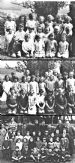
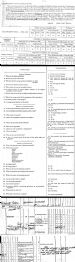
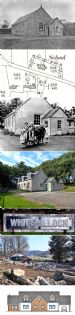
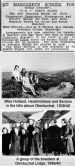
A century ago, the parish school stood at Belnacraig, the teacher being Mr Raeburn. He also officiated as session clerk. Unfortunately, during his tenure of the combined offices, the school buildings were destroyed by fire, and a large proportion of the Kirk-Session records were consumed. He retired about 1826. A new schoolhouse was then erected on the present site, and Mr Forbes, a native of the parish, was elected schoolmaster. He resigned in 1839, and was succeeded by William Reid, son of the minister of Kildrummy. He died in 1865, and was followed by James Cameron, who continued to hold office till June, 1897, when he retired. He is now resident at Rosebank, Crathes.
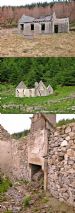
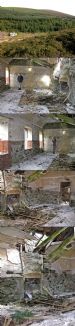
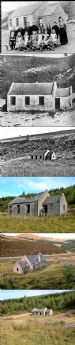
In 1868, a handsome new school was built, and six years later an addition was made to it. In 1868, a combination school was erected at Balloch (a pass between the top of Glenbuchat and Strathdon), which was intended to accommodate the outlying portions of both parishes. In this remotely situated seminary several successful teachers commenced their professional career, among whom may be instanced Alexander James Barclay, M.A., now of Cove, Nigg ; James Philip, M.A., now of Inverurie; and William Stewart, now of Clatt. In proportion to population, no parish has sent forth more sons who have taken high positions in educational, medical, ecclesiastical, military, and commercial circles. Whether this has arisen from the superiority of the grounding imparted at these schools, the determined character of its people—which has, doubtless, been fostered by the free natural beauties of the district—or from a mixture of both, is uncertain
MISCELLANEOUS.
Stone-axes, flint-knives, and arrow-heads have repeatedly been found, giving evidence that in early times the pastime of hunting was largely engaged in.
On the hills of Glenbucket, on 25th August, 1843, was found the body of Alexander Davidson, the last of the old Deeside poachers. Under the canopy of heaven, with the " bonnie blooming heather" as a couch, and on the hills over which he was wont to roam with all the freedom of a king, died this wonderful man, whose presence was as welcome at the entertainments at Gordon Castle as in the most humble cottage. A cairn was raised to mark the spot, but the body was interred in the Churchyard of Glenmuick. (See “Romance of Poaching in the Highlands of Scotland," by the late William McCombie Smith.)
The farm of Drumnagarrow was for a considerable period occupied by a family named Strachan, who claimed descent from the Strachans of Glenkindie. The last of the family was an expert violinist, and had a deservedly high reputation as a player of strathspeys. (See Colonel Allardyce’s “Strachans of Glenkindie," p. 43.) Indeed, many hold that he was the finest player of dance music that ever existed.
At Badenyon there formerly stood a castle or mansion which is believed to have been erected by the Mouats in the 13th century. The Pitfour MS. bears that it was occupied by Mr Gordon of Glenbucket prior to the erection of Glenbucket Castle in 1590.
Between Badenyon and Glen- bucket Lodge a standing stone used to be pointed out as the spot where Mouat fell in his encounter with Alexander Forbes, son of Lord Forbes, who so victory won him the hand of Miss Cameron, the heiress of Brux. Unfortunately, the stone—known by the title of Clachmouat or Mouat 's Stone—was broken up and carried off by a mason for building purposes. Alexander Walker, gardener, Castle Newe, caused diggings to be made about the spot, and unearthed a dirk which is supposed to have dealt the fatal blow. He subsequently presented it to the Banff Museum, and an attached card bears the following inscription — A Dirk. Believed to have belonged to Mouat of Abergeldie from the fact of its having been found near the place where the fatal affray took place between him and Forbes of Castle Forbes, Mouat having fallen mortally wounded. Badenyon has been rendered famous through the stirring song " John o' Badenyon," by Rev. John Skinner, the author of ‘Tullochgorum . '
Poaching and smuggling were the chief industries of the eighteenth century. To engage in the illegal manufacture of whisky was then, in the eye of the Church, considered no sin, but to aid in the carrying of it on Sundays in kegs to the Lowlands for disposal was deemed a heinous offence. Such operations were severely dealt with by the Kirk-Session, although a monetary payment invariably squared matter.
By the end of the century, however, a distinct improvement had taken place, as the writer of the Statistical Account of the parish reports that “The people are sober and very industrious. There are few that do not make their own ploughs and carte, and also their brogues or shoes." The same writer remarks that the parish lies at a great distance from every market town. Aberdeen, the post town, is about 30 miles off. To it the people must carry whatever they have for sale, and from thence all their necessaries are procured. None but those who have felt it can imagine how inconvenient it is to be at such a distance from a post office and market town, when for six or eight weeks sometimes all communication is stopped."
Lying at a high altitude, and surrounded on all sides by high hills, the parish suffers considerably in late or severe seasons. The grain and potato crops occasionally get frosted down, but the frugality and industry of the parishioners do much to mitigate the evil. In 1838, both these crops were rendered wholly unfit for use, and an application was accordingly trans- mitted to the factor for the Earl of Fife, craving that 25 bolls of meal for the poor, with 115 bolls of meal for the tenants, as also a quantity of seed corn, be sent into the parish. In 1888, 1892, 1902, and 1903, the grain crop was again frosted to a greater or less extent, but sufficiently severe to call for the importation of seed corn for the following season. It is but bare justice to the proprietors to state that they have ever shown a sympathetic and helpful spirit on those trying occasions.
In 1795, the population was 449, but the high-water mark was reached in 1871, when the population was 570. Since then, however, there has been a rapid decrease, till now the inhabitants are estimated to number no more than 345. One of the oldest parishioners remembers 45 inhabited houses and crofts which have now entirely disappeared.
Picture added on 14 November 2020 at 16:29
This picture is in the following groups
school
school
school