The Glenbuchat Image Library
No: 2539 Contributor: No Contributor Year: 2023
146 Glenbuchat Mill Artefacts 1


Mill artifacts
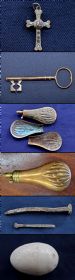
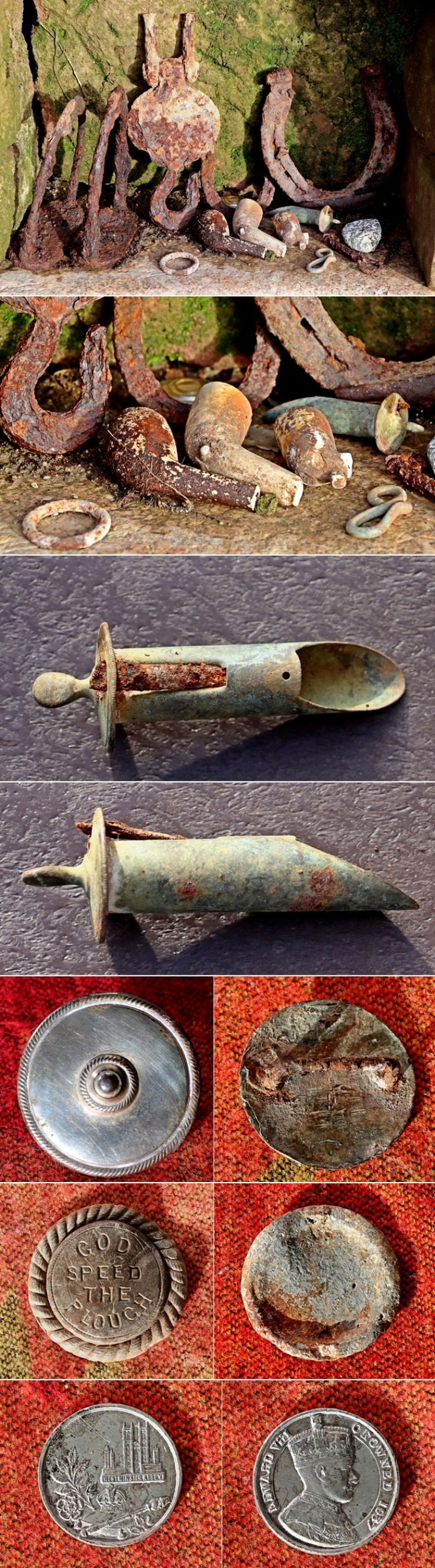
The above series of photos show a number of artifacts discovered during the renovation of the Glenbuchat Mill Cottage in 2022-23
They show
Photos 1 and 2 a selection of artefacts displayed in a niche in the stone wall by the house
Photos 3 and 4 show a 4cm long unidentified object
Photos 5 and 6 Circular medallions
Photo 7 a Medal to celebrate the Coronation of Edward Vll
The first two pictures show a collection of artefacts typical of a mill, horseshoes, stirrups, clay pipes and hooks.
The third and fourth pictures show an object about 7 cm long. The purpose of it is unknown. Any suggestions welcome
The fifth and six pictures show both side of two medallion shaped pieces of metal about 6cm in diameter. One is in the shape of a shield and the other is inscribed God Bless the Plough. On the back is a rectangular hoop.
These are Bridle Rosettes.
The primary function of horse bridle rosettes is to secure the bridle headstall which holds the crown piece and brow band together on a riding or driving bridle and allows the rider to control the horse’s head, speed, and direction.
From the internet site: Fort McCoy ArtiFACT: Horse bridle rosettes
Horse bridle rosettes are not just an ornament, but an important part of a driving or riding bridle. A bridle, or headgear, consists of a bit, headstall (part of the bridle that encircles the head of the horse), and reins.
The primary function of horse bridle rosettes is to secure the bridle headstall which holds the crown piece and brow band together on a riding or driving bridle and allows the rider to control the horse’s head, speed, and direction.
Rosettes are held in place on the headstall by a large rectangular shank on the back of the rosette through which the bridle strap passes.
They were used to identify military war horses, as an adornment for a funeral or wedding, a means of advertisement for businesses and fraternal organizations (think of today’s car bumper stickers), and also served as ornaments depicting favourite activities of the time.
Horse bridle adornment has been around for a very long time, including depictions of elaborately decorated horse bridles in Ancient Egyptian art.
They became extremely widespread from the 1800s to about the 1950s, primarily during a time known as the “Gilded Age” in the United States, with the riding and driving public.
In ancient and medieval times, horse bridle rosettes were made of metals such as iron, bronze, and copper.
In the 1800s, materials used for the rosettes shifted to that of glass domes enclosing hand-painted artwork, dye cuts, pictures, and photographs set in a metal frame.
The designs of the rosettes ranged from plain to elaborate. Horse bridle rosettes were first used in the United States by the U.S. Cavalry.
The U.S. Cavalry used a plain design, less elaborate as the horse bridle rosette pictured here. More ornate rosettes included colourful dye cuts and transfers. The most popular designs were of flowers and animals.
Today, many people consider horse bridle rosettes to be collectibles. Oftentimes, they are used in jewellery such as brooches and necklaces.
Horse bridle rosettes are still manufactured today and used for their original purpose of holding the bridle together.
The motto God Speed the plough is based in folklore:
"God Spede the Plough"is the name of an early 16th-century manuscript poem which borrows twelve stanzas from Geoffrey Chaucer's Monk's Tale.
It is a short, satirical complaint, listing the various indolent members of the clergy who will demand a share of the ploughman's harvest, rendering his work futile.
"God speed the plough, 'a wish for success or prosperity,' was originally a phrase in a 15th-century song sung by ploughmen on Plough Monday, the first Monday after Twelfth Day, which is the end of the Christmas holidays, when farm labourers returned to the plough. On this day ploughmen customarily went from door to door dressed in white and drawing a plough, soliciting 'plough money' to spend in celebration.
Encyclopaedia of Word and Phrase Origins by Robert Hendrickson (Facts on File, New York, 1997).
It is also the source of the phrase wishing some one ‘god speed’ before a journey. The full phrase a "God speed the plough" is a wish for prosperity and ease for whatever you're about to do. And we always shorten it to "godspeed". This is an old meaning of 'speed': success.
The final medallion in Picture seven is of a Coronation Westminster Abbey medal in Aluminium, stuck to commemorate the coronation of Edward Vll. What this was doing behind a wall at Glenbuchat Mill is anyone’s guess.
The coronation of King Edward VIII of the United Kingdom was due to take place at Westminster Abbey on 12 May 1937. Preparations had already begun and souvenirs were on sale when Edward VIII abdicated on 11 December 1936. He did this because of opposition from many quarters to his intention to marry Wallis Simpson, who had already divorced twice. His coronation was cancelled as a result of his abdication. The coronation date itself was not abandoned; Edward VIII's brother George VI and sister-in-law Elizabeth were crowned on that date instead.
 View Large Version
Picture added on 08 December 2023 at 21:19
This picture is in the following groups
mill
mill
mill