The Glenbuchat Image Library
No: 2452 Contributor: Lesley Riddoch Year: 2022
139 Lesley Riddoch at Drumnagarrow


The following article was written by Lesley Riddoch in her book ‘Huts’. She had kindly allowed the Glenbuchat section to be reproduced here.
It reflects life at the edges of the Glenbuchat in the 1980’s when many properties in the glen were still empty.
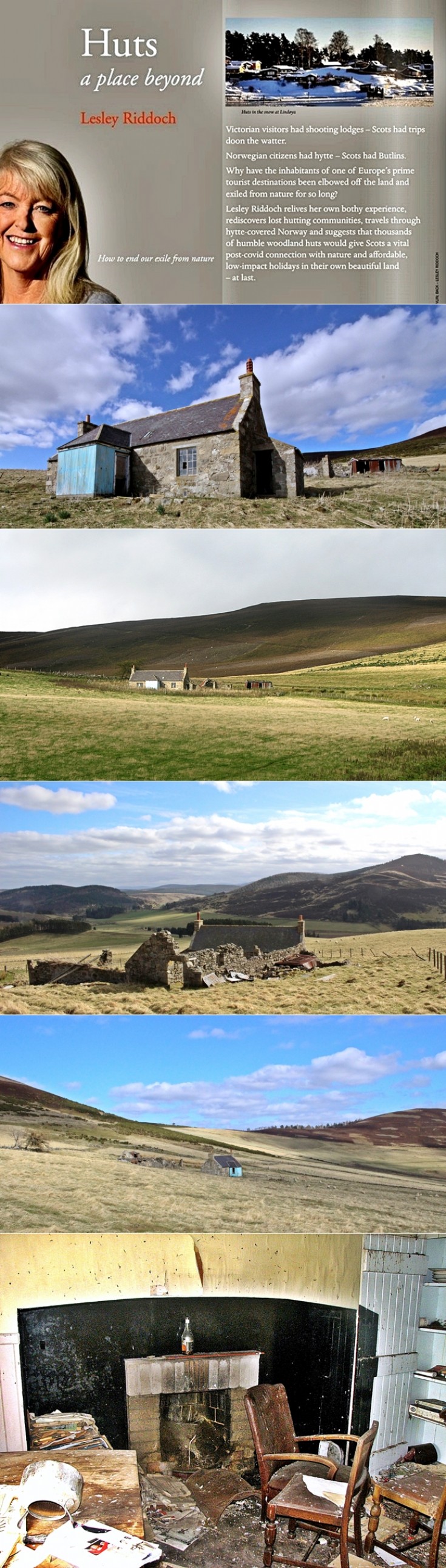
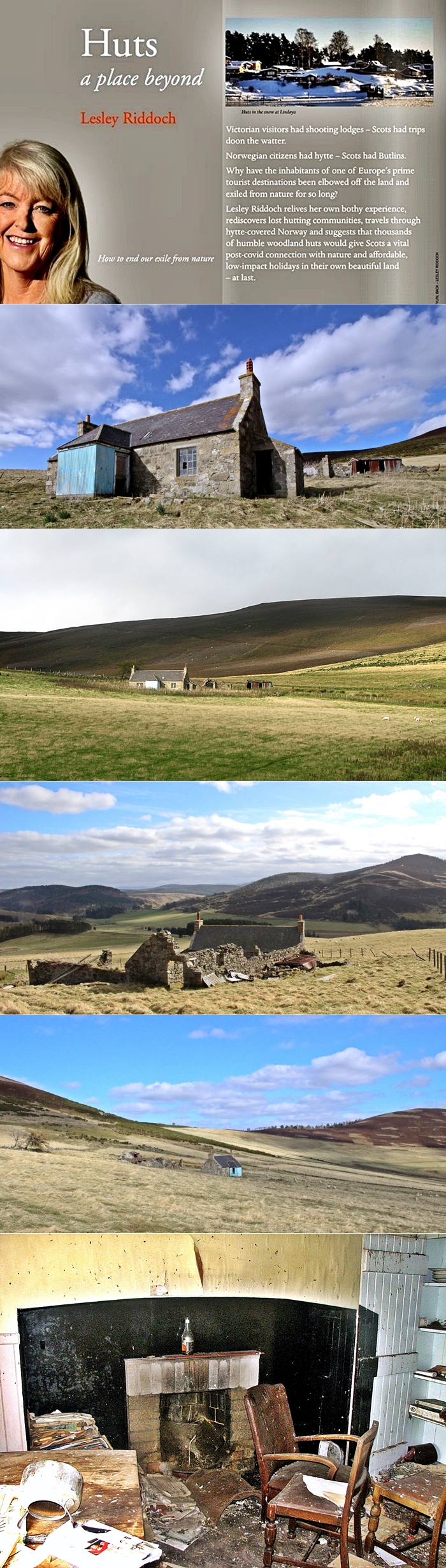
The Pictures above show:
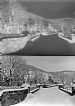
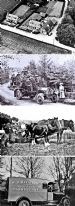
1 The front and back cover and of Lesley’s book
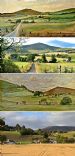
2 & 3 View looking north at Drumnagarrow with the hills behind.
4 View looking south from Drumnagarrow to Ben Newe on the right.
5 View looking west showing the isolation of the cottage.
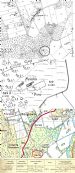
6. Interior of the cottage with the fireplace.
Thanks to Steve Cameron for some of the oictures.
Lesley Riddoch
Lesley Riddoch is an award-winning broadcaster, writer, journalist, independence campaigner and land reform activist. She writes weekly columns for The Scotsman and The National and is a contributor to The Guardian, BBC Question Time, Scotland Tonight and Any Questions.
She is founder and Director of Nordic Horizons, a policy group that brings Nordic experts to the Scottish Parliament and produces a popular weekly podcast. Lesley has presented You and Yours on BBC Radio 4, The Midnight Hour on BBC2 and The People’s Parliament and Powerhouse on Channel 4. She founded the Scottish feminist magazine Harpies and Quines, won two Sony awards for her daily Radio Scotland show and edited The Scotswoman – a 1995 edition of The Scotsman written by its female staff. She was a trustee of the Isle of Eigg Trust that pioneered the successful community buyout in 1997. She has presented and co-produced films about the Faroes, Iceland and Norway and during lockdown, presented Declaration, a film celebrating the 700th anniversary of the Declaration of Arbroath. Lesley was awarded a PhD in July 2020 and lives near the sea in north Fife.
She has related her experiences in her book called ‘Huts’ which describes isolated dwellings in remote places.
Huts published by Luath Press, The Royal Mile, Edinburgh EH1 2ND
Lesley Riddoch
Drumnagarrow
It’s luscious country. Green and deep. It’s Friday at 8pm in August. Wee smirrs of heat-haze hover just above the road that heads north from Perth to Glenshee, Braemar, Balmoral and beyond. This fabulous walking country is empty, as it always is, because this is Scotland. The tourists have reached their self- catering cottages and hotels. The lairds and entourages are in their shooting lodges. Anywhere else, a road through such majestic mountain scenery, would still be full of life on a beautiful summer’s evening. Hutters would be heading north after a week’s work — most quitting an hour early to get up the road in good time. Anglers would be on the move, making for huts along the salmon-filled Don and Dee. But as usual I was almost alone on that four-hour drive from Glasgow to my own rented hut, tucked between two hillocks in an obscure Aberdeenshire glen. Luck helped me stumble across it. Luck - and curiosity.
Back in the ‘80’s. working aa a radio reporter in BBC Scotland.in Glasgow, l was sent to work in Aberdeen for three months. l opted not to stay in Granite City (no offence) in the hope I could sample some craic in its rural hinterland instead. The only rentable house between Aberdeen and Inverness with an all-important landline in those pre-mobile days was Coldstriffen, located in Glen Buchat, 45 minutes west of Aberdeen. The owners of the nearby Kildrummy Castle Hotel had renovated the house, lived there for a while, but apparently got snowed in one had winter and concluded that living six miles from their business wasn’t wise. So, it was available to rent. The house itself was line, the drive into Aberdeen scenic but Glen Buchat was the real discovery. Unusually fertile, with lime deposits supporting fields up to 1,200 feet, the glen once supported dozens of farms and hundreds of people, till decline and depopulation kicked in.
The eastern entry to the glen is still a single-track road, passing just above Glenbuchat Castle, built in 1590 for a member of the Gordon clan to marl-t his wedding, but now a ruin. I generally approached from neighbouring Strathdon to the south, branching off the main road at the intriguingly named Castle of Newe (given that extra ‘e’ by its owner Sir Charles Forbes in the 1820s to stop post going to Newcastle-upon-Tyne). Another single-track road twisted up through dense, dark forests stashed with deer, owls, a wildcat (okay, a large, powerful-looking tabby, miles from a house), brambles and mushrooms in the autumn and a permanent air of mystery.
Emerging from the forest, the road continued to climb past Eastertown. No houses marked this old ‘ferm toun' when l first arrived, just a few collapsed ruins, corners of fields with clumps of rhubarb and other poignant markers of past use. After 16 years of summer picnics amidst the clearance ruins of Caithness, this landscape of eerie absence felt strangely familiar. The road led on through the pass known locally as the Deochry to the highest point of an elegant heathery shoulder, which stretched up to the graceful, conical dome of Ben Newe. Below, I could see the little church and graveyard of Glenbuchat, the cluster of houses tucked into the knobbly drumlin hills that partly block the glen and Coldstriffen itself, at the foot of the dark hill opposite.
This became my regular entrance to the Glen - a perverse 20-minute detour beyond the easier, castle-flanked route. And over three months, that oft repeated journey brought something else to my attention — sitting high above my temporary home, meeting my gaze at the same elevated height, a single, simple, two-windowed cottage without any visible track or signs of life.
Below, the Water of Buchat ran through the glen to meet the powerful, silent River Don, producing bright patches of yellow marsh flowers and verdant, sheltered nooks. Above, the sub-Munro foothills reached up into heather and moor land. But my mind was somewhere in between. Fascinated by this abandoned house.
After three months, I reluctantly returned to Glasgow. But that Hogmanay, l headed back with my obliging boyfriend, and hauled him up the hill to investigate. We set off from Coldstriffen in the snow to discover that the cottage is a lot easier to locate from the hill opposite than the road directly below. After 20 minutes erratic ascent, and stumbling in the falling darkness between clumps of woodland, we spotted it above the highest field of neeps.
The stone-built cottage sat sheltered between two low hills. It looked abandoned, but the slates on the roof were impressively intact. Perhaps that was what made me knock. To our astonishment, the old wooden door opened. Thinking fast - it was January 1st after all - l produced a half bottle, wished our mystery host a guid New Year and after some doorstep hilarity about the unlikely nature of this first-foot, we went inside and sat down. When my eyes adjusted to the darkened room, lit only by some candles and the open fire, Alan Campbell (a lecturer in Anthropology) explained the house was called Drumnagarrow - (arguably) in Gaelic ‘the little garden on the hill’ or the little ridge of the horses (Druim nan gearran). I remember the luxurious comfort of those ancient deep brown, leather armchairs. How relaxed the mood as we talked and drank whisky - yet also how daring. Here we, complete strangers, enjoying easy companionship atop a strange hill, in the pitch dark and freezing weather outside - talking earnestly about land reform, bathed-wire fences, hares and Scotland's future. It shouldn't have been happening. None of us should have been there.
But we were.
That was 1985.
A year later, l got a call from Alan. He’d just bought another cottage, 20 miles further east at Corgarff and the little bothy on the hill in Glenbuchat was empty. If I didn't rent it, Drumnagarrow would fall to pieces. A mission, a reason and a prospect of wee adventures. As a youngish broadcaster, there was no option but to live in Glasgow. But that didn't mean l had to stay there at weekends too. Maybe this would be the ideal compromise.
So, l headed north the next weekend to meet the owner Sandy McRobert, a tall, slightly stooping, flat-cap-wearing fairmer who spoke broad Doric and assessed me carefully.
‘Aye, mebbe we could dae wi your stock in the glen. ‘
Trying not to rise to the bait, l assured Sandy there was no way I'd be boosting the local population, but would appear at least once a month all-year-round. Clearly Sandy didn't believe me, hut wasn't all that interested. Not while l was standing beside an uncoupled-up, entirely normal Peugeot 2.05. liven though l couldn't supply the desired details about horse power or towing capacity, Sandy thought the car was a stoater, eminently capable of scaling the hill and a good sign. He'd nearly bought a Peugeot himself once, was put off by the French sounding name and had regretted it ever since. Of such strange coincidences are possibilities born.
We left The Special One in the farm yard and took a run up the hill in Sandy's battered old Land Rover, accompanied by three cowed looking collies. Drumnagarrow was in a pretty battered state too. Nothing more than an (occasional) trickle of water dripped from one tap in the corrugated-tin-clad kitchen, there was no toilet, no electricity, thus no fridge, lights or heating, and the gutter was hall-hanging off too. There was a deep, wide fireplace in the main room, with a bed room, containing a single lied with a very vintage mattress, a central empty room facing north which Felt damp and another south-facing room, which also felt unaccountably cold. Old carpets, those fabulous old leather armchairs, assorted pots, pans and cutlery, a wood-splitting axe, a small outhouse for a chemical loo and a semi-demolished shed overgrown with nettles completed the package. There was no proper track up to the cottage or creature comforts within. except for one surprisingly ornate dark wooden dresser, a small rectangular mirror cunningly held to a rickety wooden frame with a bit of twisted wire and above the fireplace in the main room, an unsettling large, framed photograph of a standing man and seated woman in classic. stiff Victorian pose.
Her slightly greying hair was tightly coiled. He looked out unsmiling, one proprietorial hand on her rounded shoulder. Their demeanour was hardly welcoming. .-and to cap it all, someone had popped her eyes with open, so her unseeing stare travelled everywhere.
‘Ye can aye tak it doon, ye ken - if she's upsetting ye‘.
Sandy’s words sounded sympathetic; hut his tone was scathing.
I realised the grim-looking couple would have to stay. They were part of Drumnagarrow’ s past — a reality I didn't understand. hut simply had to accept. Otherwise, I’d be forever on the hack foot, ‘editing' the place instead of living in it and placing doom-laden meanings on entirely innocent objects. After a few months, I’d likely he so familiar with the place, I’d not even see that picture.
‘I’ll take it.
‘Sandy seemed highly amused at the idea of a woman trying to lend for herself halfway up a hill. So, hack down at Milton, standing by the Peugeot. the deal was done. The rent was £365 - one pound for each day of the year. And there were no further rules. Or help.
And actually. that was the way I wanted it.
Without electricity, running water or a flushing toilet. the smallest everyday tasks become difficult. Satisfyingly difficult. Find a box of matches in the dark if you haven't put it back in its proper spot earlier. You cannae. leave a hox of matches there for two weeks assuming it won't get damp. You dinnae. Start a fire without dry kindling or firelighters. It's not easy. Try to cook food once the gas bottle has run out and the nearest supplier is an hour's drive away. Crisps again. Discover a sheep has died in the lean-to shed containing the chemical toilet. Recover, then break the habit of a lifetime and ask for help, only to discover no local farmer will acknowledge this as his dead sheep. Gritted teeth.
Try over and over again to use a Tilley lamp properly, but reliably fill the room with thick black smoke instead. Annoying. Then stumble across a roup (farm sale) with a box of 900 candles plus a manual typewriter thrown in for a tenner and no other bidders.
Deep joy.
Over time, I became rather chuffed at my general handiness (Tilley lamps notwithstanding). I could chop wood, though occasionally it was easier to heave a log indoors and keep pushing it into the fire over the course of a few days. Messy, hard to light, and doubtless a fire hazard - but satisfying all the same. Arriving one night to a flooded floor in the main room, l fixed the collapsed pointing in the hardest to reach upper section of the gable-end wall the next morning, only to discover the hard way how quickly cement sets. There were near constant problems of dampness, partly explained by the discovery of rocks, pebbles and concrete poured down the chimney of the less-used south-facing room. Sandy professed he had no knowledge of how this happened but speculated it might have been ‘tae keep the birds oot'.
A few days later, Angus from neighbouring Strathdon turned up to unblock the chimney, sent by Sandy. Unhooking a ladder from the top of his car, he nipped up onto the roof for a look.
I could hear the long, whistling intake of breath from down below.
‘It’s nae good, ye ken. Someone's ta'en a puckle o‘ stanes and chucked them doon wi cement.‘
This much I already knew.
‘Hae ye hae onything l can yaise tae bash it oot, like?‘
A woman without a ladder was hardly likely to have a battering ram. But after a quick, gloved guddle amongst the nettles that swamped the derelict outhouse, Angus came back with a long iron post he’d twisted off a disintegrating bedstead. He climbed back onto the low roof, complimenting the perfect state of the slates, and sat down carefully with a stabilising leg on each side before lifting; the iron post and stabbing it down into the chimney-pot, over and over again. I could hardly watch.
Ten minutes of precarious, high-energy pounding later, nothing had moved.
‘Angus, it doesn't really matter. I hardly use this room anyway.' ‘
That’s because it's damp, quine. It'll a’ start tae move soon. ‘It didn ‘t.
‘Would you like to stop for a cup of tea, Angus? ‘He wouldn't.
Hell may have no fury like a woman scorned. It also has no obsession like a man performing an impossible act of DIY. Angus was now hent over the chimney, his sandy hair blown in .1 wispy hoop over his head.
‘Looks like a hit of rain!’
‘Och that'll come tae nothing.
Clearly, Angus wouldn't stop till the stones were dislodged, the pole was broken or he was knackered. So, l left him to it.
An hour later, a massive crash signalled success. Of a kind. The hearth in the spare room lay almost demolished by rocks which had cascaded suddenly from on high, followed by the pole which had been sharpened into a veritable javelin by hours of grinding.
Leaving me to haul the heavy, jagged lumps outside over the next few days, Angus dusted himself down, reloaded the ladder on top of his car and absolutely refused any kind of payment for his help.
‘l was just being neighbourly, ken.’
Still, neighbourliness should not have to be its own reward. l realised the right thing to do was find out what Angus liked to drink at the local shop, buy large amounts and leave it on his doorstep. 1 also soon discovered that a truly impossible-to-dislodge blockage remained in the chimney, along with a spear- sized hole in the outer chimney wall, which meant the fire and thus the room were still unusable.
I closed the door to consider my next move and opened it two years later. Only to find that a bird had indeed got in and made a nest in the corner of the room.
l shut the door again and pondered the possibility that Sandy might actually be psychic.
So, with dampness now a fairly permanent problem, pillows and duvets had to be hauled up and down with each visit, often meaning several repeat journeys by foot. Without running water, hygiene was confined to enlivening cold washes.
I'll be honest. The only time my former husband Chris had second thoughts about the wisdom of getting hitched was climbing the hill to behold life in the bothy.
But to me any difficulties were minor, temporary and liberating. The men in my life have always been confident about practical tasks, competent with tools and fond of solving practical problems. So, in the ‘proper’ world I was generally stopped from having a go. Even though trying, making mistakes and having a go to tackle things your own way is a delicious experience and an essential part of building confidence in your own capabilities. So at the hut, l ‘fixed’ things my own way, cobbled together solutions, held my ground, and eventually knew that ground fairly well. l gave myself permission to make a total mess of tasks I’m sure the average power tool-wielding man would have found straightforward. And loved it.
This weekend life of small unpredictable adventures was precious beyond measure after working weeks full of constraint, convention and convenience, not to mention fairly unbending ‘80s gender stereotypes.
Nothing compared to the delight of arriving at the dead of night and waking up amidst the hills, buzzards, stoats, pheasants and mountains hares - way above the farms, tractors, fields, moors and houses of Donside. l loved the freedom to walk up to the strange tor-like extrusion known locally as the garnet stone - or up to the old pines, where capercaillie often skimmed the heather like low-flying turkeys.
From the house, l could see all the way south to Mount Keen in Deeside and sit outside for hours happed up in blankets watching the Northern Lights. I went to dances at Glenbuchat Hall, piping at the Lonach (James, enjoyed the craic at the Kildrummy Arms and got supplies of freshly laid eggs from the local shop.
l also learned about the house itself.
It seems Drumnagarrow was once the home of James Strachan, who was born two years before Culloden. That overwhelming defeat saw the glen’s ownership transferred from Jacobite John Gordon to the Hanoverian supporting Earl of Fife. Strachan's son, also James, was born in I783 and became a well-known fiddler held in high esteem by his famous Deeside contemporary, Scott Skinner whose composition the ‘Fisher ‘s Rant ‘was named ‘Drumnagarry' in Strachan ‘s honour.
James lived at Drumnagarrow for 40 years until 1821. His daughter Mary married William Hardie, a descendant of another fiddling master Peter Hardie of Dunkeld, himself a pupil of the famous Neil Gow. William and Mary had a family of I5 and their own son James became one of Scotland's most famous violin makers. In 1851, nine of them lived at Drumnagarrow, in 1918, there were just two occupants and the last recorded resident left in 1960. Reconstruction of estate houses, cottages and steadings just before World War One meant my bothy was probably a different building to the one occupied by the Strachan and Hardie clans — though in the same patch. But I was intrigued to think such a strong musical gene bad run through the place for more than a century.
That long reach of family tradition was a feature of my own childhood through long summer visits to Wick, where our arrival from Belfast would prompt the distribution of Callard & Bowser toffees by my grandfather, Magnus More (extracted from white quarter pound bags stashed round the front room) before the womenfolk pulled in for tea and lengthy, painstaking tributes to the Wickers who'd died since our last visit.
‘Och, ye mind, Helen, at chap, e mannie Farquhar, he lived up by Houstons. Ye do mind. He wiz ages with oor Kathlyn.' And so, it would go on until sortie particular detail finally prompted a memory. ‘Aye. l do mind mither. He was related to Wheecha,’ the local nickname for an auld man who struggled with cancer. 'They don't mince words in Wick. But they do go on. As one sadly demised Wicker was conversationally laid to rest, the women would move relentlessly on to the next nearly forgotten soul, aided by more tea and local newspaper cuttings stored between pages of Nana's bible. If we were lucky, my brother Graeme and l would escape to the Old Man's Rest above Wick harbour with Granda More to watch the third or fourth Boy Andrew pull into port, under the watchful, assessing gaze of men who’d fished on the original or maybe the second boat of the same name. An occasional summer highlight was the Halkirk Highland Games where sons of previous champions dominated the heavyweight events, children of well-known piping families carried on their parent ‘winning ways and every prize list began with a local Caithness name.
Family was a form of currency in Wick and l rather admired its non-negotiable reach, even though my own life was lived very differently. Mum ventured far beyond Wick by marrying a Banff shire lad and would-be poet turned RAF pilot and then insurance manager in the sobering wake of World War Two. They moved first to Wolverhampton, then Belfast and finally Glasgow which meant a life of mobility, ever-changing local accents and persistent outsider status for all of us. So, the thought of that family of 15, produced by the awesome Mary Strachan, was a kind of anchor. A borrowed anchor, a substitute anchor even, but a connection to a particular place that felt worth honouring.
Knowing all of this, and presuming that the grim-faced pair in the portrait were also part of Drumnagarrow’ s long, living tradition, it seemed important to keep the frame on the wall and the house intact.
But it wasn't plain sailing. During the first tentative year of rental, some events were profoundly unsettling. One spring after-noon l arrived after a winter's visiting gap, and immediately made the fire. I started the usual process of unpacking pillows, duvet covers, sheets and towels and heard a bang outside like the sound of a car backfiring. Except 1,200 feet up Little Firbriggs hill, that was hardly likely. I went outside to investigate - saw nothing - and came back to find myself standing on a dead mouse which certainly hadn't been there before. l scooped it up, chucked it out, washed my hands in the freezing water of the cattle trough and went back inside to make up the bed in the box room. Shaking out the duvet, the remains of a rabbit fell out. Clearly it had been there awhile and something had eaten all the flesh, leaving just fur and bones. Trawling my limited knowledge of cat and stoat behaviour (this was the era before the internet and mobile phones), I was still taking nature's little mysteries in my stride when there was a deafening crash from the main room. That picture complete with the unsmiling Victorian couple, heavy wooden frame and glass had smashed down onto the stone hearth. Seconds later the room was full of flies.
That was it. All the shrugged-off mysteries of the previous year rushed back into my mind. All the sensible explanations of strange moments suddenly collapsed. Clearly, the place was haunted and I was going to die. Heart pumping, mind racing, breath panting, my only thought was to get out.
With every step across the fields towards the car I could feel the approach of the mad axeman. Of course. He'd been living in the bothy for years and was suddenly homeless because I'd come along. Now he was hounding me out with a flurry of small, hard-to-explain incidents which had finally produced the desired vortex of sheer terror and immunity to rational thought.
Exactly where was the mad axeman staying now, out here on the cold hill? How could he have contrived to insert a mouse under my foot? Where had the flies come from? Why was I now looking under all the seats in the car?
It didn't matter. I was completely spooked and went off to stay with a friend in neighbouring Deeside.
After that, I found it hard to stay alone overnight at Drumnagarrow. But hit by bit I pieced together a possible explanation. The cord on the picture frame had been ripe and only needed the first real heat of the year from the fire to give way. House flies spend winter in a hibernation-like state, hidden away in cracks and crevices (like the back of picture frames). When temperatures climb in spring, they're ready to move - and the sudden crash of the picture woke them up with a bang. It took longer to figure out the rabbit and mouse - but the explanation soon presented itself in the shape of a stoat, scampering from the house, still partly clad in its white winter fur. Stoats like to coorie into beds, duvets and bring their meals with them. I had simply disturbed this chap en-route to the bed we evidently shared. A forensic exanimation of the wood-panelled interior revealed no obvious entry points, but a look outside showed several scrapped-out holes. Once these were blocked with stones, the animal appearances stopped.
Slowly, slowly, the panic subsided. Completely.
A couple of years later, after patiently connecting each strange sound, disturbance and half-chewed deposit back to its inevitable animal source, the paralysing fear had evaporated. By then, if the mad axeman had appeared, I would not have moved a muscle.
After years of the townie's over-reaction to every non-existent threat, I had gone to the other extreme - generally unrufflable and very calm in natural surroundings.
I didn't find the reason for every strange occurrence at the hut, but I stopped needing to. It would be just another quirk of nature that I might eventually understand. But it wouldn't be a problem.
One night, after four years as an occasional occupant of Drumnagarrow, I was sitting outside, reading in the twilight and heard something move through the tangle of nettles, grass and tansy towards me. I Finished the page I was reading, set the book down and quietly turned to look into the face of a small roe deer. We surveyed one another. There was no threat coming from me and no panic coming from her. After a few minutes, the deer strolled off. It was a perfect moment.
And there were lots of them.
Life at the bothy made me feel like Heidi, who opened her front door every week of my formative childhood years to reveal villages, houses, civilisation, responsibility and the demanding world of people all safely distant. down below. Heidi lived above and beyond. In this ramshackle bothy, so did I. Though I imagine our hill-top lives had very little else in common.
I'd guess the delicately plaited Swiss lass never took all her furniture outside and leaned it carefully again the gable wall to cement that large javelin-shaped hole in the chimney. I don’t suppose she stumbled slightly upon descent causing a cascade of old wooden furniture, a bruised arm and (looking on the bright side) a plentiful supply of firewood. I don't imagine thereafter she looked fondly at the radio/cassette player damaged in the fall - which henceforth operated only as a radio - and smiled each time she remembered the gloriously eccentric reason for its limited functionality.
I'm guessing Heidi didn't spend five hours carefully unpicking (and then rebuilding) a dry stane dyke when her valiant Peugeot came to rest there, after failing to thrash its way up the snow- laden track one winter's day. And I don't imagine Heidi eventually dragged that poor, unloved, unclaimed dead sheep on an old plastic bag to the back of her stone bothy, setting fire to it with a sprinkling of paraffin, because the winter ground was too hard for a burial. Discovering the paraffin did no more than blacken the fleece, I'm almost certain she did not then build a proper fire on the singed, sheepy mass and watch it burn all night, taking care to sit upwind of the terrible smell. I'll wager she did not thereafter have a large black shadow on her back wall. l don’t suppose Heidi relished being free to try daft things, make mistakes, chop. build, bum, play, morn, cook, imagine, eat or drink what she wanted. l imagine Heidi got sensibly married and in the fullness of time had her plaits cut.
I know that neither she, nor any other sensible human being, would enjoy the perverse pleasures of weekends without creature comforts.
‘So, would you like us to just drive up the hill - as far as we can go in the snow and see the Sami huts right at the top? ‘
No words can express the delight of being completely understood by a flame-haired, young Nordic stranger.
 View Large Version
Picture added on 04 July 2022 at 14:17
This picture is in the following groups
places
places
places