The Glenbuchat Image Library
No: 906 Contributor: No Contributor Year: 2013
115 Old Glenbucket and Warlds End Fraserburgh


A request form a Canadian correspondent on the web site led to research that brought to light John Gordon’s (Old Glenbucket) house in Fraserburgh.
The request was as follows:
On my GG grandmother Margaret (Murdoch) Simpson's death record it shows her death at Glenbuchat cottage in 1907. She died of TB. I would like to know if this was a Sanatorium for tuberculosis patients. Her home was Sinclair Hills near Fraserburgh and I would like to know why she was so far from her home.
Any information would be appreciated.
On researching the Murdochs in Glenbuchat I could find no connection with the lady in question. To my surprise, however, I did find a Glenbuchat link to Fraserburgh in the presence of a house there owned by Old Glenbucket himself.
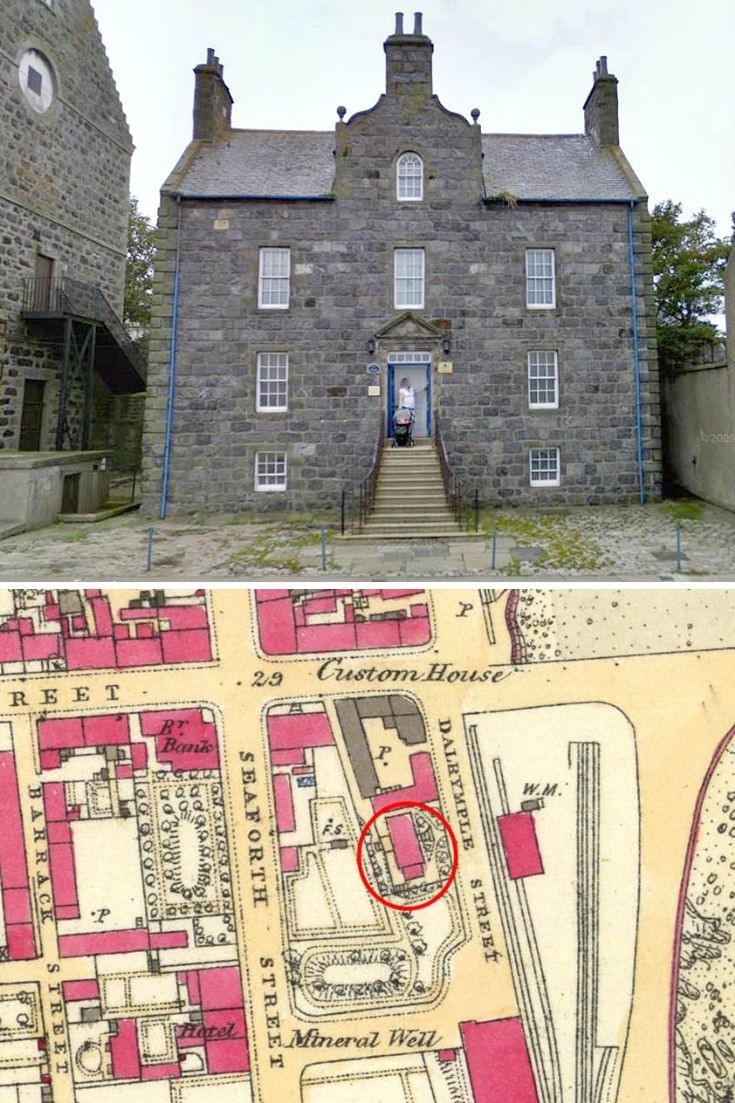
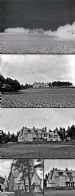
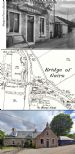
The house is a called now ‘Warlds End’ House and above is a photo from Google Street View and an 1850’s map. While I could find no mention of a Fraserburgh sanatorium, the Glenbuchat Cottage mentioned may be the cottage at the rear of the House in the extensive garden.
More details are available in a Leopard Magazine article
Elegant town house
That Fraserburgh became a notable town – more than the average burgh of barony – can be seen in the elegant town house of the Gordons of Glenbuchat down on the Shore, now known as Warld’s End. The house is now in 1767 garb, but there is evidently an older structure within.
And that leads directly into the entirely unexpected saga of Fraserburgh as a garrison town. The North-East being staunchly Jacobite, it was dealt with harshly after 1745. Fraserburgh had manned gates, and a garrison built against the southern edge of the town, probably in the grounds of Warld’s End. The garrison commander probably occupied the house itself. There are buildings and reused bits of buildings on the high platform (parade ground?) immediately behind the house which might be relics of this period.
The house is a listed building and details are available from The British Listed Buildings Web Site.
The World's End 11 Dalrymple Street, Fraserburgh
Location: S Harbour Road, Fraserburgh, Aberdeenshire AB43 9DN
Listing Text
Circa 1767(') 2-storey and basement 3-window squared heathen stone with freestone dressings; quoins, shaped wallhead gable with arched window and ball finials, stairs to pedimented door-piece obscured by wooden porch, moulded eaves course and chimney copes. Poor condition.
References:
Cranna, Fraserburgh Past and Present p.382
Pratt Buchan p.175
Notes:
Belonged to the Gordons of Glenbuchat. Lord Pitsligo hid here after Culloden. Sold to Charles Gordon 1766. One of the best houses of its date in Aberdeenshire
If anyone knows any more information about the house or sanatoriums in Fraserburgh please let us know.
Various newspapers and publications refer to ‘Warld’s End’
Fraserburgh: Past and Present,
By John Cranna 1917
Harbour Treasurer
One of the most interesting houses in Fraserburgh, and one with a history, is “The Warld’s End.” Pratt, in a footnote in “Buchan,” says: “There is a tradition that in remote times a Castle, called ‘Glenbucket’ stood on the site now occupied by the house known as ‘The Warld’s End,’ but, as far as can be learned, there is no existing record of it, either printed or written.” Probably Dr Pratt was right in saying that there was no evidence to prove that a castle called Glenbucket once stood on the site of “The Warld’s End,” but the worthy doctor was evidently unaware that “The Warld’s End,” or probably an older mansion, which occupied the same site, belonged to the Gordons of Glenbucket up to 1746, and was occupied by that family, in the olden days as a town’s house, probably during the bathing season. There is ample documentary evidence to prove this, which makes “The Warld’s End” property, with its historical connections, still more precious in the eyes of Fraserburgh people. The information to be given now is entirely new to them.
The laird of Glenbucket, and the owner of “The Warld’s End,” in the beginning of the eighteenth century, was John Gordon, a man of a fiery disposition, a born fighter, and a staunch supporter of any cause he espoused. In view of his close connection with Fraserburgh, a brief reference to Glenbucket as a man may not prove unacceptable to “Broch” readers. A notice of him in Billings’ “The Baronial and Ecclesiastical Antiquities of Scotland” sums the man’s character up in a few sentences. It is as follows: “The Laird of Glenbucket was a feudatory of the Earl of Mar, and his rude fortalice very near the centre of the Earl’s domains. It would depend entirely on the turn taken by intrigues in London, about which the Laird of Glenbucket knew no more than he did of the politics of the Court of Cathay, whether he should be called out to fight for King George or King James. The latter was decided on, and the sturdy laird, having once taken his position, stuck to it. He was present, at the head of the Gordons, in the victorious part of the Jacobite army at the battle of Falkirk, and was all along conspicuous among the Highland leaders in that war. He kept his Jacobite feelings warm for thirty years, and heartily joined the standard of the Prince, unborn in his days of military leadership, who made the descent on Scotland in 1745. He was one of the few men of mark who escaped the vengeance of the successful party on both occasions, escaping to France in 1746. Not having been among those who had to feed the popular appetite for vengeance, and deliver a dying declaration on the scaffold, he has no place among the Jacobite biographies; but his name was so formidable, that, according to tradition, George II. used to start from disturbed dreams, in efforts to pronounce the name of Glenbucket, accompanied by exclamations of terror.”
The last part of the notice gives an awesome turn to the picture, and though King George’s disturbed dreams need not be accepted as Gospel, it may be mentioned that the blood-curdling tale is one truly Scotch, which occurs time and again in connection with the wind-up of historical or traditional stories of the North Country.
For his part in the rebellion all Glenbucket’s property, including “The Warld’s End,” was forfeited to the Crown. “The Barons of His Majesty’s Court of Exchequer in Scotland,” exposed, as an attainted property, “The Warld’s End” for sale by public roup at the Cross of Edinburgh, on the 2nd day of July, 1766. It was purchased by a Charles Gordon, Writer to the Signet, for the sum of £38 1s. 1⅓d. A copy of the disposition by the Barons of Exchequer, in favour of Charles Gordon, the purchaser, dated 15th August, 1766, is in the possession of Provost Finlayson, so that these facts are above suspicion “The Warld’s End” property in those days comprised not only the ground conveyed by the late Captain Dalrymple to the railway company and now comprised within their boundaries, but the whole of the area, mostly built upon, lying to the south of Commerce Street and bounded by Dalrymple Street, Seaforth Street, and the road leading from Seaforth Street to the Railway Station. Of course, this road and Dalrymple Street formed part of the property at one time. And all this ground went for £38 1s. 1⅓d. in 1766! Such a transaction was a libel on the importance of Fraserburgh! In addition to “the house at the head of the town,” it was the current belief in Fraserburgh fifty years ago that “The Warld’s End” was also a hiding-place of Lord Pitsligo for some time after Culloden.
Before the harbour improvements of last century changed the face of the foreshores from the root of the South Pier southwards, the sea came up quite near to where Dalrymple Street now is; and old natives, in delighting to tell of the changes that had taken place on the town, were wont to relate how, after a violent easterly gale, they had seen great heaps of seaware left on the road quite near the front gate of “The Warld’s End.” The name of the house is rather unique, and why it should have been so designated has puzzled many. The explanation is probably this: The town at the time the house was built was all located about the Braeheads and the northern part of Shore Street, with branches running towards High Street and College Bounds. The new house, so far separated from the town proper, at a time when distances were viewed differently from what they are to-day, would have appeared practical
Aberdeen Press and Journal - Tuesday 31 July 1945
"THE WARLD'S END": LINK WITH '45
THE Warld's End " House, situated quite near Fraserburgh railway station, is of interest in these days, on the eve of the 200th anniversary of the '45. It was the property of a robust Jacobite and, writes a correspondent, because it was believed to have been a hiding place of Lord Pitsligo, it must find its place in any record of the time.
" The War Id's End" is of two storeys, stone-built, with stone stairway leading to the upper fiat. Before harbour improvements of last century changed the face of' the foreshore, the sea came up quite near to its entrance. The first bomb dropped on the town in 1941 seriously damaged the building which was recently purchased by the Town Council from Dalrymple Hall and Cafe Co., Ltd. Born Fighter
The owner of "The Warld's End" was John Gordon, the laird Glenbucket. Strathdon, whose family occupied it during the bathing season. Gordon was a man a fiery disposition, a born fighter, and a staunch supporter of any cause he espoused. He was out in the "Fifteen," and it is said that he was the man who went to Italy and induced the Pretender to come over and endeavour to set the Stuarts back on the throne. Glenbucket was present and at the head of the Gordons in the victorious part of the Jacobite army at the Battle of Falkirk, and was all along conspicuous among the Highland leaders in that war. He was one of the few men of mark who escaped to France in 1746. It is said that his name was so formidable that George 11. used to start from his disturbed dreams in efforts to pronounce the name of Glenbucket, accompanied by exclamations of terror!
Property Forfeited
For his part the rebellion all Glenbucket's property, including "The Warld's End," was forfeited to the Crown. The latter was exposed for sale by public roup at the Cross of Edinburgh on July 2, 1766. and was purchased by a Charles Gordon, writer to the signet, for the sum of £38/1/11d. A copy the disposition in his favour was formerly in the possession of the late Provost Finlayson. Fraserburgh. And it should be noted that The Warld's End" property in those days comprised a large area of around now occupied by part of Commerce Street Dalrymple Street and Seaforth Street. Attainted property seemed to be going cheaply! After the '45 a detachment of soldiers was stationed at Fraserburgh, quarters in Commerce Street, still known as the Barrack I Square.
Aberdeen Press and Journal - Thursday 25 October 1928
GORDON OF GLENBUCKET.
Fraserburgh Link with Famous Jacobite. Delivering the opening lecture at the Fraserburgh West Parish Church Literary Society, the Rev. J. H. Williams chose as his subject, John Gordon of Glenbucket," whom described as one of the most famous of all Jacobites, and but for whom the Jacobite Rising of 1745 would not have taken place at all. John Gordon, said Mr Williams, was born at the farm of Noth, near Rhynie, in 1676. He was for the most of his life factor to the Duke of Gordon, and always in the summer-time he went to Fraserburgh where he had a seaside house, which stood near the railway station. The Warld's End was built by John Gordon.
He Recruits for Prince Charlie.
Glenbucket concerned in every attempt restore the exiled family, from Killiecrankie to Culloden. He was only twelve when he followed his father to the Jacobite camp. The supreme event of his life—and one which > certainly made history—occurred in 1737, when he sold his castle and estate, and with the money went journey to Rome, and thus was responsible for the plan of the attempt to set Charles on the throne. When the Pretender landed at Kinloch Moidart, Glenbucket presented his chief with the first prisoners of the war. Appointed major-general, he was indefatigable recruiting efforts in Aberdeenshire and Banffshire, which supplied the Prince with a quarter of his army. The remaining three-fourths were French, English, Lowland men and Highlanders. Fraserburgh, Peterhead, and the north part of Aberdeenshire was very strongly Jacobite.
After Culloden. He was of the party that wanted to continue fighting after Culloden. He was tried and sentenced to death, but the job was to get hold of him. Escaping on a small Swedish sloop 'near Fraserburgh, he went to Boulogne, where he spent his few remaining years. He treated with kindness and attention by the French court, and he received £2000 a year, marshal's pay. died in 1750.
He was married Jean, elder daughter of Harry Forbes of Boyndlie, near Fraserburgh, by whom he had a large family, and the blood of old Glenbucket was in the veins of some of the once Royal Houses of Europe. The Chairman, Mr George M' William, in proposing a hearty vote of thanks to the lecturer, stated that after the Warld's End House was confiscated and. with the around on which it stood, was sold.
Appropriate Jacobite songs were given on the gramophone illustrate the address, which was enjoyed large audience.
Fraserburgh Herald and Northern Counties' Advertiser - Tuesday 07 August 1945
Property Forfeited
For his part in the rebellion all Glenbucket's property, including the 'Warld's End,' was forfeited to the Crown. The latter was exposed for sale by public roup at the Cross of Edinburgh on 2nd July, 1766, and was purchased by a Charles Gordon. writer to the signet, for £38 1s l1d. A copy of the disposition in his favour was formerly in the possession of the late Provost Finlayson, Fraserburgh. And it should be noted that "The Warld's End" property in those days comprised a large area of ground now occupied by part of Commerce Street. Dalrymple Street and Seaforth Street. Attainted property seemed to be going cheaply! After the '45 a detachment of soldiers was stationed at Fraserburgh, in quarters in Commerce Street, still known as the Barrack Yard.
Picture added on 24 March 2013 at 21:49
This picture is in the following groups
buildings
buildings
There is a Warlds End public house at the bottem of the High Sreet on Edinburghs Royal Mile. A plaque on the wall states that in the 16th century Edinburgh was a walled city and the pub stood at one of its gates.
'As far as the people of Edinburgh were concerened, beyond these gates was no longer their world hence the name The Warlds End'
In Fraserburgh, at Warlds End, an older structure, before the present house of c.1767 stood and may have been a castle or defensive structure, beyond which the Broch townsfolk were outwith the protection of the town.
'As far as the people of Edinburgh were concerened, beyond these gates was no longer their world hence the name The Warlds End'
In Fraserburgh, at Warlds End, an older structure, before the present house of c.1767 stood and may have been a castle or defensive structure, beyond which the Broch townsfolk were outwith the protection of the town.
Added by Ken Cruickshank on 02 April 2013
I know someone who was born there,still very much with us, alive and kicking. E-mail me any query and I will forward to person concerned. Blue plaque on the wall names Thomas Blake Glover,the Scottish Samurai involved in the making of the Mitsubishi Corporation having stayed at the "Warlds End"
Added by Gordon Wackett on 05 June 2013
Valuation Roll 1891-2 lists Fraserburgh
Entry 616 "Warlds End" proprietor The Dalrymple Hall and Cafe Company, Limited. per John Findlayson,secretary,Fraserburgh with tenants John and Thomas Park,shipowners and the occupier being George Windslow, oil manufacturer.The same applied to entry 617,Office,"Warlds End" except the occupier was John and Thomas Park.1918-9 Valuation Roll lists item 2020 same owners as 1891 but building vacant,item 2021 House "Warlds End" occupied by Miss Macallan and item 2022 The Dalrymple Cafe, hall,recreation and other rooms all listed under the umbrella of "Warlds End" John Findlaysons address by this time was listed as 13 Frithside Street,Fraserburgh.
Entry 616 "Warlds End" proprietor The Dalrymple Hall and Cafe Company, Limited. per John Findlayson,secretary,Fraserburgh with tenants John and Thomas Park,shipowners and the occupier being George Windslow, oil manufacturer.The same applied to entry 617,Office,"Warlds End" except the occupier was John and Thomas Park.1918-9 Valuation Roll lists item 2020 same owners as 1891 but building vacant,item 2021 House "Warlds End" occupied by Miss Macallan and item 2022 The Dalrymple Cafe, hall,recreation and other rooms all listed under the umbrella of "Warlds End" John Findlaysons address by this time was listed as 13 Frithside Street,Fraserburgh.
Added by Gordon Wackett on 10 June 2013
My 6 x great grandmother - Barbara Dalrymple is listed by our family as having been born in this house in 1800. Daughter of Jas. (John or James?) Dalrymple. Can anyone confirm they lived there?
Added by Annabelle Kinkead -Weekes on 04 January 2014
Barbara Dalrymple was also my grt grt grt Grandmother, 7th & youngest daughter of James Dalrymple, merchant, & his wife Jane Gamack. Born at 'World's End' in 1800. She married Dr. Alexander Thomson of Aberdeen and they and their only child, Jane, emigrated to Tasmania, later Port Phillip (Melbourne) in about 1833. Would much appreciate any information about the history of the house.
Added by Lisa Stephens on 02 May 2014
I believe my fathers family became owners of the 'Warlds End' at some point before the council bought it.
Apparently my dad's great Aunt Maggie-Ann's people were the owners.
I never met her, but she had passed on a story she herself was told as a child, that Charles Edward Stewart had been a guest there during the Jacobite rebellion. I notice today the local museum seems to agree.
Apparently my dad's great Aunt Maggie-Ann's people were the owners.
I never met her, but she had passed on a story she herself was told as a child, that Charles Edward Stewart had been a guest there during the Jacobite rebellion. I notice today the local museum seems to agree.
Added by Brian S on 03 February 2015
I am researching (and have published material on) Barbara (nee Dalrymple) and Dr Alexander Thomson as they and small daughter Jane were amongst the first handful of people camped in 1836 on the site which would become Melbourne Victoria. Does anyone know more about Barbara's family and the link to Dalrymple Street.
Added by Anne Marsden on 03 July 2016
Yes, this Barbara (nee Dalrymple) and her husband, Dr. Alexander Thomson (founder of the City of Geelong in Victoria, Australia)are the same individuals mentioned above in 2014 by my 2nd cousin Annabelle Kinkead-Weekes and myself. We have quite a bit of information about these ancestors, so could you get in touch with me at ? We would be interested in your research (we live in Australia). I believe the site of the Thomson's camp in March, 1836 was the present site of St. Paul's Cathedral. There was apparently a large gum tree there, under which Dr. Thomson took Sunday Presbyterian services, as a catechist.
Added by Lisa Stephens on 22 November 2020
buildings


Fraserburgh, Aberdeen and Banff (e.g. the Grants of Castle Grant on Speyside)were favourite coastal towns.
After the defeat at Culloden in April 1746, Gordon of Glenbuchat,hunted by the government forces and with £1000 on his head, eventually made his way to the Buchan Coast (which he probably knew well with the Warlds End connection and could rely on help.) He escaped on a ship to Norway on November 27th 1746.
His wife and family were left destitute and the Warlds End, along with his other properties (not Glenbuchat Estate which had been sold to the government supporting Lord Braco befoere the '45)were forfieted to the Crown. It was sold by public roup on the 2nd July 1766 at Edinburgh Cross, and bought for £38/1/1 1/3. by a Charles Gordon. Along with the house went a large area of ground covered by Commerce, Dalyrymple, and Seaforth streets today.
The P&J of July 1945 states:-
Before the harbour improvements of the last century (19th) changed the face of the fore shore, the sea came up quite near to its entrence.
The first bomb dropped on the town in 1941 seriously damaged the building, which was recently purchased by the Town Council from Dalyrample Hall & Cafe Co. Ltd.