The Glenbuchat Image Library
No: 647 Contributor: No Contributor Year: 1600
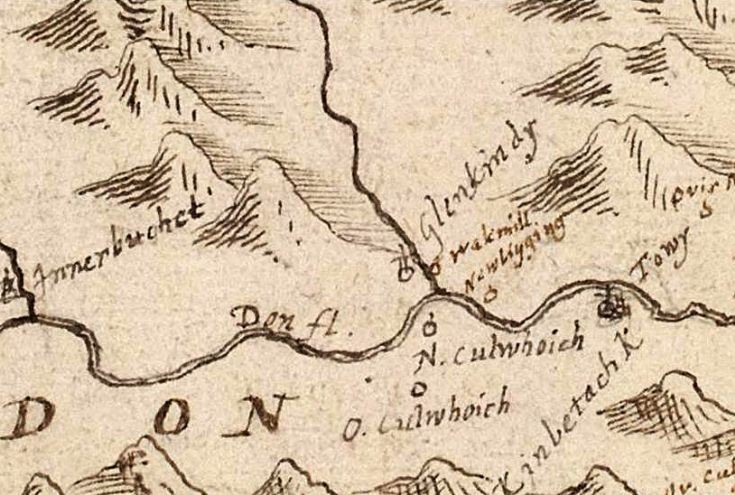
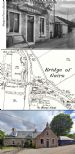
74 Site of WaulkMill at Glenkindy


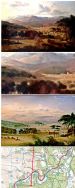
1580 Map of Robert Gordon
Gordon, Robert, 1580-1661
Gordon, James, 1615?-1686
The Waulkmill (Wakmill) must have been convertedfrom a woollen mill to a meal mill by the 18th Century
Note details about Glenbuchat Woollen Mill
WALK-MILL, n. Wauk-mill. A fulling mill.
Fulling or tucking or walking ("waulking" in Scotland) is a step in woollen clothmaking which involves the cleansing of cloth (particularly wool) to eliminate oils, dirt, and other impurities, and making it thicker. The worker who does the job is a fuller, tucker, or walker.[1] The Welsh word for a fulling mill is pandy. This is used in several place-names.
Fulling involves two processes—scouring and milling (thickening). These are followed by stretching the cloth on great frames known as tenters and held onto those frames by tenterhooks. It is from this process that we derive the phrase being on tenterhooks as meaning to be held in suspense. The area where the tenters were erected was known as a tenterground.
Originally, this was literally pounding the cloth with the fuller's feet (whence the description of them as 'walkers'), or hands, or a club. From the medieval period, however, it often was carried out in a water mill.
Fulling mills
From the medieval period, the fulling of cloth often was undertaken in a water mill, known as a fulling mill, a walk mill, or a tuck mill. In Wales, a fulling mill is called a pandy. In these, the cloth was beaten with wooden hammers, known as fulling stocks. Fulling stocks were of two kinds, falling stocks (operating vertically) that were used only for scouring, and driving or hanging stocks. In both cases the machinery was operated by cams on the shaft of a waterwheel or on a tappet wheel, which lifted the hammer.
Driving stocks were pivotted so that the 'foot' (the head of the hammer) struck the cloth almost horizontally. The stock had a tub holding the liquor and cloth. This was somewhat rounded on the side away from the hammer, so that the cloth gradually turned, ensuring that all parts of it were milled evenly. However, the cloth was taken out about every two hours to undo plaits and wrinkles. The 'foot' was approximately triangular in shape, with notches to assist the turning of the cloth.
Details of the Mill at Glenkindie.
Mill of Glenkindie
Site Type WATERMILL
County ABERDEENSHIRE
Parish TOWIE
Council ABERDEENSHIRE
NGR NJ 42876 14495
Latitude, Longitude 57.217623N, 2.947503W
Mill of Glenkindie, from 18th century. Rubble, with a brick-built kiln and a large overshot wheel with segmental gearing which drove the millstones and adjoining sawmill. The mill was rebuilt early this century after a fire.
Taken from "Aberdeenshire: Donside and Strathbogie - An Illustrated Architectural Guide", by Ian Shepherd, 2006. Published by the Rutland Press http://www.rias.org.uk Archaeological Notes
From The Reids at Rinmore
By now we are near the bottom and on the left hand side is a Mill House. This is the old meal mill. There is still a disused wooden mill wheel to the right and the whole building is generally in very good order. On talking to John Coutts, a Glenkindie inhabitant of some 80 years, whose grandfather was a mason and built many of the houses around Glenkindie, I am informed that the mill was lived in by one Herbert Ellis a joiner and miller, who ground the oatmeal here until recently.
From the 1858 HM Factory Inspectorate Report
Factories and Workshops. Annual Report of the Chief Inspector of Factories ...
By Great Britain HM Factory Inspectorate
District of Scotland Report of Sir John Kincaid Inspector of Factories for the Half Year ending the 31st October 1858
In October last I received from the Procurator Fiscal of a communication reporting an accident that had caused the loss of a leg to a girl named Ann Sutherland employed in a factory at Glenkindie. 1 had never before heard of such a factory but I requested Mr Walker the Sub inspector of that division to proceed at once to the place and inquire into the circumstances reported. Glenkindie is in Strathdon a remote part of Aberdeenshire about twenty miles from Huntly from which place I received Mr Walker's report dated 28th October showing that Alexander Skene wool spinner who now occupies the factory at Glenkindie had been in possession of it for 30 years.
He employs two girls and a boy in the factory and three male adults at hand loom weaving he admitted that he had heard of a Factory Act but never paid any attention to it under the impression that if his mill came within its provisions he would have been called upon to attend to them. Mr Walker after describing the nature of the accident added that the injured girl was in a fair way of recovery and Mr Skene had assured him that he would attend to her education she being an orphan and that he would continue to employ her the same as before the accident
Under all circumstances I did not feel called on to take any proceedings in regard to the past but I have now placed the factory under the Act and every precaution has been taken to prevent the recurrence of such an accident but Mr Walker describes the place as a miserable hole ill lighted low in the ceiling and the apartment much too small for the machinery
1851 census
Wool Mill Glenkindie
Alexr Skene Head Mar 44 Wool Manufacturer empyg 8 MorrayShire, Elgin
Jane Beattie do Wife Mar 35 Manuf's Wife AbdnShire, Aberdeen
James Skene Son 5 Scholar do, Strathdon
Ann do Daur 3 -- do, do
Helen do Daur 1 -- do, do
Margaret Milne Serv U 19 House Serv MorrayShire, Speymouth
Jane Jamieson Serv U 25 Mill Hand do, Duffus
Grace Cumming Serv U 16 do do AbdnShire, Aberdeen
Agnes Munro Serv U 17 do do, do
Ann Alexander Serv U 16 do do, do
Robert Ross Serv U 55 Weaver do, Old Machar
James Stewart Serv Widr 44 Weaver do, do
Joseph Allan Serv U 18 Weaver do, Cruden
Edward Mennie Serv U 11 Mill Hand
Picture added on 13 July 2010 at 21:57
This picture is in the following groups
buildings
buildings
External Links
1696 Poll Book
1696 Poll Book
buildings


Edoitors Comment:
This page refers to the mill at Glenkindie as noted in the map above but the section on the Glenbuchat Mill relates to another mill at Bridge of Buchat, which as the above correspondent rightly states is on the the banks of the River Buchat at 'Innerbucket' west of Glenkindie, aslo noted in the above map