The Glenbuchat Image Library
No: 2541 Contributor: No Contributor Year: 2023
152 'Snow Kirk' Corgarff


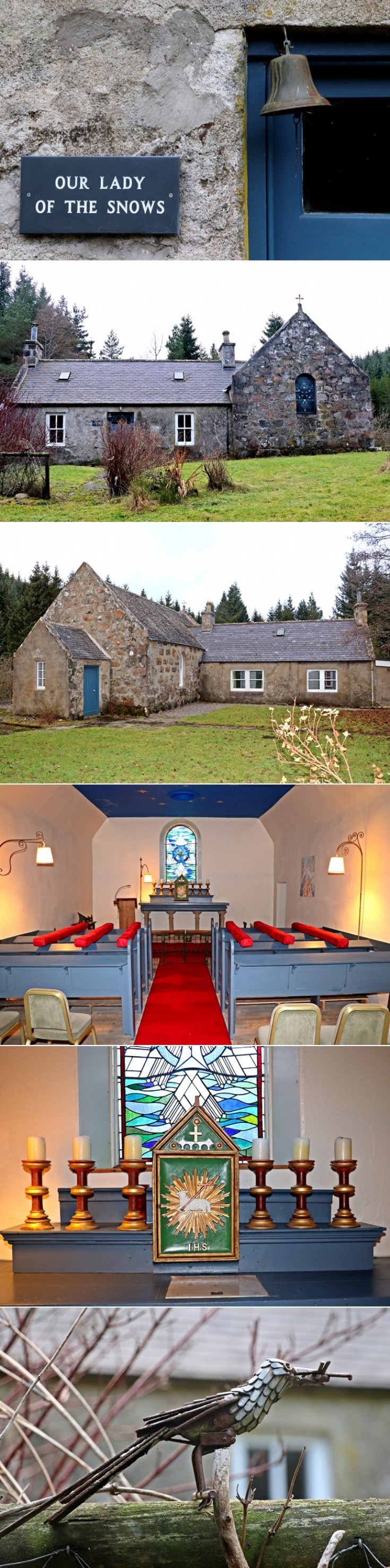
Our Lady of the Snows, Roman Catholic Chapel, Corgarff
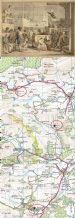
Hidden behind trees (at present anyway, as trees are being felled nearby) just at the junction of the Gairn road with the Strathdon Cockbridge road, lies a small Roman Catholic Chapel called ‘Our Lady of the Snows’.
Over many years the Catholics in the UK had been the subject of persecution. As a result, many choose to move to parts of the country where they cold worship undisturbed.
After the Reformation, (1560 in Scotland), Roman Catholics in Britain had been harassed by numerous restrictions. Roman Catholics could not purchase land, hold civil or military offices or seats in Parliament, inherit property, or practice their religion freely without incurring civil penalties. The first Relief Act (1778) enabled Roman Catholics in Britain to acquire real property, such as land. In 1791 another bill was passed that enabled British Catholics to practice their religion without fear of civil penalties. The Emancipation Act of 1829 in Parliament. This act admitted Irish and English Roman Catholics to Parliament and to all but a handful of public offices. With the Universities Tests Act of 1871, which opened the universities to Roman Catholics, Catholic Emancipation in the United Kingdom was virtually complete.
The result of this oppression was that many Catholics moved to more remote parts of the kingdom. In the North East of Scotland up near Strathdon, were two Catholic chapels and seminaries for training Catholic priests.
Scalan in Glenlivet
In Glenlivet, just over the Ladder Hills west from Glenbuchat, is Scalan
There was a remote college at Scalan in the Braes of Glenlivet which was once a seminary and it was one of the few places in Scotland where the Roman Catholic faith was kept alive during the troubled times of the 18th century. The seminary was first established in a small cottage and, on several occasions in the 1720s, pupils and staff were forced to go into hiding due to the presence of government troops in the area. In 1746, following the Battle of Culloden, the Duke of Cumberland led a detachment of troops who burned the cottage to the ground. Scalan was subsequently rebuilt, and the site of the earlier cottage can still be identified to the west of the two-storeyed farmhouse and attached cottages which were acquired in 1767 and converted for seminary use. Some features include panelled doors, stone-flagged floors and box beds.
Shenval in the Cabrach
In the Cabrach just over the Hills to the north of Glenbuchat there was a Catholic chapel at Shenval was possibly erected soon after the Reformation. The chapel and priest's house were burned after Culloden by the Duke of Cumberland, but were rebuilt in 1780. They fell into ruin after 1831 Between 1717 and 1799, with the help and support of the Dukes of Gordon, it functioned as a seminary, schooling over 100 youths who subsequently left Scotland to train as priests in Scots Colleges abroad. It also served as an administrative centre for the Roman Catholic church in Scotland. In that year (1731) as many as 700 Catholics were ministered to by the priest at Shenval, in the Cabrach
Strathdon/Corgarff
After the 1791 act, the Catholics in Strathdon and Corgarff got together to raise money to build a chapel nearer to their work. It is said that the laird gave his support because the tenants would take less time in going to church as they did not have to cross the hills.
Land was given by John Forbes of Newe (Bombay Jock) to build the chapel. The site was just at the junction of the Strathdon/Corgarff road and the Gairn Road
By 1808 the money was raised with the help of the Dukes of Gordon, and the first service took place in 1808. Later on, in the 1850’s a small cottage was added to the chapel to allow the priest to stay
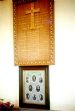
Recently the chapel and house had fallen into disrepair. It was bought by Adrian and Rosemary Walker (Rosemary is a descendant of Bombay Jock). They have tastefully restored the house and chapel as shown in the above photographs.
St Mary Ad Nives (St Mary of the Snows)
The story of our lady of the Snows is as follows:
August 5: Our Lady of the Snows (From RomanCatholicSaints.Com)
Improbable as it is for snow to fall during August, history tells of a snowfall that seemed more impossible, namely in Rome, Italy. August 5, 352, snow fell during the night in Rome.
There lived in the Eternal City a nobleman, John and his childless wife, who had been blessed with much of this world’s goods. They chose the Mother of God as the heir to their fortune, and at the suggestion of Pope Liberius, prayed that she might make known to them how to do this by a particular sign.
In answer, the Virgin Mother during the night of August 5, appeared to John and his wife and also to the Holy Father, Pope Liberius, directing them to build a church in her honour on the crown of the Esquiline Hill. And what would be the sign that John and his wife had requested?
“Snow will cover the crest of the hill.”
Snow rarely falls in Rome, but the flakes fell silently during that night, blanketing the peak of the historic hill. In the morning the news quickly spread and crowds gathered to throng up the hill and behold the white splendour. The snow had fallen in a particular pattern, showing the outline of the future church. When it became known that the snow was a sign from Mary, the people spontaneously added another to her long list of titles, Our Lady of the Snows.
There is another ‘Snow Kirk’ in the Spital in Old Aberdeen
Click for details of the Snow Kirk, The Spital Aberdeen
Our Lady of the Snows derives from Bishop Elphinstone’s veneration of the Virgin Mary and his familiarity with the second-ranking church in Rome – Sancta Maria Maggiore ad Nives. There is a chapel at Corgarff, still in use, named for the same miracle of snow in a Roman August. So much for the name, which has come down through five centuries as the Snow Kirk. It was built as the parish church of Old Aberdeen so that the Cathedral and King’s College Chapel could be left free for more ceremonial functions. The relationship can be described in terms of bells. St Machar boasted a peal of 14; King’s began with 15 but relinquished two of the smaller ones to the Snow Kirk. Sundays and feast days must have been joyful with these many chimes. Only the two Snow bells were popularly identified by name: ‘Schochtmadony’( meaning Shuggle Madonna) and ‘Skellat’, which simply means a small bell.
From Historic Environment Scotland Web Site
Corgarff, Our Lady of The Snows Roman Catholic Chapel and Chapel House
1808. Small rectangular-plan chapel with stone porch at SW, voussoired round headed windows and simple interior, and single storey, 3-bay, harled cottage (former priest's house) attached at right angles. Sited just S of former Ford of Tornahaish close to Old Military Road. Chapel has boulder base course.
FURTHER DESCRIPTION: elevation to NE with window to advanced gable of chapel at right; cottage to left with centre door and flanking windows. SW elevation with chapel porch set-back at left and further window at right. Out-of-character additions to NW of chapel and SE of cottage.
Small pane glazing patterns in timber sash and case windows; modern NE chapel window; rear cottage windows enlarged to bipartites with plate glass glazing. Red slates to chapel, grey slates and cast iron rooflights to cottage. Coped ashlar stacks with thackstanes and cans; ashlar-coped skews.
INTERIOR: chapel interior very simple with original stone altar facing liturgical east, wooden tabernacle and decorative cast iron altar rails. Simple timber pews with panelled backs and boarded timber wall to SW with integral pew.
Statement of Special Interest
Ecclesiastical building in use as such. A simple but fine Roman Catholic chapel and former priest's house overlooking the Burn of Tornahaish and nearby Boilhandy, now completely hidden from view by trees. Services are held here very infrequently, and even in the 1860s services were performed only once in three weeks. The Statistical Account records a decline in population as early as the late 18th century, and continues 'there are upwards of 100 Roman Catholics, mostly residing in Corgarff, which is regularly visited by a priest of that persuasion, who resides in the neighbouring parish of Glengairn. The new NE window was installed 2003.
Category changed from B to C(S) in 2006.
References
Bibliography
Statistical Account (1791-99), Vol 13 p176. New Statistical Account Vol 12 (1840), p555. I Shepherd RIAS Gordon (1994), p69. 1st edition Ordnance Survey map (1869-70).
 View Large Version
Picture added on 15 December 2023 at 18:06
This picture is in the following groups
church
church
Very interesting and informative reading and well written and presented on the above pages
.Well done to all concerned with took the time and effort to put it all together.,it made excellent reading.
Permission Given
Ed
.Well done to all concerned with took the time and effort to put it all together.,it made excellent reading.
Permission Given
Ed
Added by James m Pirie on 29 August 2025
Really interesting and informative and well written a joy to read and reflect on times gone bye.
Added by Jimand on 03 September 2025
Well written and a joy to read about the history of the
surrounding area 🙏🏿
surrounding area 🙏🏿
Added by Jimandmo@me.com on 03 September 2025
church




Ed
Email reply sent