The Glenbuchat Image Library
No: 2528 Contributor: No Contributor Year: 2023
146 Whisky in Glenbuchat


Whisky in Glenbuchat
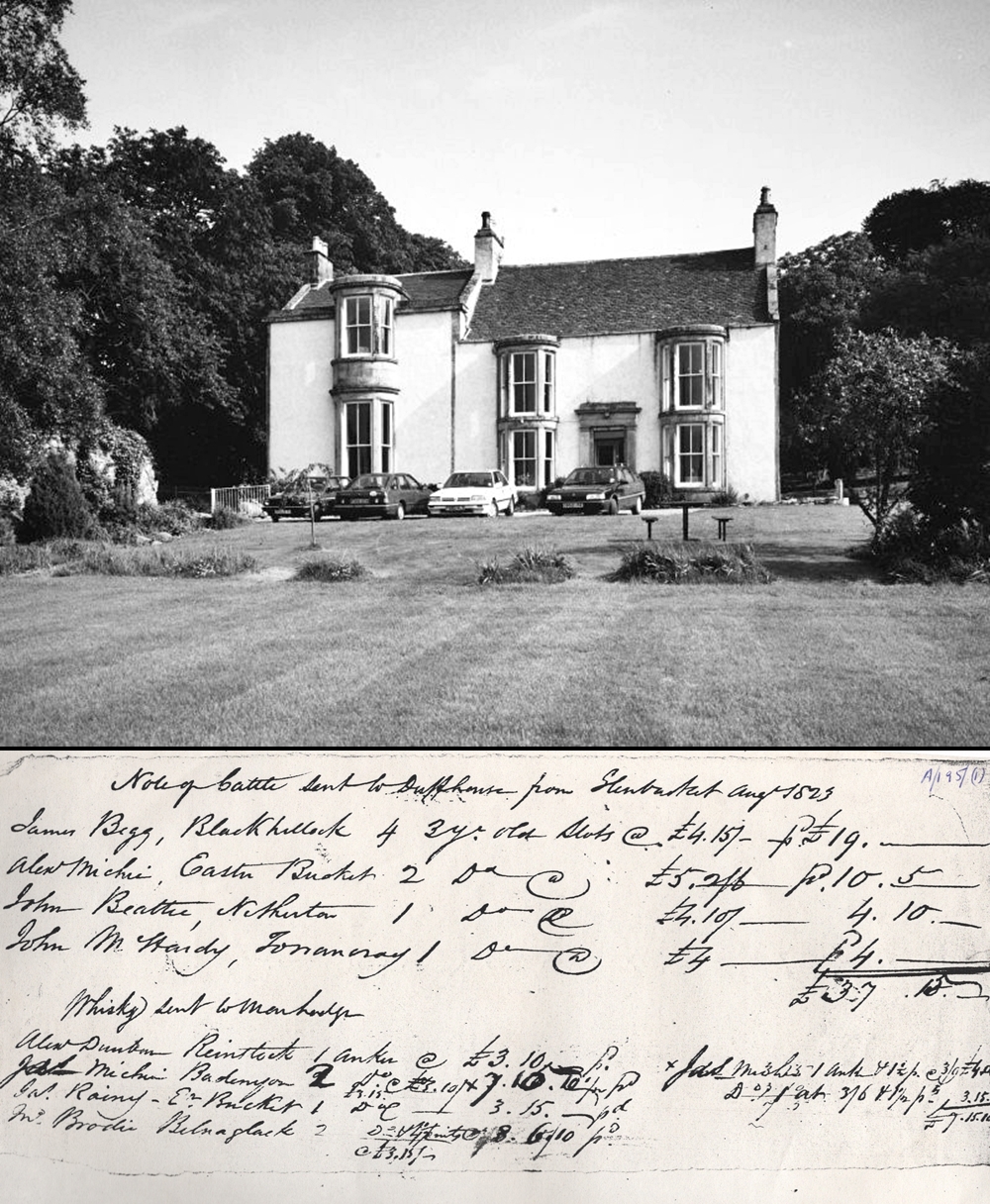
Pictures above:
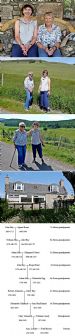
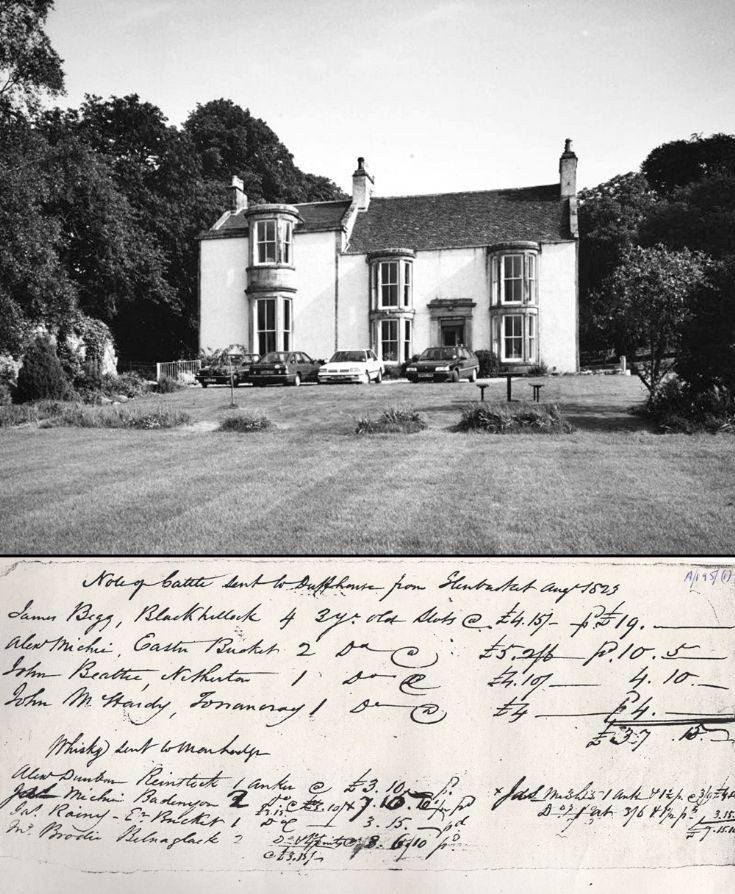
1. Montcoffer House
2. Pages from Montcoffer House Papers
The Above page from the papers of Earl Fife, the Laird of Glenbuchat, (Called the Montcoffer Papers after Montcoffer House, an early home of Earl Fife) shows the sale of cattle and whisky from Glenbuchat. The whisky was sent to Mar Lodge also owned by Earl Fife. Later Earl Fife lived at Duff House banff
Click for details of Montcoffer House
Montcoffer House, near Banff built on the site of an earlier manor or mansion house. Although 'Ogilvie of Montcoffer' was listed amongst the lesser barons of Aberdeenshire in 1598, it appears that during the late 16th and 17th Century a branch of the Irvine family also has some form of interest in Montcoffer. The lands were in the possession of the Russell family from circa 1690 until 1755, when it was sold to William Duff of Braco, Straloch. The present Montcoffer House (Listed B) dates from the early 18th century, and was renovated circa 1774-75 by Fife Estate then further extended circa 1880. It is a 2-storey 3-bay house with later wings at the rear and to the west forming a double pile. It is harled with ashlar margins, and bows with cill courses and chamfered reveals.
Sale of Whisky sent to Mar Lodge and Cattle to Dufftown from Glenbuchat as noted in the Montcoffer House Document
Cattle
James Begg Blackhillock
Alex Michie Badenyon
John Beattie, Netherton
John McHardy Torancroy
Whisky
Alex Duncan Reinstock
James Michie Badenyon
James Rainy Easterbucket
William Brodie Belnaglack
(Anker; Scotland: twenty Scotch pints.)
William Duff, 1st Earl Fife (1696 – 30 September 1763) was the son of William Duff of Dipple, He purchased Glenbuchat in 1736
Early beginning of Whisky in Scotland
From: https://www.scotch-whisky.org.uk/discover/story-of-scotch/
The story of Scotch begins as early as the 15th century. The earliest documented record of distilling in Scotland occurred in 1494 in the tax records of the day, the Exchequer Rolls.
An entry lists “Eight bolls of malt to Friar John Cor wherewith to make aqua vitae.”
Friar John was in luck – this was enough malted barley to produce almost 1,500 bottles of a potent spirit which would be refined and improved in the years ahead.
Illicit stills and running from the tax man
The increasing popularity of Scotch attracted the attention of the Scottish Parliament, looking to profit from the fledgling industry. The first taxes on Scotch were introduced in 1644 which led to an increase in illicit whisky distilling across Scotland.
Smuggling became standard practice for the next 150 years. The excisemen, or gaugers, as they were known, and the illicit distillers began a game of cat and mouse, with canny Scots coming up with increasingly ingenious ways of shielding the spirit from taxation. Even usually honest members of the clergy would hide Scotch under the pulpit, and the illicit spirit was even transported by coffin to avoid the taxman!
By the 1820s, as many as 14,000 illicit stills were being confiscated every year, and more than half the whisky consumed in Scotland was being enjoyed without the taxman taking his cut.
In 1823 the Excise Act was passed, which sanctioned the distilling of whisky in return for a licence fee of £10, and a set payment per gallon of proof spirit.
Whisky in Glenbuchat
Prior to the Act of 1823, Glenbuchat was full of small whisky stills and the whisky was reported to be a better whisky that its famous neighbour Glenlivet. Below are links to examples of Glenbuchat Whisky production
At the passing of the act, Lairds chose to allow whisky distilling on their land or not.
Dufftown was founded in 1817 by James Duff, 4th Earl of Fife. He was also the Laird of Glenbuchat
Dufftown, about 30 miles from Glenbuchat, soon became a centre for whisky distilling due to the excellent pure water sources in the area including many springs and the rivers Fiddich and Dullan. The Dufftown area was rife, in common with other areas in Moray, with illegal whisky production and the first legal distillery to be built in Dufftown was the Mortlach distillery which was completed in 1824 on the site of an illicit still.
The early distilleries of Dufftown were: -
Mortlach 1823
Glenfiddich 1886
Balvenie 1892
Over the hill from Glenbuchat is Glenlivet where one of the world’s most famous malt whisky is distilled. Why distilling in that glen flourished and Glenbuchat distilling disappeared is unknown but may be due to the laird Earl Fife preferring to centre whisky production in Dufftown.
After the act however whisky distilling did not immediately disappear and secret stills were present in the glen and the inhabitants were also involved with the smuggling of whisky. In fact, one of the last shootouts between the customs men and the smugglers which ended with a fatality took place on the Ladder hills on the edge of Glenbuchat
Click on this link to find out more about Ladder Hills, (bordering Glenbuchat) Smuggling, and Whisky
Click on this link to find out about Mrs Dow Peatfold and smuggling.
Click on this link to find out about Distilling at Smiddyford/Roadside, Glenbuchat
Click on this link to find out about the history of Glenbuchat Whisky at Colditz Castle POW Prison
Start at 9min 14 sec for Glenbuchat Whisky
Click on this link to find out about the story of Alexander Davidson and smuggling
The excerpt below refers to Smuggling and Kidnapping of an excise witness.
At this time the manufacture of illicit whisky was the only healthy and prosperous industry in the Highlands. Sandy Davidson threw in his lot with the smugglers, and elected the most hazardous and dangerous part of the undertaking namely, that of conveying the manufactured article to the market. For fully a couple of years he was a prominent member of a gang who manufactured sma' still on an extensive scale in the mountainous districts of the Highlands of Braemar and in the braes of Glenlivet. He withdrew from them when he could no longer tolerate their methods of warfare, but not before he accumulated a considerable sum of hard cash.
A Kidnapping Adventure.
His severance from the smugglers came about in this way. One clear moonlight night in the late autumn, a cavalcade of smugglers' ponies and carts heavily laden were on the way to Aberdeen. Hounding a sharp boulder of a hill with the imperturbable and wide-awake Sandy Davidson acting as leader the party were met by a large contingent of gaugers. A regular scrimmage took place, during which an exciseman was shot dead. The occurrence caused quite a sensation, and one man was arrested on the capital charge. The only evidence that the Crown could adduce was that of a solitary witness, a gauger, who identified the prisoner, and would swear that the accused was the man who shot his colleague. The trial would take place in Aberdeen in a couple of months, and the result was looked upon as a foregone conclusion. The Crown witness must be removed by book or by crook, at least till the trial was over. Sandy Davidson was consulted. He would not listen to any plot that aimed at the eternal removal of the gauger witness. "Give him," he said," "a six months' holiday somewhere. That won't hurt him." A couple of nights after this, the fatal witness was kidnapped, and his sudden disappearance was set down as another smuggling murder. When the date of the trial came round there was a postponement for a month, but ultimately the charge had to be withdrawn, and the prisoner liberated. Late in the summer the missing gauger, fat and plump, turned up as mysteriously as he had disappeared. He bad, he said, been taken by easy stages to the remote island of St. Kilda, lying in The Western Main, by three masked men, who acted as kindly towards him as could be expected of them. He was hospitably treated by the natives, in fact, he had a good time of it. With the first boat that reached the island he returned to civilisation. Meanwhile the alleged murderer had taken refuge on the broad bosom of the American Republic, and was never afterwards heard of. The fierce bloodthirsty proclivities evinced by the smugglers was not at all to Sandy Davidson's liking, and when a favourable opportunity presented itself, he quietly deserted them with £700 in his pockets as his share of the proceeds of the spoils. From that period till the grave closed over him, covering a period of more than twenty years, he was an inveterate and invincible poacher, a kind of Ishmalitish Nimrod of the hills, spending the most of his time in pursuit of game. He was frequently arrested.' and on one occasion he was caught napping by no less a personage than Sir George Macpherson Grant, father of the present Sir George. Sandy, while passing the time till Sir George and shooting party retired for the day to the lodge, fell sound asleep. He was suddenly awakened by the sound of approaching footsteps and by hit faithful dog " Charlie " whining and crouching: close to him. One of the sportsmen angrily' stepped towards the poacher stretched at full length in the heather. “I demand your name instantly, sir," He shouted. “My name, sir," the poacher said, with the utmost coolness, and remaining in his sitting posture, " is Alexander Davidson, of Glenbucket. What is yours, pray ?" " My name, fellow, is George Macpherson Grant, of Ballendalloch, and I require you to follow me." Sandy was muleted in £5 for this little affair, but some time afterwards he said that the money was by no means lost, for the moors of Ballendalloch had to pay for it handsomely " I knew Sir George perfectly, and he knows me, but I thought it would not be every day I would have it in my power to ask the name of such a great man." For the consideration of from £5 to £10 Davidson could provide the southern stranger with one of the finest stag heads in the forest. Some of these trophies strange as it may seem, adorn at the present moment the residences of at least two well-known Edinburgh families. Even to-day the Northern poacher does not kill the stag so much for the carcase, which yields only from 4d. to 5d. per pound, as for the head, which almost invariably produces a return of £5, and a much higher figure if it is royal in the number of points. Sandy was held in the highest esteem by some of the foremost landed proprietors, and was often the guest of the late Duke of Gordon at Gordon Castle. An invitation from the present Duke of Gordon was found on his person at the time of his death, asking him to attend and take part at a supper and ball. He had often expressed the hope that when in the romantic drama of his life closed be should pass into the undiscovered country among his beloved hills.
Curiously this is exactly what happened. On the 25th of August) a party of sportsmen found the dead body of the poacher cold and stiff on the moors on Glencairney, in the wilds of Glenbucket, with the faithful dog " Charlie " seated on his breast, watching over him. The remains of the last of the old Highland poachers were laid deep down in the throbless loam of the family burying ground, and the grave is marked by an undressed stone on which are cut in rude characters the initials of some of his turbulent ancestors, and bearing the date 1715.
 View Large Version
Picture added on 05 July 2023 at 22:39
12 Contribited Pictures, Text ll