The Glenbuchat Image Library
No: 2510 Contributor: Ken Cruickshank Year: 1736
141 Glenbuchat Estate Boundary letter 1736


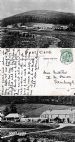
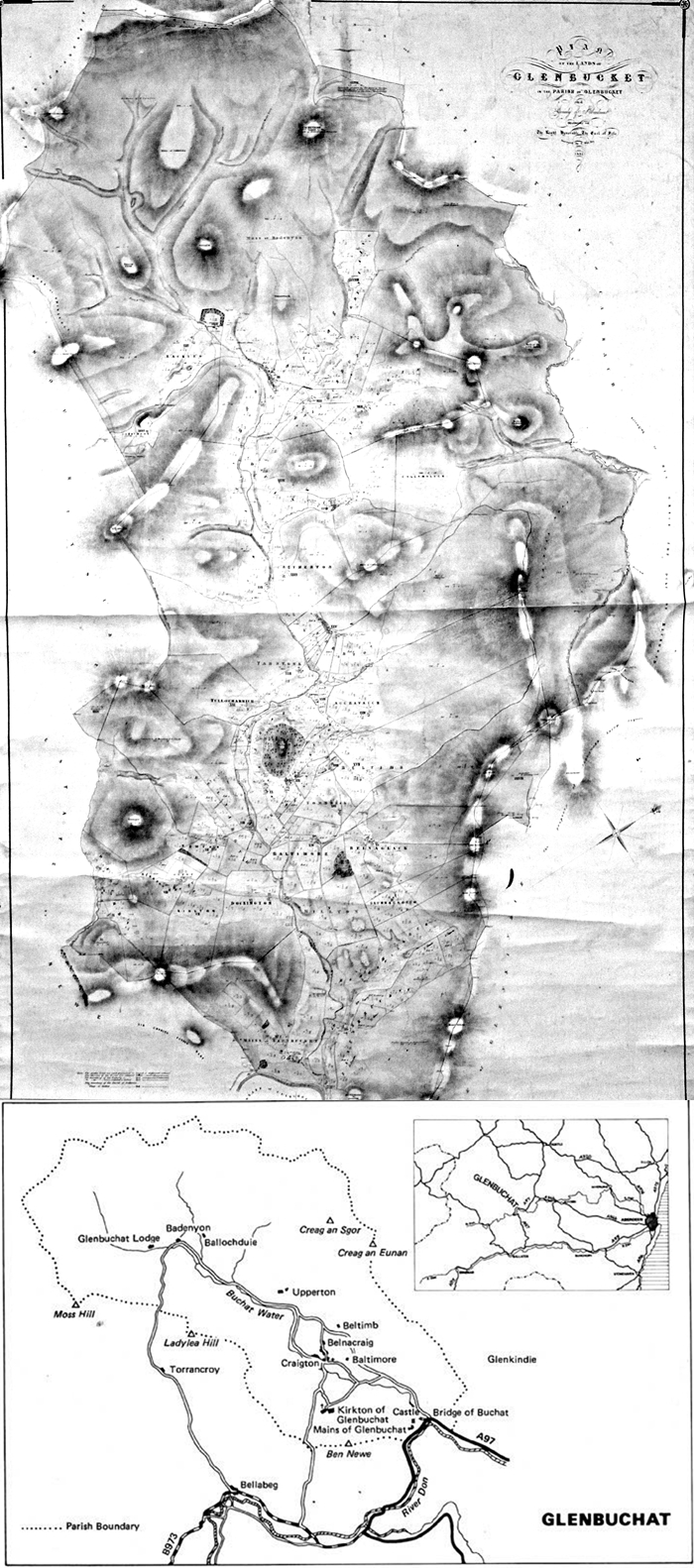
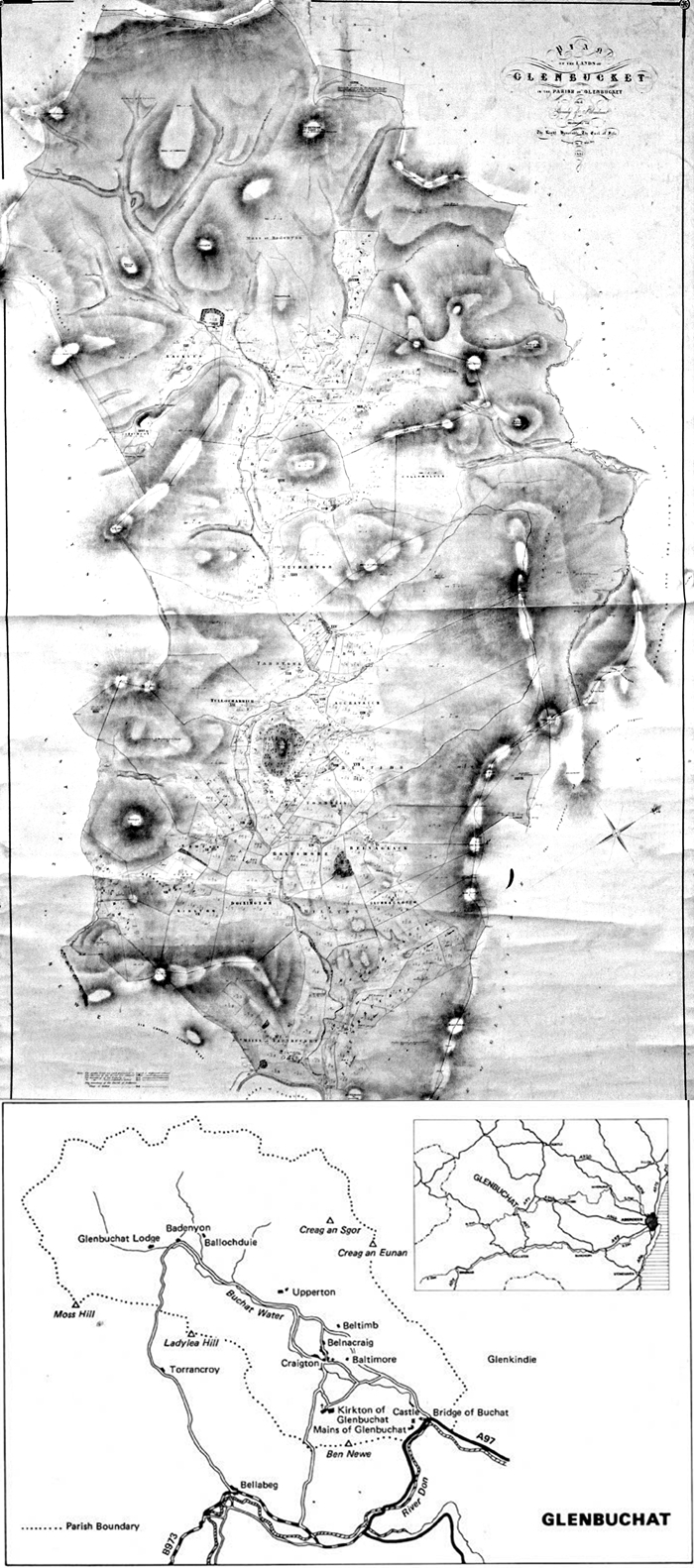
Pictures above show:
1. Estate map boundaries 1864
2. Modern map of Glenbuchat and Glen Nochty
Glenbucket Boundaries
The following is a copy of document in Bolton Library which was sent to Ken Cruickshank a number of years ago. In it, John Gordon writes in his own hand about the estate of Glenbucket. He was in the process of selling his estate to William Duff of Braco, Earl Fife.
The exact boundaries of Glenbucket as given in this interesting letter of 13th December 1736 from John Gordon Glenbucket to the purchaser Lord Braco, afterwards Lord Fife. The original grammar and spelling as been retained.
The estate of Glenbucket was originally bought by George Gordon of Knockespock prior to 1590. It was sold by the Great Glenbucket for the sum of £700 (presumably Scots pounds) in 1737
13th Dec 1736
My Lord,
As to the marches of Glenbucket you want to know about, I possessed them since I had concerns. They are as follows:
On the south and west side from ye bounds of ye Kirkton to the head of little Glen Nochtie there is ane letter of marches. On the north and east side beginning at ye water of the Don and up by ane dyke at the head of ye lands of Dales Park, till you come to ane wall on the face of ye brae above ye lands of aforesaid town to the top of the hill above the Dales Park and from that as wood and water shears till you come to Cragienenum (?Craigenscore)
From thence down the burn of the west line to the Inver thereof. From that westward up the south side of the burn runs beyond the Buckie of old Deveron till ye come to the burn betwixt the Buckie Calladie burn of the Garbet till ye come to ye shoulder of ye hill above the muckle Garbet where there is a glacket of hollow twixt the said hill and hill above Rintange: and down that glack twixt the hills and till ye come to ye burn runs to ye scores till ye come to a shealing belongs to Glenbucket on the north side of a little burn, under a great reddish rock, and up the south side of that burn till ye come to the Gell Cairn and going the top thereof as wood and water shears till ye come to the march with little Glen Nochtie.
This is all I know or pretend to, wherein I was never interrupted, only one Andrew Gauld lived in Breaklack told many years ago that I had made encroachment near the Buckie of Old Deveron which I begged Duke George Gordon to cause examine and according he sent his Baillie and examined witnesses, the Duke present. When he witnesses for me were examined, and when his Grace found the thing to be false, and Gauld’s impertinence to me, caused him to be put in stocks and desired a good neighbourhood in all time coming, which has still continued and I have never heard more about it. The extract of the examination and of the witnesses I have in my custody and shall give you. There are eight or ten pleughs I cannot be positive about which pay ten marks to the Breaklack yearly for liberty to pasture on the sand hill Buckie which is continued for the space of many years before I believe was born.
At least I have been informed so, since I knew Glenbucket which will be thirty-seven or thirty-eight years back and I am
My Lordship
Your most humble and obedient servant
John Gordon
Family History of Earl Fife.
William Duff of Dipple and Braco, born 1653, died 1722,
Married first in 1681, Jean Gordon of Edinglassie,
they had nine childrren; six daughters and three sons.
Married second, 1703, Jean Dunbar of Durn, they had one son and four daughters.
A successful businessman then prospering principally as a banker, or old-fashioned money-lender, but active also in every aspect of foreign trade, both import and export, north of Aberdeen. He was ever ready to help local lairds with their liquidity problems, and was even faster when foreclosing on the lands they had given him as security.
William Duff, 1st Earl Fife (1696 – 30 September 1763)
The son of William Duff of Dipple,
In 1719 he married Janet Ogilvie, daughter of James Ogilvy, 4th Earl of Findlater.
She died in 1720
In 1723 he married Jean Grant, daughter of Sir James Grant, Bt.
He inherited substantial estates from his father on his death in 1722. He inherited £30,000 in cash, a rent roll of £6,500 a year, and unencumbered estates, in all totalling substantial wealth at that time.
He purchased Glenbuchat in 1736
He was Member of Parliament for Banffshire from 1727–34, and was created Lord Braco of Kilbryde in the Peerage of Ireland on 28 July 1735, and Earl Fife and Viscount Macduff, also in the peerage of Ireland, by letters patent dated 26 April 1759, after proving his descent from Macduff, Earl of Fife.
He commissioned the construction of Duff House in Banff in 1740.
He continued the policy of his family by purchasing further large estates in the counties of Aberdeen, Banff, and Moray, and managed all his possessions with much care and ability. Two years after his father’s death he rebuilt the castle of Balveny, and between 1740 and 1745 he built the splendid mansion of Duff House at a cost of £70,000. During the Jacobite rebellion in 1745 he joined the Duke of Cumberland, and offered the Government his free services in any way that might be desired. By his first wife, a daughter of the Earl of Findlater and Seafield, he had no children, but he married again, a daughter of Grant of Grant, and two of his sons in succession inherited the earldom.
Explanation of Scots Words
Glack, n., v. Also glac glaik.
A hollow between two hills,)
Pleughs: a measure of land size
backie dim. The back-yard or garden.
The above text refers to ‘Buckie of Old Deveron’. This may be a mis spelling of Backie.
The maps from 1850 mention Backie in a number of forms and not Buckie
Backie Hill
Backstrype of Backie
Backies Croft
And above Ryntaing at the source of the Deveron east of Garbet Hill therefore the Backie of Old Deveron will be the land beyond the source of the Deveron River
 View Large Version
Picture added on 20 January 2023 at 21:03
This picture is in the following groups
estate
estate
estate