The Glenbuchat Image Library
No: 2425 Contributor: No Contributor Year: 2021
35 Alan Cameron and Glenbuchat Holidays


The Cameron Family of Glenbuchat.
Click for Alan Cameron’s memories of Glenbuchat
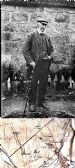
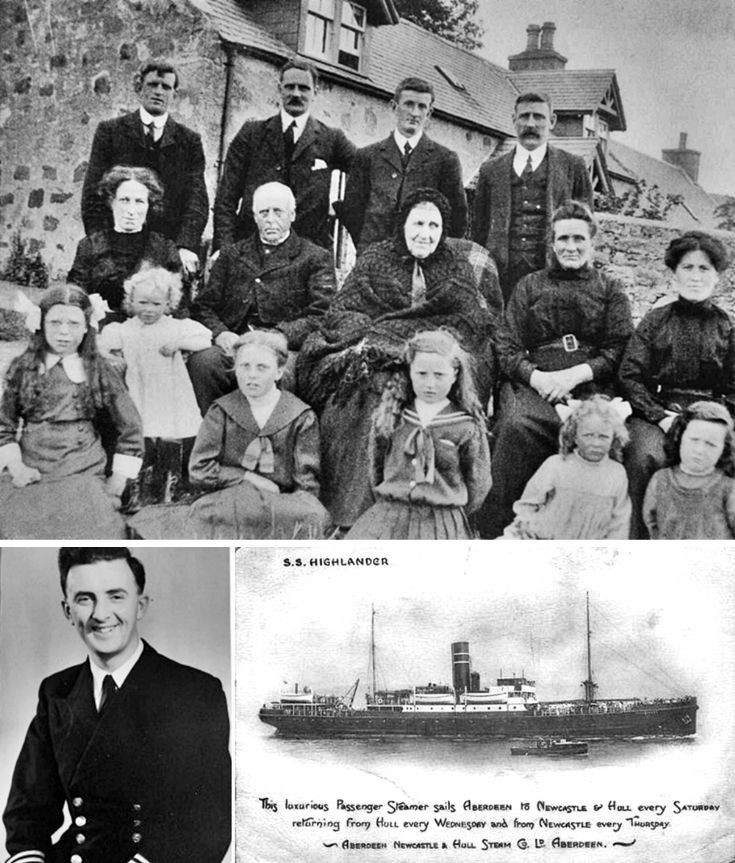
Photo above;
1. The Camerons of Sunnybrae family photo. (1913) was taken at the funeral of James Cameron. back row; Brothers left to right are George, William, Robert and Alexander Cameron. Second row: Jeannie (wife of George), Daniel Cameron, Ann Chree (Daniels Mother-in-Law, Ann (wife of Daniel), Bella (widow of James). Children Left to right; Girl called Anderson (no relation), Florence (in white dress), Jessie, Isabella, Ethel (in white dress), Elsie.
Four of the six Cameron brothers left the Glen to become policemen.
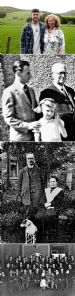
2.A young Alan Cameron and the S.S. Highlander
Editor’s Note
Alan Cameron, who was born and brought up in the Newcastle area, was a regular visitor to Glenbuchat in his childhood. His mother Christina Davidson was the daughter of Walter Davidson the owner of the Craigton shop at Glenbuchat and his father, Robert Cameron came from Sunnybrae Farm in the Glen.
In 1999, in response to receiving a copy of Ken Cruickshank’s book of pictures of Glenbuchat (Glenbuchat Yesterdays), Alan sent Ken a copy of the Glenbuchat part of his family history to add to Ken’s knowledge of Glenbuchat. Ken has now passed his collection of photos and papers to myself for adding to the web site.
Alan had enjoyed many happy holidays with his relatives in Glenbuchat and obviously thoroughly enjoyed viewing the pictures in Ken’s book and he also added forwarded pictures which now appear on the web site. Alan also made contributions to the Comments section on the Web site.
I tried to contact Alan to get his consent to include his documents on the web site, but the email was returned and on searching the web I found that sadly he had died on Thursday 16th April 2020 aged 94.
He obviously had a great love for the Glen, especially its past and although still admiring the beauty of the Glen, he regretted the passing of the community spirit that existed in his childhood. He was obviously keen on collecting and recording his family’s past history and I hope that he would approve that his historical record of Glenbuchat is preserved and made available for others to read.
If, however, members of the family feel that this is inappropriate, please contact me view the email link on the Introduction Page of the web site and I will arrange its removal. I hope however they will view it as a memorial to Alan, whom I never met but whom I feel I know through his writing.
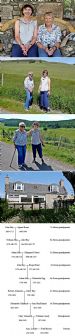
Immediate Cameron Family Tree
Daniel Cameron
Birth 25 March 1846 Tullynessle, Aberdeenshire
Death 31 July 1914 Sunnybrae. Glenbuchat Cemetery
Parents
James Cameron 1813–1883
Jean Sinclair 1824–1903
Spouse
Ann Chee 1853–1942
Children
James Cameron 1876–1913
Ann T Cameron 1877–
William Cameron 1879–
Alexander Cameron 1880–1958
George Cameron 1882–
Charles C Cameron 1889–
Robert Garden Cameron 1893–1969
Robert Garden Cameron
Birth 3 Oct 1893 Lumsden, Aberdeen, Scotland
Death Feb 1969 Gateshead on Tyne, England
Parents
Daniel Cameron 1846–1914
Ann Chee 1853–1942
Spouse
Christina Ingram Davidson 1900–1995
Children
Norman Davidson Cameron 1921–1944
Dorothy Cameron 1924–2009
Alan Cameron 1926–2020
Adrian W Cameron 1927–2001
Private
Private
Private
Private
Walter Cheyne Davidson 1879–1946
Birth 10 Feb 1879 Meikle Ardo, Aberdeen, Scotland
Death 08 Jun 1946 Glenbuchat, Aberdeen, Scotland
Parents
George Davidson 1825–1900
Ann Gray 1838–1901
Spouse &
Isabella Grant 1874–1951
Children
Christina Ingram Davidson 1900–1995
Walter George Davidson 1902–1970
Mary-Ann Grant Davidson 1904–1995
James Alexander Davidson 1906–1992
Isabella Davidson 1908–1987
Robert Grant Davidson 1912–1989
Donald Davidson 1917–1996
Christina Ingram Davidson
Birth 07 Mar 1900 Sinnahard, Towie Aberdeenshire, Scotland
Death 02 Sep 1995 Riding Mill, Northumberland, England
Parents
Walter Cheyne Davidson 1879–1946
Isabella Grant 1874–1951
Spouse
Robert Garden Cameron 1893–1969
Children
Dorothy Cameron 1924–2000
Two other children
The Cameron Annual Glenbuchat Holidays of the 1920s and 30s.
Alan Cameron and his family used to travel to Glenbuchat by ship from Newcastle.
The following are some comments about the ship ‘The Highlander’. Later are Alan’s comments on the journey.
The Highlander, slipping her moorings and heading down river and out to sea, was one of the most endearing sights on the Tyne. Before the Second World War, this lovely ship plied her trade up the north coast from Hull, calling in at Newcastle and going on to Aberdeen.
She carried fare-paying passengers, goods and livestock. During the summer the Highlander also undertook cruises to such places as Scarborough. Aberdeen on the Friday. On her return journey she was back in Newcastle on the Sunday before sailing on to Hull.
On the Tyne she berthed opposite Broad Chare, in Newcastle, and the company office was at 77 Quayside, where tickets for the trip (adults 5s – 25p and children 3s – 15p) could be purchased right up to the time of sailing.
It was a popular sight on a Sunday morning when, on her return from Aberdeen, crowds would gather to watch ponies and sheep being brought ashore before the Sunday market started. The heavy gangway used for this purpose was brought along from the Swing Bridge and dockers would be aided by what seemed like half the children of Newcastle lending them a helping hand.
But this ship was also an unsung war hero and earned her battle honours by being the first merchantman to shoot down enemy aircraft when its Lewis guns downed two Nazi bombers in August 1940 off Scotland.
The ship had just survived a bombing attack from one aircraft and as the enemy turned to rake her with machine-gun fire they underestimated the Highlander, coming in too close.
The ship’s gunners opened up and the Heinkel burst into flames and crashed into the sea about 100 yards astern.
The gunners were celebrating when another Heinkel suddenly swooped into the attack. The Germans missed with their bombs and it proved a costly mistake as the ship’s machine-gunners, flushed with success, had their eye in. The plane burst into flames, lost height and its port wing hit the Highlander’s port lifeboat which swung the plane around onto the poop deck. Two of the ship’s crew were injured but they put out the fire and the Highlander proudly sailed into Leith harbour displaying its war prize.
Tragically, the ship was later sunk by aerial torpedo off Aberdeen, going down with all hands.
Alan Cameron takes up the story:
The fares were only about half of that for rail. So then commenced a new, and for me at least, a fascinating method of travel to Scotland each year, lasting up to the onset of the Second World War.
The Highlander would leave Hull on the Wednesday and be in Newcastle 12 hours later, early on Thursday. Casting off shortly after noon, the Highlander was in Aberdeen on the Friday. On her return journey she was back in Newcastle on the Sunday before sailing on to Hull.
The "Highlander" sailed from Newcastle quayside on a Thursday evening with two classes of passenger. Those in cabins and those travelling "Steerage". Fortunately, our family could at least afford cabins as those in " Steerage" were accommodated on wooden seats in an enclosed space above the noisy steering engine and where movement of the vessel was more pronounced. The ship also carried general cargo to Aberdeen but on the return trip the holds were filled with cattle and pigs. In rough seas the animals inclined to sea sickness in the same way as the human passengers and what with the smell and squealing of pigs it is no wonder the passenger fares were half that of rail. On the day of our sailing Dad used to hire a chap with a pony and small cart to transport him and our luggage to the ship. We had a very large and old-fashioned wooden trunk with a rounded lid and big brass lock. I suppose it was very necessary for a large family. Mother and the rest of us followed on by tramcar from Heyworth and got off in Newcastle, on the King George V Bridge. In those days the lifts worked and we descended to the quayside and then along to the "Highlander's" berth.
It was always a great adventure for us kids and we loved sleeping on double decker bunks and looking out of the little "round window". The chief stewardess usually kept an eye on us when Mum and Dad were up in the saloon. There was a piano there and Mother played it on every trip to the delight of other passengers, who loved her Scottish melodies. I think Dad probably enjoyed a few free "drams" as a result. I recall on one trip being taken for a look round the engine and boiler room and it must have seemed like something akin to Hell, with the glare of flames from the coal fired furnaces and the thrashing up and down of the open crankcase steam engine. Little did I realise that not that many years later, in my first ship, I would work in just the same conditions and even enjoy them.
The ship usually docked around dawn in Aberdeen and Dad took us children for breakfast at a local cafe where we had porridge, hot baps and milk. We also usually visited the Fish Quay for a look at the fishing boats unloading their catches and I still recall my fascination at being shown an 'Angler" fish, with a "rod" protruding from its head. Around 9am, Grandfather Davidson would arrive in his car, the trunk was strapped on the luggage grid, the family squeezed in and off to the Glen we went. Grandfather always brought a large jar of 'sweeties" for us so there was peace and quiet on the journey.
Our holidays in Glenbuchat were always happy and the folks there were so very kind to us. I seem to remember (no doubt incorrectly) that most of the time the sun shone every day. There was always something to do, old cars and vans to play on, a swing which, if you went high enough, allowed one to see over the manse wall, the farm at Sunnybrae where we played in the hayloft or in the fields at haymaking time, the Buchat river to 'splodge’ in, helping to pick Grandad's strawberries and eating most of them, attending the Lonach Games in Strathdon, going for milk from a local farm, going out with our uncles in the mobile shops to call at crofts and farms throughout the Glen and neighbouring countryside. That and ever so much more.
On Sundays we always attended Church in the morning and after lunch Grandad would pack everyone into his car and take us for trips to interesting and beautiful places in the area. We were sometimes joined by Aunts Polly and Bella who worked in Aberdeen and who had come out for the weekend. They were very fashion conscious and most fastidious in their appearance. Mother was often very pleased to receive some of the clothes they no longer wanted, though I don't think she ever felt a Cinderella to her two better-off sisters. One Sunday in each month we went to the "Auld Kirk" (old Church) which was located to the south side of the Glen. This was done, I believe, to prevent loss of its sanctity by lack of Christian worship there. There was no organ or piano and Grandfather who was the choir master used to start a hymn by striking a tuning fork on a stone to obtain a suitable key.
Picture added on 08 December 2021 at 18:40
This picture is in the following groups
people
people
people