The Glenbuchat Image Library
No: 2412 Contributor: No Contributor Year: 2021
119 Run Rig farming system


Run Rig Farming System
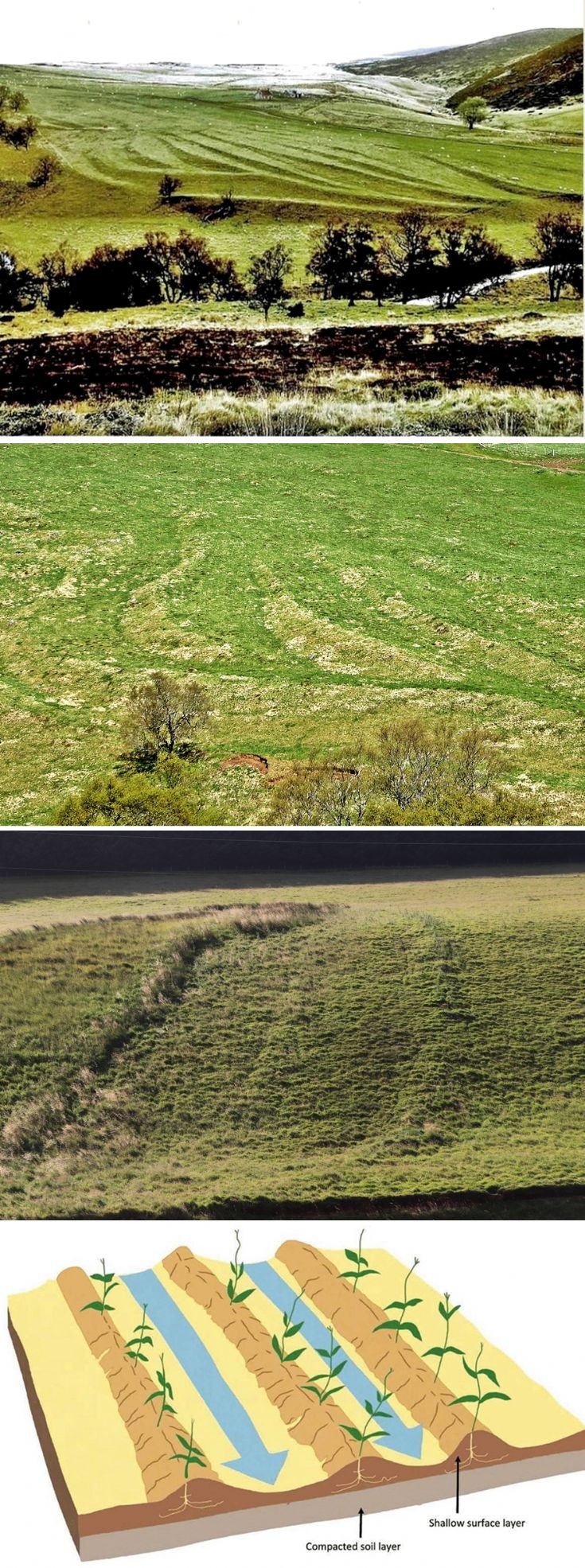
The above pictures show ridges left in the fields due to the Run Rig system of farming.
The Pictures show:
1. Ridges in Glen Ernan some years ago taken by Ken Cruickshank
2. The same ridges in Glen Ernan taken 2018
3. Ridges on the banks of the River Buchat possibly due to Run Rig, taken in 2019
4. Diagram of Run Rig
Runrigs were a feature of Scottish agriculture that began in the fourteenth and fifteenth century, and continued until the enclosure of the better farmland in Scotland which began between about 1750 and 1790
The runrig system: the ‘rigs’ were long strips of arable land, about 20 feet wide separated by ‘runs’ of uncultivated land, created by subdividing a larger area of arable land. The assignment of these strips was intermixed so that the strips that were held by an individual would be scattered throughout the land areas and not necessarily all be contiguous; and the rigs would be reassignment periodically, between annually and every few years, to ensure that no one individual or family had continuous use of the best land. The land would be farmed in a communal manner to a lesser or greater degree, with individuals helping each other and sharing certain tasks
While possibly it might have been an equitable system it was very inefficient. Half the land, i.e. the run between the ridges was unproductive and the small strips discouraged any use of machinery except hand tools. The fact that the leases were moved at intervals meant that a good farmer had little interest in improving the land.
Ken Cruickshank in his Album about the Kilns of Glenbuchat states:
The people lived in settlements - fermtouns ( or the Highland equivalent - clachans ), a cluster of dwellings and outbuildings surrounded by the cultivated ground, divided into infield land and outfield land.
The Aberdeenshire ‘Poll Book ‘of 1696 shows that in Glenbuchat (old spelling - Glenbucket) there were eleven of these clachans, ranging from the largest one at Belnaboth (town of the bothies or huts) with around nine tenants; their families and servants, to small ones at Crofts and Beltom (Beltimb) with 2 or 3 tenants each.
‘Infield land, close to the farming township, was the best land and received most of the scarce manure and fertiliser (dung and other organic material. and dressings of lime). It was intensively cultivated and grew the main corn crops year after year, in simple rotations such as oats/oats/bere, with occasional fallow years.
Outfield land, further away from the clachan, was brought into cultivation from ‘waste ground’, cropped for a few years with oats until yields began to fall off, and then left fallow to recover, or to return to waste. The land was worked on a communal basis with a pooling of animal and manpower and tools, using the runrig system (intermingled rig and furrow cultivation strips, each worked by different tenants so that they all had a share of the best land) on open areas of the stony landscape between the lower wet boggy areas and haughland, and the higher moors, in the growing season the stock were sent to the shelling areas of the hills for summer grazing, allowing the grass and crops around the townships open lands to grow and ripen in safety.
The non-renewal of leases of the jointly tenanted clachans and farms and the abolition of the practice of subletting holdings ended the run-rig system of cultivation and consolidated the inter-mixed strips of ground of different tenants into single-tenanted farms and crofts. This was often a gradual, on-going process in the late 18th and early 19th centuries, with the new holdings being formed in a piecemeal fashion. In Glenbuchat, however, there appears to have been a decision taken by Fife Estates, between 1813 and 1815 to finally complete the reorganisation of their properties (possibly stimulated belatedly by the agricultural boom years of the Napoleonic Wars). Adverts placed in the Aberdeen journal of November 1813 and November 1815 offered up the majority of farms, crofts and lands of the old clachans for let by public auction
(See also the Upperton Lease 1765 between John Hay and the Earl of Fife)
Picture added on 03 November 2021 at 20:39
This picture is in the following groups
farm
farm
farm