The Glenbuchat Image Library
No: 2297 Contributor: No Contributor Year: 2020
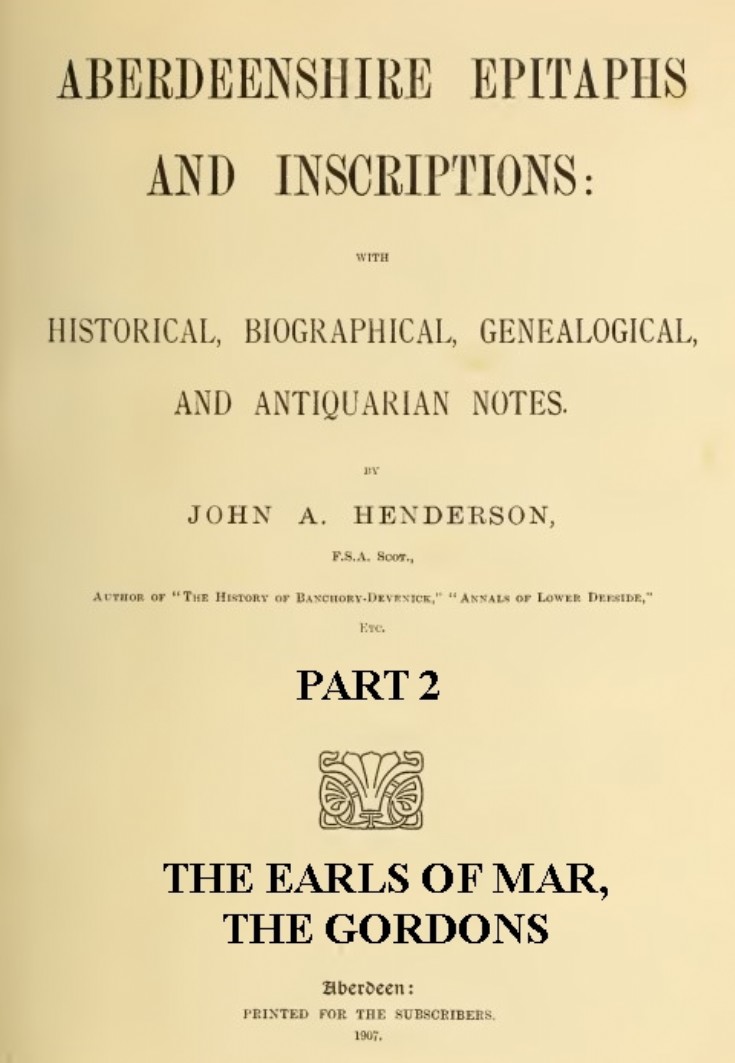
2 Earls of Mar and the Gordons


THE EARLS OF MAR.
Click for Glenbuchat Epitaphs and Inscriptions album
The lands of Glenbucket originally formed a portion of the barony of Kildrummy and lordship of Strathdon. As such, they belonged to the Earls of Mar, but on account of complications afterwards arising respecting the title to and the possessions of the earldom, the following brief explanations are made; — Margaret, daughter of Donald, Earl of Mar, who fell at Dupplin in 1332, became Countess of Mar on the death of her brother Thomas, in 1377. She married, as her first husband, William, first Earl of Douglas, and, besides a son, James, second Earl of Douglas, who fell at Otterburn in 1388, she had a daughter, Isabel, who succeeded as Countess. This lady married, first, Sir Malcolm Drummond; and, secondly, in 1404, Alexander Stewart, natural son of Alexander, Earl of Buchan. Stewart had already taken possession of the Countess and her castle of Kildrummy under circumstances which are well known. On the death of the Countess, her scheming husband succeeded in securing from the King a grant of the earldom in favour of himself and his natural son, Thomas. After the decease of the survivor of the two, Robert, Lord Erskine, was, in 1138, retoured heir to the Countess Isabel. He died in 1452, leaving a son, Thomas, Lord Erskine, whose succession to the earldom was resisted by the Crown. In 1457, the service of Robert, Lord Erskine, was reduced, and the earldom, with its numerous possessions, including Glenbucket, thereupon reverted to the Crown. From time to time the Crown made grants from the original Mar estates.
Thus, in 1507-8, James IV. granted three separate charters to Alexander Elphinstone, son of John Elphinstone of Elphinstone (and his wife Elizabeth Berlay or Barlow, who had been a servant or maid of honour to the Queen), of various lands on Upper Donside, including " Balnabooth in Glenbouchat," " Forrest of Baddynyone and Kilvalauch," ' : Inuerbuchet, Wester Inuerbuchet, Eister Inuerbuchet, etc." (Antiq.j IV., pp. 217-218 and 278.)
Elphinstone was best known in Aberdeenshire as laird of Invernochty, or Strathdon, and he secured a new Crown charter to his possessions in 1513, before which date, he had been honoured with the title of Baron Elphinstone of Elphinstone. He fell with his King and the flower of the Scottish nobles at the battle of Flodden.
THE GORDONS.
From the Elphinstones, Glenbucket passed to a branch of the Gordons, whose early history being somewhat confused may be cleared up by the following notes: — According to the Balbithan MS., "John Gordon of Cairnborrow married Bessy Gordon, Buckie's daughter," and their eldest son, John Gordon, Laird of Edenglassie and representative of the Family of Cairnborrow, married, first, the Laird of Wattertons daughter Bennertnan, now Lairds of Elsick, with whom he begat three Sons and two daughters, his eldest son, William Gordon, Laird of Rathemay, and (who got the) Stock of Cairnborrow, his second son Sir Adam Gordon of Park, Glenbuicket, Innermarkie, Edenglassie, and Auchinandach, his third son, John Gordon, Laird of Invermarkie, Edenglassie, etc. ; his eldest daughter married the Laird of Brux Forbes, his second daughter married Robert Coutts, Laird of Achterfoull.
The said John Gordon, Laird of Edenglassie, etc., married to his second wife the Lady Benum and Lady Foreran, her name is on the House of Glenbuicket which he built, but by that Lady he had no Succession. The last-mentioned John Gordon and his first wife, Elizabeth Bannerman, had sasine on Badinzone (Badenyon), also on Easter and Wester Inverbuchettis in the barony of Kyldrymmie, on 10th September, 1572. In 1573-4 they had an action of removing in the Sheriff Court of Aberdeenshire against William Anderson in Drumnahuif relative to the town and lands of Badinzone, while in July or August, 1584, the same John Gordon, but then designed as " apparent of Carneburrow " was the pursuer in an action of cognition in the same court against Alexander Elphinstoun of " Balnaglaik," in which he produced his title to Easter and Wester Innerbuchettis as above. (See New Spalding Club’s Sheriff Court Records, I., pp. 195 and 308.)
On the property of Easter Bucket, Gordon, who appears to have been in affluent circumstances—erected, in 1590, the strong castle of Glenbucket. On the lintel stone of the door he caused his own name with that of his second wife to be inscribed. Only the following words and letters are now legible —
. . . . NE . HELEN . CARNEG AR. . . .EMANIS . BOT
At the time, however (1845-52), that Mr R. W. Billings made his sketch of the castle for his " Baronial and Ecclesiastical Antiquities of Scotland," the whole in- scription was intact
— IOHN . GORDONS . HELEN CARNEGIE: 1590.
NO . THING . ON . EARTH . REMANIS . BOT . FAIME.
Mr Billings in his description remarks that the word " faime " in this case " is not intended to mean celebrity but the humbler attribute of good repute."
The castle occupies an elevated and picturesque situation on a declivity of Ben Newe. It commands the passage up Glendon, as also the comparatively narrow inlet to Glenbucket. Messrs Macgibbon and Ross (Castellated and Domestic Architecture of Scotland) describe it as a fine specimen of the house or castle with square towers at diagonally opposite angles. The windows are considerably larger than those in many old Aberdeenshire castles, but precautions were taken against assault by having them well protected by upright and cross bars fixed securely into the stonework about six inches apart. In the upper portion a slight effort at ornamentation had been made, one specimen still remaining. Although the building has been roofless for a lengthened period, it still stands forth in solitary grandeur as an almost permanent certificate of the excellence of its construction.
Helen Carnegie was the widow of Turing of Foveran, and John Gordon having purchased the estate of Denholm, she is designed in the preceding extract as “the Lady Benuin and Lady Foveran." The Pitfour MS. bears that it was not till 1591 that Gordon acquired the full proprietary rights to Glenbucket, the seller being Lord Elphinstone, at the price of £35,000 Scots, or £2916 13s 4d sterling New Infeftment was granted on 3rd April, 1594. (Antiq., IV., p. 450.) Gordon possessed the warlike and proud characteristics of his clan at that period. He was charged with participating in the murder of the Bonny Earl of Moray and the burning of Donibristle in February, 1592. For a time, he was " at the horn," but this was ultimately relaxed. He was at the battle of Glenlivet (4th October, 1594), along with his father and seven brothers, each being attended by a " Jackman and a footman." This made up " a good company, being twenty-seven well-mounted men out of one Family." (Balbithan MS.)
Late in life, Gordon contracted a third marriage, with Elizabeth Wishart, who, as his wife, is mentioned in a charter of confirmation dated Aberdeen 15th June, 1620, granted by the Bishop, Dean, and Chapter of Aberdeen of the town and lands of Dumeathis, etc., to be held by the said John and Elizabeth in conjunct fee. (Wimberley's Gordons of Knockespock, p. 49.) Gordon died 22nd January, 1622. (Pitfour MS.) Adam Gordon, the second son of the first marriage above stated, succeeded to Glenbucket during the lifetime of his father, his sasine being dated 11th June, 1620. He received the honour of knighthood. About 1617, he purchased the estate of Corncairn, Ordiquhill, and re-named it Park, a title which it has since retained. He also built the village of Old Cornhill. He was twice married—first, to Christian, daughter of William Gordon, fifth laird of Gight. The eldest son of this marriage was Sir John Gordon of Park, who, in 1631, married Margaret, daughter of Sir James Sibbald of Rankeillor. It was he who, in 1665, erected the Gordon of Park aisle in the graveyard of Ordiquhill. Sir Adam Gordon married, secondly, Helen Tyrie, daughter of Sir William Tyrie, of Drumkilbo, and their eldest son, Patrick, succeeded to Glenbucket. Sir Adam died in September, 1629, and, according to the Balbithan and Pitfour MSS., was buried within the church of Glenbucket.
It is worthy of note that in the same year a new parish church was erected. Perhaps it was intended as a memorial of Sir Adam, who was warmly attached to the glen. Patrick Gordon, the succeeding laird, was a noted free-booter. He levied black-mail over many parishes, and did not hesitate to annex property according to his erratic will. He believed that might was right, and followed— The good old rule, the simple plan, that they should take who have the power, and they should keep who can. The parish of Cushnie received considerable attention at his hands and those of his followers. In 1647, before the Commissioners of the General Assembly, he and a confederate ‘ ‘ acknowledged their accession to the rebellion, humbly upon their knees." In 1651, he married Jean, eldest daughter of Sir Robert Arbuthnott of that Ilk, and widow of Alexander Burnett, younger of Leys. He died in Aberdeen, "of sore disease," on 16th January, 1666 (Row's Diary), " and was buried in the Gordon's Isle in the Cathedral Kirk of Oldmacher, being Laid down by my Lord Gordon's side who was killed at Alford being both of them very Intimate in their life, and brave men as the age produced, and now no doubt are more ardent in Love and affection in heaven." (Balbithan MS.)
Adam Gordon, the eldest son, succeeded. He appears to have had a bitter hatred towards Alexander Strachan of Glenkindie, whom he succeeded, in 1676, in getting accused of the murder of Alexander Stour. £20,000 Scots of bail was accepted for Strachan, and, after a protracted litigation, an Act of the Scottish Parliament was passed in Strachan's favour and declaring that the charge had originated in the malice of Gordon. (Acts of Parliament, 1695, — 471.) He married Jean Douglas, daughter of Douglas, laird of Glenbervie, and died in 1693, survived by his wife and eight children, the five youngest of whom were unprovided for. (Poll Book.) Mrs Gordon's allowance under her marriage contract was £1000 Scots of rent out of the best of the lands of Glenbucket "nearest adjacent to the house." She "entered on the possession of the mams and house " on her husband’s death "and uplifted some of the rents, out of which she did aliment her eight children till May [1696]" when an unfortunate quarrel arose between her and her eldest son, Adam Gordon, over their respective rights. The son behaved in the most callous fashion, necessitating an appeal by the lady to the Privy Council. In her complaint it was alleged that " she was coming south to take advice regarding her affairs, when her son Adam Gordon followed her with an armed force, and, on her refusal to comply with his request that she would return, avowed his determination to have her back though he should drag her at a horse's tail. Then seizing her with violence, he forced her to return to Glenbucket, three miles, and immured her there as a prisoner for thirty days, without attendance or proper aliment; indeed, she could have hardly eaten anything that was offered for fear of poison."
The Privy Council seemed satisfied with the accuracy of the statement, but it is believed that, through influence and promising amendment of his conduct, Gordon got the procedure sisted indefinitely. (Privy Council Register, and Chambers’s " Domestic Annals of Scotland," III., pp. 159-60.) Adam Gordon, who entered the army, attained the rank of captain. He " dyed abroad in Holland of a Decay " (Balbithan MS.), before which, however, Glenbucket had been sold to John Gordon, son of George Gordon of Noth, Chamberlain of Strathbogie and laird of Knockespock. John Gordon sold Knockespock, and was afterwards designed as of Glenbucket. He was the father of John Gordon, the famous Jacobite General.
"OLD GLENBUCKET," THE GREAT JACOBITE.
John Gordon (better known as ' Old Glenbucket") married, in 1702, Jean, daughter of Harry Forbes IV. of Boyndie; and among their family were—John, who married Ann, daughter of Sir Alexander Lindsay of Evelick ; David, of Kirkhill; George, a medical practitioner in Jamaica ; Alexander, who fell in Russia ; Helen, who married John Macdonnell, of Glengarry ; Isobel, who married Donald Macdonnell II. of Lochgarry ; Christian, who married George Forbes of Skellater, father of " Marshal - General John Forbes - de – Skelater” of the Portuguese service ; Henrietta ; Clementina ; and another daughter whose name is uncertain. A keen Jacobite, and of a brave and chivalrous disposition, Gordon joined the rising of 1715, in which he rendered considerable service in the way of raising troops and encouraging proprietors to enlist in the movement. Letters still extant prove that his influence, fidelity, and zeal were relied upon by the Jacobite leaders, and the Earl of Mar, who recognised him as a "hard fighter," sent him many private communications couched in the friendliest terms. Want of space prevents the following of the various movements which led up to the battle of Sheriffmuir, on 13th November, 1715. Suffice it to say that Gordon fought in that engagement in the first line, but the indecision of Mar made the issue only partially successful and utterly unprofitable. So disappointed was Gordon that he could not refrain on the field from expressing his mind in the words —" Oh, for one hour of Dundee!"
For a time thereafter he was obliged to go abroad. Before 1724, Gordon had returned and had been invested by the Duke of Gordon in certain property in Badenoch by virtue of a mortgage. The tenants, who belonged to the Clan Macpherson, took umbrage at the change of management, and refused to pay their rent, Glenbucket, in consequence, instituted legal proceedings for their ejection—a measure which was even then (Chambers’ Domestic Annals, III., pp. 488-90) as much calculated to engender murderous feelings in Scotland as it ha6 since been in Ireland. Five or six of the Macphersons called one evening at Glenbucket's house, and, on being admitted, expressed regret for the difficulty which had arisen—at the same time promising to pay the arrears sued for. Glenbucket, who was sickly, was sitting on his low- framed bedstead preparing to go to rest. This opportunity the visitors determined to turn to account, and, while talking in a conciliatory tone, they gradually drew close and fell upon him with their dirk6. Having an advantage for the moment, they gave him many wounds, but fortunately none that were deadly. At. length. getting hold of his broadsword, he speedily drove the scoundrels from the house. The Duke of Gordon followed up the case, with the result that the three principal offenders were compelled to take refuge abroad. (See Captain Burt's " Letters from the Highlands," II., p. 73.) It may be added that the attack upon Glenbucket was at first reported to have ended fatally, which suggested the poem " A Curse on the Clan Macpherson” — May that cursed clan up by the roots be plucked Whose impious hands have killed the good Glenbucket! Villains far worse than Infidel or Turk, to slash his body with your bloody durk. (See Alexander Pennecuik's Poems.)
Within five years of this episode, Gordon was suspected by the Government officials of again intriguing on behalf of the Jacobite cause. How far this was justified has not been clearly stated. In the summer of 1729, however, General Wade characterised him as a "dangerous fellow,” and likely to "play the fool" if "encouraged by the agents from abroad." (Culloden Papers, No. cxlii.) In 1738, he accepted a commission—as Major-General — from James Stuart, and no King in storm and stress was ever more loyally served by a subject. As late as 14th August, 1745, the hope was expressed by Lord President Forbes that Glenbucket's prudence and temper would not only keep himself out of the rising, hut also lead him to dissuade his relative Glengarry from rushing to "his certain destruction." This anticipation was speedily belied, for six days later it was reported by the Lord President “that Glenbucket with a few Highlanders is in the neighbourhood of Strathbogie and alongst Deveronside, busy trying to levie men for the Pretender's service, and prowling about to intercept all intelligence." Again, on 5th September, the same correspondent reported that " Glenbucket is not with the rebels, but has gone down to the low country to try to raise men." On the 4th October, with a body of about 400 troops raised in the districts of Strathdon, Strathaven, Glenlivet, etc., he joined Prince Charles at Edinburgh, and became a member of his Council. He accepted the Colonelcy of the company, his eldest son John acting temporarily as Lieutenant - Colonel, and his grandson William as Captain. From depositions which were subsequently taken against him, it is evident that he went by the title of " General," was " an old man," " not very tall," " much crouched," wore " a white cockade," " rode on a little gray highland beast," " marched with the rebel army be- tween Manchester and Wigan," etc., and " back again to Glasgow." (New Spalding Club’s "Historical Papers," II., pp. 353-54.)
The retreat northwards, and the crushing defeat sustained by the Jacobite army at Culloden—in both of which he took part — are matters of history. The subsequent privations which he underwent had better be told in his own words —
“ . . . by ways and means I made it my business to keep up a spirit amongst the King's friends until the Prince came, who I had the pleasure to wait off when arrived (old and infirm as I was) amongst the first, and continued with him till that fatal and unhappy day at Culloden; and since that time it is not possible to represent what dangers and fatigue His Royal Highness underwent ; and, for my part, all looks on me as a miracle that escaped, considering my situation of health and age. It would be too long a tale to give an account of all; but I thank God I got this length after all this misfortune has befallen me. I do not despair, but hope to live to see the King restored is my earnest prayer and wish. I am now a very poor man, 74 years of age, banished my country, and attainted—my house burnt, my wife and family obliged to leave the country where I lived, and go amongst her relations, and I . . . supported meanly on their charity.
The damned Government of England had such spite and malice against me that when all was burnt, and taken away her back clothes and children's, she got into a poor cottage, a tenant's house, there came a party to burn it, and did burn the next, which obliged her in the melancholy situation the children were. I had come out of a desert that morning, twelve miles from any country, where I had lain 48 hours under a rock, and had travelled terrible rocks and mountains in a prodigious rainy night ; and after I had got a bit of meat, such as my wife had to give, I laid myself down on a little straw to rest, but behold I was not lain three minutes, when I was told there was a party within half a mile, which obliged me to make off in haste. The party came before I got to a hill on the other side of a river, and burnt a house at the door where my wife and children staid, which obliged them to remove in all haste. I retired to a little wood, and continued there till night, when I travelled till daybreak, and lay in a hill all the day. Some parties were near me searching; however, I was not found. When the night came, I went to a poor man's house and changed my clothes with his rags, prevailed with the poor man to go along with me, and he put me down to the coast in the low country and returned, where I turned beggar, and allowed my hair to grow on my face, but that could not save me. Whatever disguise I put myself in, I had the misfortune to be suspected. Parties were sent from all places to search all the shires of Aberdeen and Banff for me, and not spare money to find me. In this way I continued for some months. “
The remainder of the letter bewails the loss he had sustained when his " house was robbed and burnt," of the commission as Major-General which had been granted him in 1738 by James, his king. (Letter by Gordon to Mr Edgar from St Ouen, 21st August, 1747, copied from No. CXV. of " The Stuart Papers " in Browne’s “History of the Highlands.") The popular impression that Gordon forfeited the estate and castle of Glenbucket through his adhesion to the Stuarts is erroneous. Many years before Culloden he had received cash advances from William Duff of Braco, Balvenie, etc. (created Baron Braco of Kilbryde in 1735), to whom, in 1737, he sold the whole lands and castle. His expenditure in securing recruits and otherwise furthering the Jacobite cause had doubtless been considerable. The result was that when the Lords Justices instituted an inquiry into the value of his belongings in 1749-50, they found as follows—" Yearly rent of Real Estate £4. Value of Personal Estate £3. The debts exceed the value." (New Spalding Club’s “Records of Invercauld," p. 430.) It is thus seen that practically everything was staked by Gordon on the second rising, and, although its non-success left him almost a penniless exile, the following letter (copied from the Jervise MSS.) shows that he kept up a brave and cheerful spirit, that he honourably discharged certain monetary obligations, that he lived economically, that he manifested a tender interest in the welfare of his daughters, and that his loyalty to the Prince remained un- shaken —
G. Innes to General Gordon of Glenbucket.
“Hon'd. Dr. Sr.—
Last night I had yr's of 9 June, and ae you are curious for news about The Prince, I must tell you that last post from Rome brought above twenty letters assuring that H.R.H. did latly cast up at Venice, whence he immediately wrot to the King then at Albano, who immediately returned to Rome with the Duke, and after a long conference with the pope, it was concluded that The Prince should repair to Ferrara or Bologna. Some of the letters assuring this are from men of the best intelligence in Rome, who would never give out such news so confidently, unless they were positively true. Yet we have scepticks here who want them confirmed. I’m sure you could not be glader to receive than I was to transmit you the accounts of your gratification [?], qch I shall pay by your order to M. Hay upon sight. I wonder I have no letters from Hallhead nor Coabardie, to whom M. Gordon and I wrot as soon as to you. There was no need of your being so exact in the triffle you owd me, which was always at your service so long as you pleas'd, tho' it had been much more. I don't look upon you as an ordinary person; your age and long, distinguished services, with many other considerations, do require a particular regard to be had for you. I'm very sorry for my friend Lochgarrie’s case. It seems he must be strangely altered from what I saw him. He does ill to let himself be so dejected; and I can't but commend you mightily for keeping up as you do. Both of you certainly are much in the right in going to such a cheap place as you mention. It were telling several we have here in a reall starv- ing condition they had taken such a wise course so long as they had where with all to do it, whereas now it is past time, they having neither subsistence here nor to go elsewhere. Tho an gvent list be compos'd of near ninety persons, yet all the Court has (been) gratified by the list given we (which) is only fourteen persons, with promises to do for ware in a short time. I wrat to evry one of the fourteen that were not in reach of me, and I'll surely do the same without losing a moment to every one that anything shall be alloted to hereafter; and this pray tell them from me, as occasion shal offer, that you either see or write to them. Do what we will, or say what we will, the Court will take its own method with us. 'Tis very hard your Daughters should meet with such unnatural usage at home; but I believe the natures of our folks at home are become generally as ill turned as the times we live in. Could I possibly think on any place for these young gentlewomen to be received in at any easy rate, I would most readily acquaint you, but realy at present I know not of one single place, especially for a stranger, but is most unaccountably dear. The heavy taxation on communities (commodities) of all kinds being exhorbitant, these difficulties are the less to be wondered at. However, to serve you. I shall use my utmost diligence and enquiry, so as nothing at least shall be wanting on side.
Meanwhile I am, most respectfully and sincerely,
My dear and worthy Sir,
Your most obedient humble servant,
G. Innes.
Paris, 14th June, 1749.
All yr friends hero offer you and Lochgarry their most humble service.
(Addressed)
A. Monsieur. Monsieur Le General Gordon de Glenbuket
a Boulogne sur Mer. “
Far from the Scottish hills which he loved so well, Gordon died at Boulogne sur-Mer, 16th June, 1750, aged 77. The banner which he carried in 1715, and again in 1745, is illustrated in the New Spalding Club's " Historical Papers," Vol. II. The old-fashioned musket which he used at Culloden is preserved in the museum of Mr Hugh Gordon Lumsden of Clova. A painting of him was recently bequeathed to the National Gallery of Scotland by a gentleman in London who claimed to be a descendant, but—for a reason which may be readily guessed—it was not accepted. An etching of him has also been sold, but its accuracy is doubted. It shows a half-length of a stout old man in uniform (minus headgear), with a broad, determined face, and bald on the crown, but having long, smooth hair hanging down on the shoulders.
As previously explained, Glenbucket was purchased in 1737 by William Duff—Lord Braco—who, in 1759, was created Viscount Macduff and Earl Fife. The property remained with his descendants till sold in 1884 by Alexander William George Duff, the sixth earl, who, in 1889, became first Duke of Fife. The history of the duke and of the various earls is too well known to require repetition. The purchaser was Henry Burra, a prominent banker, and one of the leading citizens of Rye, Sussex. He died at his residence, Springfield, Rye, in February, 1886.
Picture added on 14 November 2020 at 16:12
This picture is in the following groups
people
people
people