The Glenbuchat Image Library
No: 2272 Contributor: No Contributor Year: 2020
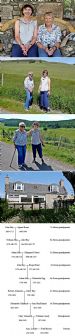
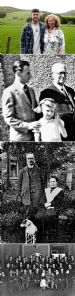
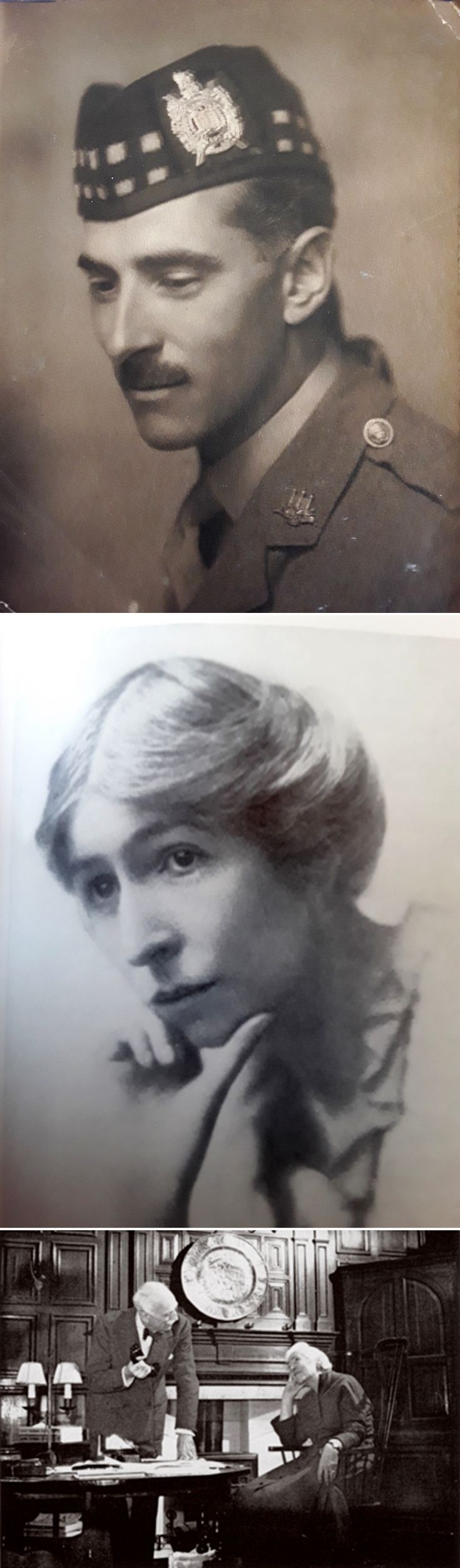
16 Alban Ernan Forbes Dennis and his wife Phyllis


Alban Ernan Forbes Dennis
Pictures above
1. Alban Ernan Forbes Dennis
2. Phyllis Bottome
3 Alban and Phyllis in later life
Alban Ernan Forbes Dennis was the grandson of General Sir John Forbes of Inverernan, Strathdon. His mother Mary Ann Forbes, the General’s daughter, married George Beauchamp Gore Dennis
Click to see the Inverernan Album
Alban was the fourth child and, with his future wife Phyllis Bottome, they made a rather exotic couple with some interesting connections with spying both direct and indirect.
Tom King a member of the Forbes family kindly supplied the above photos and also wrote:
“They (Mary and George Dennis) had in all five sons. The fourth was named Alban Ernan Forbes Dennis after Scotland, the water that enters the River Don at Inverernan House and his mother's family. He went by A.E. Forbes Dennis and our family and his friends called him Ernan.
Ernan, as you see from the photo, cut a rather dashing figure, transferred from rather less dangerous duty as a calvary officer in Egypt in WWI to serve under his older brother Col Frederic Dennis DSO in KOSB 7/8 in the trenches of France. His uncle Major Gordon S.D. Forbes DSO had already been killed in action in the 7/8 and his brother had been wounded seven times before Ernan joined the regiment. Ernan was severely wounded in 1918 and while he was recovering in England his brother Fred was killed just before the end of the war.
When he returned to duty he was attached to the General staff and then assigned to Marseilles as undercover intelligence officer and then as a civilian he ostensibly worked in Vienna in the Foreign Office as a passport control officer but was actually conducting counter intelligence throughout central Europe in the early 1920s. I don't think MI6 was the name of the section he reported to at that time. After a couple of years, he had a falling out with someone in London and he resigned.
His wife Phyllis Bottome, a very successful author of over 34 novels and a number of volumes of short stories, was born in Kent to an English mother and American father, was generally referred to as a British author as she spent almost all, but a few years as pre-teen , of her life in England or in Europe. She may have provided some cover to Ernan but was not an employee of the government,
Also, in the 1920s Ernan, who had received a Diploma in teaching from London University, and his wife started an unusual school for boys to teach languages and life skills. The school was called “Tennerhof school” and founded in Kitzbühel in 1924. They all lived together in Kitzbuhel, Austria, they were quite attached to the boys and remained in contact with some over the years. Some became quite famous such Ian Fleming who in a letter thanked them for the time he spent with them and the influence Ernan had on him.
Fleming's character is very similar to one of Bottome's in a mystery written a number of years earlier and based loosely on Ernan. A number of her novels were dramatized and some were made into successful films such as Mortal Storm and Private Lives. They both lived long and interesting lives.”
One of their addresses in London was
Lonach Cottage
46 Lexham Gardens
London W8
Thus preserving their Strathdon links.
The above story was also noted in “The Silent Game: The Real World of Imaginary Spies by David Stafford.
Writing about Ian Fleming, the author of the Bond books he said:
“A dead hero as a father, his mother a very wealthy widow, and his brother an outstanding scholar and athlete, Fleming, for all his material security, developed into a rebellious adolescent. a potential black sheep of the Fleming clan. Leaving Eton early under a cloud, he went to the Royal Military College at Sandhurst, hated it, and dropped out. At this point his concerned and exasperated mother sent him abroad to be straightened out by an eccentric couple, Captain Forbes Dennis and his wife, Phyllis, who ran a language-cum-finishing school at Kitzbtlhel, in Austria.
Intriguingly, Forbes Dennis was also a member of the British secret service. During the war he had been an intelligence officer in Marseilles, and after the Armistice had been transferred to Vienna as SIS Head of Station under the traditional cover of Passport Control Officer. Even more intriguing, his wife was also involved in the game, publishing a spy novel entitled The Lifeline in I946 under her own name of Phyllis Bottome. Under the guidance of those two players in the silent game at Kitzbtlhel, Fleming acquired some stability and maturity. Phyllis encouraged him to write. Under her direction he produced an unpublished short story with the title “Death, on Two Occasions”, and to the end of his life Fleming remained deeply grateful to her for having set him on the path as a writer.
Whether or not they also set him on the path towards intelligence work is difficult to say, but at the very least it must have helped Fleming's later entrée into the small club of those who played the silent game to have spent four formative years in the hands of two of its practitioners.”
And more about Phyllis Bottome herself.
From “A Woman Out of Time”
By Andrea Crawford
Born in England in 1882, her mother English, her father an American Anglican minister, she published her first novel at the age of 17—the same year she contracted tuberculosis while nursing her eldest sister, Wilmett, who was dying of the disease. For much of the next decade, Bottome stayed in sanatoriums in Switzerland and Italy, where she made lifelong friends and gathered rich material for her fiction. On such a retreat she met A. Ernan Forbes Dennis, a young Scotsman to whom she became engaged until the strain of his recovery and her recurring illness caused them to break it off. Some years later, however, they reunited and, in 1917, with Forbes Dennis on leave from the war front, the then-35-year-old writer made the trip from London—where she had shopped for her wedding gown during one of the first air raids—to marry him in Paris.
After the war, Forbes Dennis took a job with Britain’s diplomatic service and the couple moved to Vienna, where they saw first-hand the post-war breakdown. As an official at the British consulate, her husband was “flooded under an ocean of Palestine immigrants, each one a separate tragedy and a crying need,” Bottome wrote. “There were only certain categories of Jews for whom he was allowed to issue visa passports; and what was to become of those to whom he could not give passports, in starving Austria?” The situation affected them both deeply.
In Vienna, Bottome also met the renowned psychoanalyst Alfred Adler, who would have an enormous effect on her and serve as a model for the professor in The Mortal Storm. (His influence, The New York Times wrote in her obituary, “was responsible for much of the merit and some of the defects of her writing.”) Interested in Adler’s theory of individual psychology, Bottome and her husband became Adler’s students and friends. After his death in England in 1938, she returned to Vienna to secure his personal papers, managing to leave just three days before the Nazis entered the city.
In 1930 Bottome moved to Munich to study under one of Adler’s practitioners. She found the city not unlike the Vienna of ten years before. Three out of four houses were unoccupied, the shops empty. “I hope I shall never live to see such misery again as I saw that winter, when every half-hour some wraithlike shadow came to our door for the soup,” she wrote. Amid the poverty lay growing danger. “No one could live in Munich between 1930 and 1933 and be unaware of Hitler.”
That awareness would provide the real strength of The Mortal Storm. She was present as Hitler came to power and, she notes in her autobiography, “could write of the Nazis as [she] saw them, at first hand; and from an English point of view.” In 1932, she often sat just a few yards away from Hitler at Café Heck, where she and her group of psychology students regularly met for coffee and cake. “A small and insignificant figure in his brown uniform,” she recalled, “Hitler sat alone in the corner opposite to us, with his back to the wall. I never saw him at a table in the middle of the room…. We noticed that he never had a friend to share a meal or asked a comrade to sit down at his table with him.”
The story is taken up in Wikipedia:
“In 1924 she and her husband started a school in Kitzbühel in Austria. Based on the teaching of languages, the school was intended to be a community, and an educational laboratory to determine how psychology and educational theory could cure the ills of nations. One of their more famous pupils was Ian Fleming, author of the James Bond novels. In 1960, Fleming wrote to Bottome, "My life with you both is one of my most cherished memories, and heaven knows where I should be today without Ernan. “It has been argued that Fleming took the idea of James Bond from the character Mark Chalmers in Bottome's spy novel The Lifeline.
In 1935, her novel Private Worlds was made into a film. Set in a psychiatric clinic, Bottome's knowledge of individual psychology proved useful in creating a realistic scene. Bottome saw her share of trouble with Danger Signal which the Hays Office forbade from becoming a Hollywood film. Germany became Bottome's home in the late 1930s, and it inspired her novel The Mortal Storm, the film of which was the first to mention Hitler's name and be set in Nazi Germany. Bottome was an active anti-fascist.
In total, four of her works – Private Worlds, The Mortal Storm, Danger Signal, The Heart of a Child – were adapted to film. In addition to fiction she is also known as an Adlerian who wrote a biography of Alfred Adler.
Bottome died in London.
A letter from TS Elliot to Phyllis in 1936:
“11 May 1936
[The Criterion]
Dear Miss Bottome,
I find that I have had for an unpardonably long time a manuscript of yours about Ezra Pound. l am very dilatory at looking at unsolicited contributions for the reason that they are almost uniformly useless, and induce in the bulk depression and misanthropy. Hence your manuscript was here for some time before I was aware of its existence, and even after I had read it I did not keep my good intentions of writing to you.
I think it is a lively and interesting and just appreciation, and I should like to see it published. My first feeling — which makes the delay still more unjustifiable — is that it would do very much better if it could possibly be rammed down the throat of some other editor. I mean that my association with Pound is very well known, and that the Criterion is one of the few places in which his own work can get published, so that an article like this would make much more impression if it appeared in a less expected vehicle. I don’t know what influence or connections you have with periodicals, but l think the matter is worth considering. Meanwhile l will keep the article here?
Yours sincerely,
T S. Eliot
Family History
Mary Ann Forbes
Birth 11 January 1851 Tarland And Migvie, Aberdeenshire,
Death 27 October 1907 Schwesternhaus, Vomrothen Kreuz, Zurich, Switzerland
Parents
General Sir John Forbes1817–1906
Emily Sandelia Gidley Drummond1834–1910
Spouse
George Beauchamp Gore Dennis1846–1899
Children
John Ralph St.Leger Dennis 1877–1898
George Stanley Dennis 1878–1907
Michael Frederick Beauchamp Dennis Major 1880–1918
Alban Ernan Forbes Dennis 1884–1972
Alban Ernan Forbes Dennis 1884–1972
Birth 17 May 1884 Holsworthy, Devon, England
Death Sep 1972 Wandsworth, Greater London, England
Parents
George Beauchamp Gore Dennis 1846–1899
Mary Ann Forbes 1851–1907
Spouse
Phyllis Bottome 1884–1963
Phyllis Bottome 1884–1963
Birth 31 May 1884 Rochester, Medway Unitary Authority, England
Death 22 August 1963 London, City of London, England
The following information was kindly provided by Frederica Forbes Freer whose father was the nephew of Alban Ernan Forbes Dennis. Mrs Freer initially wrote a contribution on a previous page. Ernan is named after Glen Ernan which is the Glen just next to Inverernan House Strathdon the home of the Forbes family
“I am Frederica Forbes Freer (nee Dennis), daughter of Nigel (Forbes) Dennis, author, and nephew of Ernan. I knew Ernan very well indeed -- and loved him dearly. He helped so many, including Jewish families as British Vice-Consul in Vienna between the war. I am not sure what exactly Ernan did to rescue so many Jews. At his funeral, someone who knew him in Vienna came up to me telling me the figure of how many Ernan had rescued but, sadly, I didn't hear the figure at all well. He and Phyllis then opened a crammer/finishing school in Kitzbubuel where Ian Fleming and his brothers were pupils. Ian never failed to mention how Ernan and Phyllis rescued him.
In Nicholas Shakespeare's splendid biography on Ian Fleming (see below) there is a whole chapter on Phyllis & Ernan and the crammer/finishing school at Kitzbuhel (now a 5* hotel with a special James Bond suite!).
https://www.google.com/search?q=ian+fleming+by+nicholas+shakespeare&rlz=1C1CAFA_enGB689GB803&oq=Ian+Fleming+by+Nicholas+Shakespeare&gs_lcrp=EgZjaHJvbWUqCggAEAAY4wIYgAQyCggAEAAY4wIYgAQyBwgBEC4YgAQyCAgCEAAYFhgeMg0IAxAAGIYDGIAEGIoFMg0IBBAAGIYDGIAEGIoFMg0IBRAAGIYDGIAEGIoFMgoIBhAAGIAEGKIEMgoIBxAAGKIEGIkFMgoICBAAGIAEGKIEMgoICRAAGIAEGKIE0gEKMTE1MzZqMGoxNagCCLACAQ&sourceid=chrome&ie=UTF-8
Another book I should have mentioned is one written in 2010 by Pam Hirsch, a Cambridge don. THE CONSTANT LIBERAL: The Life and Work of Phyllis Bottome. It is quiet, quite splendid. She went to so much trouble; the detail is extraordinary. She came to see me and, also, to see my stepmother, Beatrice Dennis, who wasn't a great fan of Ernan having only known him at the very end of his life when he was finding things so difficult without Phyllis.
http://www.pamhirsch.co.uk/2010/06/constant-liberal.html
I am presently finishing two memoirs -- one about my late husband, Stephen Freer, a classical scholar, and one about my childhood. Phyllis & Ernan come into both. They made all the difference to my life, as they did to the life of my father, the author, Nigel Dennis, and to that of Ian Fleming -- and many others. (Ernan became a psychotherapist, having met and been greatly impressed by Alfred Adler in Vienna. It was through this work that he was able to help so many,). He and Phyllis lived in St Ives for many years, enjoying the artists there, and then in Hampstead in London. Ernan died in Brighton where he spent his last years -- and where I used to go and see him most weekends. He had a splendid Italian housekeeper but missed Phyllis deeply.”
Ernan and Phyllis were friends with Alfred Adler one of the founding fathers of psychoanalysis, and it is thought that Ernan helped to arrange a lecture tour in Scotland. Unfortunately, Adler collapsed and died in Union Street in Aberdeen while visiting the city in 1937.Adler collapsed and died in Union Street in Aberdeen when he was giving his lecture tour there. He was cremated in Edinburgh and his ashes were lost and rediscovered in 2011, when they were repatriated to Vienna. Ernan and his wife were at the Memorial Service in Aberdeen and at the cremation service in Edinburgh. Unfortunately Adler’s ashes were misplaced in Edinburgh and were only found in 2011 when they were eventually repatriated to Vienna.
Picture added on 19 June 2020 at 20:36
This picture is in the following groups
people
people
people